
Ukraine | Russia | Peace
How Vladimir Putin Changed the European Dream
What now?
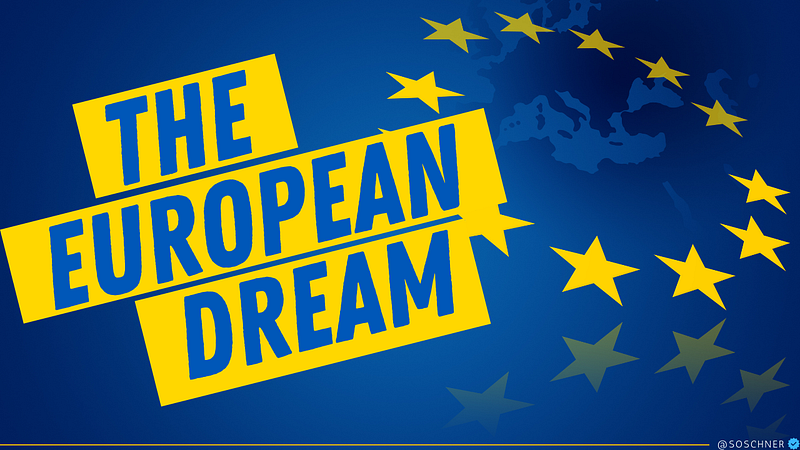
I literally cried last week when I read about Russia invading Ukraine.
The beginning of the war between Russia and Ukraine brought change to Europe. The period of peace and prosperity in Europe that preceded world war 2 ended.
Let me rephrase it.
It wasn't only ended — when the first bullet left the riffle of a Russian soldier — the idea of the post-world-war-two-area-politicians on which Europe thrived for almost eight decades was shattered into pieces:
That economic cooperation is the basis for lasting peace
I was born in 1974 and grew up with these visions.
When the people of different nations work together in businesses, it creates common values and a common culture that reduces the chances of war to zero.
This was my interpretation of the European Dream:
Motivate people to collaborate cross-border and what follows is peace, freedom and prosperity for all European people
It worked well, especially after 1989 when the former Warsaw Pact broke apart and many eastern European nations joined the European Union.
I saw it as a move towards peace, and never in my life would I have imagined that other people see danger for their lives from this development.
My perception was that everybody I met in Europe agreed to the European Dream:
Collaborate across Europe — lasting peace will be the reward
Democracy and Prosperity
The big dream is a united and peaceful Europe that collaborates with all people on this planet.
Peaceful, respectful, and open are the adjectives I want to use to describe this dream.
It worked since 1945 and ended last week Thursday when Putin opened war upon Ukraine:
Why did this go wrong?
Vladimir Putin feels threatened as the Nato, and the European Union occupied the former Warsaw Pact countries.
From what I get from mass media, the above sentence is his justification for the warfare in Ukraine.
Let's unite Russia, Belarus, and Ukraine and re-create a strong Pan-Russian-Empire, which seems to be to moniker in Russia these days.
He started a war, and it looks like he believed it would be over in two or three days; everybody would be happy and move on.
In this judgment, I believe a few miscalculations became obvious:
- The thing was, the Ukraine President representing the Ukraine people wants a democratic order and is willing to fight to the death to defend the democratic rights of his people.
- The second problem was that many people still underestimate the power of words, videos, and pictures on social media.
- The third misjudgment was about the European Union's strength and the people's will to stand up for freedom, democracy, and Peace.
The European Dream is still alive and needs some amendments to prevent such situations in the future:
Economic Collaboration helps create Peace
The basic principle of the European Union is economic Collaboration. The peaceful history of the European Union since 1945 is proof that it works.
Before 1945 Europe was a place for constant warfare, poverty, and more drama.
From the Roman Empire over Vikings to Crusades, the Napoleonic Warfare to Colonialisation and two World Wars — Europe's history is written with blood and death.
After 1945, the entire population was so fed up with centuries of killing that everybody agreed to find a way to live peacefully together.
The European Union was born and created the peace people were longing for.
This era of peace lasted from 1945 to 2022.
Communication Maintains Peace
Never Again Stop Social Life.
I don't want to debate the scientific rationale of the lockdown measures in the last two years, but I want to tap into the social consequences.
The Austrian Psychologist Paul Watzlawich wrote a short story about how people can create their reality in their minds. It is called The Man with the Hammer:
A man wants to hang a painting. He has the nail, but not the hammer. Therefore it occurs to him to go over to the neighbor and ask him to lend him his hammer. But at this point, doubt sets in.
What if he doesn’t want to lend me the hammer? Yesterday he barely spoke to me. Maybe he was in a hurry. or, perhaps, he holds something against me. But why? I didn’t do anything to him. If he would ask me to lend him something, I would, at once. How can he refuse to lend me his hammer? People like him make other people’s life miserable. Worst, he thinks that I need him because he has a hammer. This has got to stop! And suddenly the guy runs to the neighbor’s door, rings, and before letting him say anything, he screams: “You can keep your hammer, you bastard!”
The thing with locking people up is preventing them from meeting in person and talking. When people cannot meet and talk, the situation creates the problem of manufacturing their own unique reality in their minds.
And sometimes, the story in their mind is entirely different from the reality in the world.
The man with the hammer is so convinced that his neighbor is a miserable person that he isn't emotional anymore to communicate appropriately with him.
Maybe the neighbor was a nice, kind, helpful person, and maybe it was a neutral personality or the bastard the man with the hammer thought he would be.
Only real-life communication helps people judge other people, circumstances, and situations properly.
The last two years made real-life communication impossible.
This explains why some politicians stated that Putin has changed in the last two years.
Military Power Secures Peace.
Negotiation demands a position of strength, not weakness
Have you ever tried to negotiate a salary increase when you were desperate because you were close to bankruptcy?
And have you compared the signals such a person sends out to the financially independent one?
Negotiations work best when people and organizations come from a position of strength.
European countries reduced their military budgets over the last thirty years as they believed that economic ties are sufficient to secure lasting peace in Europe.
This was a total misjudgment. Nobody expected any response from European governments as the military can mainly not start a major war or respond appropriately to military threats.
It isn't a bad thing as nobody wants to start a war in the European Union. But the thing is that some tyrannic governments believe cutting back on military expenses is a sign of weakness.
My interpretation of why Russia started a war against Ukraine was the expectation that Europe won't respond.
Well, things changed quickly, and Germany already dedicated 100 billion euros to improve the German Army and will pay 2% of their GDP annually to keep the Army in good shape.
The European dream that economic Collaboration and dependency creates lasting Peace is not dead and buried.
It needs three amendments:
- Start international collaborations and dependencies to create Peace.
- People from all social backgrounds must be able to meet in person at any point in time.
- Have a solid and ready army at any point in time.
I hope that the situation in Ukraine will end and Europeans can live peacefully together in the next 75 years.
Did you enjoy the content? Then you can do the following:
- Clap a couple of times and leave a comment.
- Check out my other profiles,
- Sign up for my deep tech newsletter,
- Subscribe to my medium profile for frequent updates,
- Sign up to Medium to support the writer's community.
This article is for informational purposes only. It should not be considered Financial, Investment, or Legal Advice. Consult a financial, investment, or legal professional before making significant decisions.


