How will I survive an eleven-hour bus ride in Turkey?
I’ll document everything that happens all day!
Eleven hours on a bus from Antalya to Adana
I was up early to get ready to hit the road for the day. Hoping to get a cup of coffee at the breakfast buffet, I went downstairs at 7:40. To my delight, the entire buffet was already set up, which meant that I would have plenty of time to eat and then meet the taxi that was going to take me to the otogar (bus station, derived from the French auto gare). Ordinarily, I would take a bus or some other form of public transport, but based on what I had seen the other day when I came into town, the buses between the town center and the otogar are not very frequent. Best to be safe and hire a taxi.
The taxi driver confirmed my supposition that many of these otogars are new. The one on the outskirts of Antalya is about five or six years old, he said. It replaced one that had been more centrally located, but was old and falling apart.
We arrived at the station in plenty of time to allow me to check e-mail for fifteen minutes and also to make a withdrawal from an ATM. [Fascinating side note: many ATMs in Turkey offer options of withdrawing Turkish lira, euros, or US dollars.]
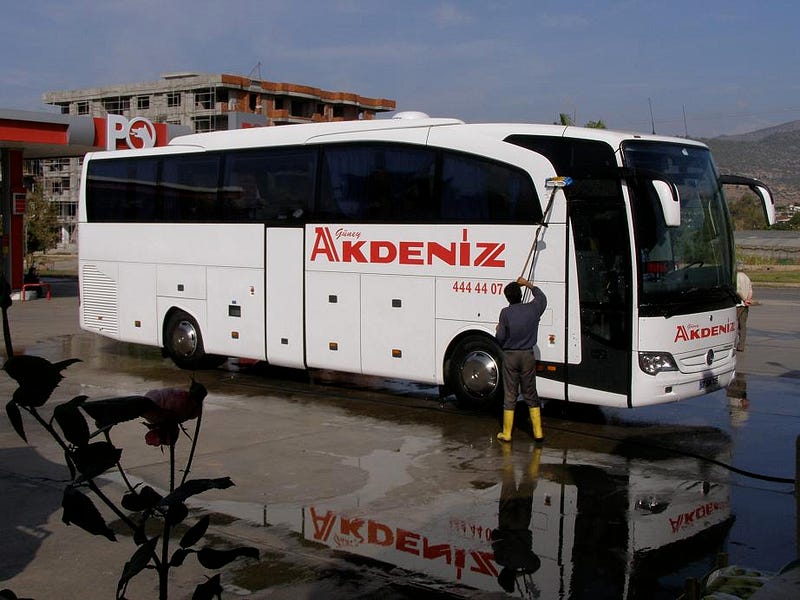
When I arrived at the right spot to get onto my bus, I was stunned at its size. I never saw such a mammoth bus! It must have been twelve feet high. Built by Mercedes Benz, it was brilliant white outside and all plush and comfy inside. The bus company name is Akdeniz, the Turkish word for Mediterranean.
Not knowing how soon our first stop would be, I thought I’d better head to the tuvalet, the local word for toilet. I try to restrict my fluid intake on days when I travel long distances by bus. One never knows when the next stop will be. Just for the fun of it, I thought I would also keep track, just for today, of how much I am spending just to go to the bathroom. The fee at the Antalya otogar is .60 YTL.
The bus companies assign seats here, so I am always sure to ask for an aisle, which affords me a place where I can stretch my legs. At just a few minutes before 9:00, our departure time, there were only a few of us in the forty-four seats. The tenth person arrived and indicated to me that he was sitting in the window seat next to me. That leaves thirty-four empty seats on board.
Seeing that there was nobody across the aisle from me, I simply moved over there. When a bus company employee came aboard to take attendance, he found that two of the women were sitting on the wrong side of the aisle and made them move. I waited for him to do that to me, but he just let me sit there.
In addition to the driver, there were two other people working on the bus: the baggage handler (who also checks tickets and collects fares of those people picked up en route), and the attendant, whose nametag identified him as “host,” and his name is Yucel. The driver and baggage handler are men in their forties or so. Yucel seems to be about eighteen or nineteen years old.
Faced with the prospect of a tedious journey, I decided that my best means of keeping myself amused and entertained was to take notes so that I could write about the day. I also recognized the challenge that I had: writing about a long bus ride and making it sound interesting to my readers. I resolved to do the best I could and see how it all worked out.
9:01 We pull away from the station. There is a handy digital display, alternating between time and temperature, located just above the driver’s head.
9:05 At a roundabout located just outside the otogar, we pick up a new passenger.
9:11 We stop at an Akdeniz office on the road heading out of town in order to pick up four more passengers, two of whom are a young mother and her toddler son, who sit right in front of me.
9:14 A new passenger flagged us down from the side of the road. We are definitely the crosstown local.
9:16 There is no destination sign on the bus to indicate where we are going, yet another person has flagged us down and boarded. Somehow, the locals know where we are headed. Evidently, there is no need for official bus stops: just stand on the side of the road and signal to the driver that you want to get picked up.
The roadway is lined with car dealerships, gas stations, and retail stores. The median is about four lanes wide all by itself, nicely planted, separating three lanes of traffic in each direction. If it weren’t for the signs in Turkish and the palm trees, we could be on Route 73 S in Evesham Township, New Jersey.
9:27 We pass the Antalya Expo Center. Signs in front indicate that the upcoming shows are Hotel Equipment, Boat Show, Food Show, and something enigmatically and enticingly titled “Fresh Antalya.”
9:32 It doesn’t look like we have left Antalya because the businesses and housing along the road have been continuous. But a sign indicates that we were leaving Calkaya. Traffic slows a bit because a truck has hit a car and they are both on the shoulder, along with several police cars. Across the road, I notice that we were passing Perge Jewels, “The Greatest Jewelry Center of the World.”
The ticket and baggage man now comes through to collect money for people whom we have picked up since leaving the station. We pass two large adjacent dessert restaurants on the opposite side of the road. The first is named Sorbet and the second is Sugarworld.
The gas stations are numerous. In addition to the familiar Shell, BP, and Total, I see some new ones: PO (Petrol Ofisi), Opet, Termo, M Oil, Erk, and Alpet.
9:52 Stopping at the otogar in Belek, we now have eighteen passengers and pick up one more. Would we have stopped at this station if the driver knew there wasn’t somebody who wanted to board?
9:57 Down the road from the otogar we pick up a young couple and two elderly women wearing headscarves. There are many fields that line the roads, and lots of greenhouses.
10:08 The ticket and baggage man prepares hot beverages for himself and the driver, but the host does nothing to make them available to the passengers. I am in the fifth row. My assigned seat is just in front of the back door of the bus. For the time being, though, as long as there are still lots of empty seats, I am still across the aisle from where I am supposed to be. Yucel heads to the front of the bus to sit with his colleagues.
10:26 We pull into the Manavgat otogar and gain seven new passengers, one of whom sits next to me in the window seat. As long as the bus is filling up, and there are now only three empty seats, I may as well move back to my assigned seat. But first, I take advantage of the fact that we are stopped for a few minutes and I head to the restroom, paying 50 YTL for the privilege. Just before we leave the station, yet another passenger comes to us, driven by a friend on the back of a motorcycle. He enters through the back door.
10:35 We leave the Manavgat otogar. Upon entering these stations, the bus drivers collect a ticket, a system similar to our getting a time-stamped ticket upon entering a parking lot. On the way out, these guys surrender the ticket and pay a fee, based on how long they were in the station. I am only guessing that it is the collection of these fees that has helped to fund the costs involved in constructing and maintaining these stations.
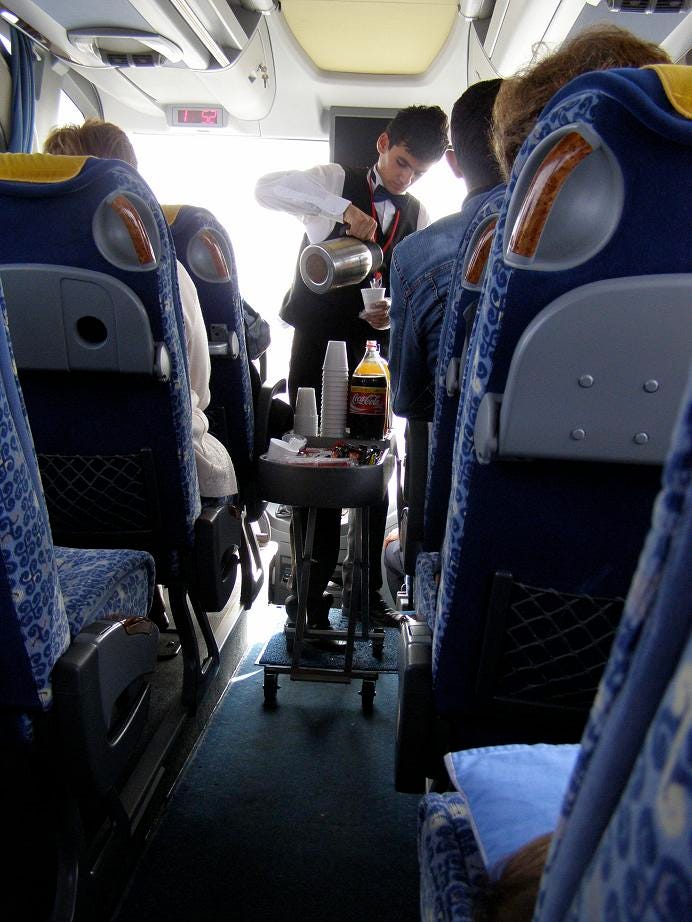
10:49 There is noise behind me. Yucel is now getting ready for the beverage service.
10:51 Yucel is using a cart, which he rolls down the aisle toward the front of the bus. This is the first time I see anyone using a cart, as usually they serve just a few people at a time from trays. My choice is Nescafé 3 in 1, a sheath of plastic containing instant coffee, sugar, and creamer already mixed in. It’s a poor excuse for coffee, but desperate times call for desperate measures.
We are now on the coast, with the Mediterranean just a matter of meters from us on the right.
I note that there is a building boom in the area, with many large resorts already completed and several new buildings going up.
10:56 We pick up three French people at one of the resorts. They sit in the seats just behind the back door, which is not far from me. It is their loud speaking that makes me realize how quiet the Turkish travelers have been. Most of them are sleeping, talking sotto voce, or just sitting there.
Smoking is not allowed on the bus. The only exception to this rule is the driver, who takes full advantage.
11:25 We are at the Alanya otogar, where the design departs from the standard that I have seen so far. This one is more like a strip mall, with fifteen ticket offices for as many bus companies. I add another 50 YTL to my restroom entrance fees, making the new total 160 YTL. If you want to make an investment in Turkey, you could do worse than going into the toilet business.
Three adults with a chubby toddler boy get on. The heavyset father sits directly across the aisle from me. In the seats in front of him are two women who look like sisters, one of whom is the baby’s mother. The boy, a spitting image of his dad, remains with his mom and aunt.
11:15 Our last remaining seats are filled by people we pick up on the side of the road. There is more building here, including a sign offering “very luxury apartments” for sale. We pass a small amusement park calling itself Disneyland Lunapark Alanya.
12:21 We stop to let some people off the bus in a town called Gazipara.
12:25 Just a way down the road, the driver makes an announcement and pulls into a restaurant parking lot. The man in the window seat next to me, understanding that I will need to know how long we will be stopped here, and also realizing I don’t speak Turkish, splays his ten fingers and makes a pushing motion in front of himself. Ten. Then he does it again. Twenty. Then he does it with his right hand only. Twenty-five. Just to be sure, I write “25” on the paper on my little pad, show it to him, and he nods. I’m elated to have had this communication success!
Inside the cafeteria, I point to a number of items that look like they may be meatless. I ask, Etli mi? (Does it have meat?) When I hear “hayir,” (no) I know I can make my choices from these.
I take my tray of food to an outdoor veranda where I eat it, in view of somebody who is hosing down our bus with water, and hand drying it. It seems superfluous to me since the bus started the trip looking like it had just been driven off the showroom floor.
I notice something funny under my table’s glass top: a banknote for 1,000,000 lira. It was last year that the Turkish lira was revalued, which meant removing all those zeroes. What had been 1,000,000 is now 1. Even today, when some people quote prices, they say “5,000,000” when the price is 5.
Though these banknotes are now worthless, I wanted one as a souvenir. I tracked down a restaurant employee and asked him to come to the table. I pantomimed that I wanted that note and asked if it was all right. He lifted the glass top and let me take it.
One more .50-YTL pee brings my running total to 2.10.
12:56 Only eight more hours to go! We are now on a two-lane road and ascending. At first, we are not directly on the coast anymore, and I see that there are fields planted on both sides, as well as greenhouses. The terrain is hilly, road serpentine. After a while, I can see that we are high above the sea and making our way closer to it. I think of the Pacific Coast Highway, US 1, as it hugs Big Sur along the Pacific.
The two toddler boys have noticed each other from across the aisle. The moms facilitate the passing of toy cars, cookies, and a blanket to each other. At one point, the chubby boy gets restless, starts to make a fuss, and one of the passengers sends him a hard candy.
13:30 The road is squiggly again. With no warning, the little boy in front of me throws up. All Yucel can offer for helping the mom to clean him up are small cocktail napkins. But the moms across the aisle are better prepared than that, as they dig into a backpack and come up with paper towels and wet handiwipes.
13:41 I close my eyes for a few minutes. I am doing all right, even with the rocking motion of the curvy road. Suddenly, I am startled by the blaring of loud music. The driver has turned on the television set, and has chosen an inconvenient time to do so, as we are in a hilly region, and the programming is sprinkled with a black screen that displays the words “Sinyal yok.” (No signal)
It’s a good thing that chubby boy’s mom and aunt are so well prepared: he is the next to vomit.
When the signal comes back to the television, it is some sort of talk show. A hostess is mediating what seems to be a family dispute. People are taking turns to speak, a few of them dabbing tears with handkerchieves. They do it in a calm manner, without any kind of jeering or being egged on by members of the audience, all of whom sit placidly and watch the story unfold before them. It’s Turkey’s kinder, gentler Jerry Springer.
14:33 I must have fallen asleep. I wake up to see that we are in a flat area and entering the Anamur otogar. It’s not a big town. The station is centrally located, as the town has hills behind it. This is one of the older stations, as it is in dismal condition. I buy and eat two bananas, then head to take a pee break (.50 YTL, bringing the total to 2.60).
14:44 We are on the road again. We have a different driver. I had wondered if the same one would work the entire day. Good thing he didn’t, as that could be both tedious and dangerous.
We are no sooner on the road than we pick up a mom and granny with a pre-toddler baby girl who sit two rows behind the driver, which puts them two rows in front of the mom, aunt, and the toddler boy.
There are two twenty-something men between them. Their appearance is on the tough side, but their behavior is gentle. One of them sees the little girl in front of him, who is standing on her granny’s lap and looking towards the back of the bus. He coaxes her from her granny’s hands and bounces her on his lap. She is now right in front of the chubby boy, and they stretch their hands forward to touch each other.
Meanwhile, Yucel does his best to clean up the spot where the first little boy had puked, and just in time, because we stop to pick up more passengers, one of whom takes the seat where the little one had been. This guy does not look Turkish to me. If he didn’t open his mouth, I would believe that his name was Kevin McCormack.
We are now in a flat area, and alongside the sea. But this doesn’t last too long before we are on the ascent and into the winding roads again.
15:00 We are in Bozyazi, population 26,600. Gotta love these town names! I am on my tenth page of notes for this description.
15:02 We stop at a small bus company office to admit two people. I turn around to see where they will sit and notice that the French people have departed. Very soon, the road is once again like the Pacific Coast Highway.
15:44 We are in Andincik, population 7,970, at sea level again. We stop to let somebody out. People then get out at fairly regular intervals along the side of the highway.
I notice that there are many buildings of four or five stories in which only one or two of the units are completed. They have windows, curtains, and apparently have people living in them. The rest of the building is barren, showing only the concrete skeletal shell. My conjecture is that people buy their unit, fix it up, and then move in, which happens one unit at a time. It must be hell for the people already living there to have to endure the work that goes on when the other units are sold — like living in a constant construction zone.
We are passing through a hilly area where there has been a forest fire. All trees that remain standing have been charred. Many of them have been cut down. The hillsides are dotted with logs that have been salvaged by work crews, some of which are busy now dealing with more of the lumber.
16:10 The road has been scraped off and is being replaced. We have a rough ride for a few kilometers. Some of the hillside has been scraped off to allow for widening of the two-lane highway.
16:36 With the hills behind us, the last moments of direct sunlight are hidden. It’s early November, so we are approaching the winter solstice.
16:50 The driver turns on the lights that line the central corridor of the bus.
17:34 The hefty dad across the aisle from me has had no contact with his son during their entire time on the bus. He gets up and moves toward the driver to negotiate the stop where he and his party will get off. The mom and aunt make sure that the little one says goodbye to the little girl who has been two seats in front of them.
I am beginning to feel the urge to urinate, as we have not been off the bus for more than three hours. It’s not critical yet — just the inkling of a tinkling.
Cell phones are starting to ring, and I also hear the signals that people are receiving text messages. Yucel is busy heading to each of these offenders to let them know that their phones should be turned off. “Kevin,” sitting in front of me, slides down into his seat and leans his head against the window. At first, I think he is trying to take a nap, but then, when he sits up again, I see that he was sneaking in a phone call.
After a moment, “Kevin” advances to the front of the bus, ostensibly to speak to the driver. He sits on the top of the three steps that lead from the driver’s area. He’s there for several minutes. I think that he is trying to find the place where he is going to get off. But no. We stop and pick up a lithe and lovely young woman who returns with “Kevin” and sits next to him. They can’t suppress the smiles on their faces. Though they are right in front of me, I can’t hear their voices — they are talking that softly to each other, keeping their faces within an inch of each other as they speak.
17:49 Yucel heads down the aisle with his beverage cart. We haven’t had a stop for more than three hours and he is handing out more liquid refreshment? These Turks have strong bladders!
18:00 Granny in the second row is holding the baby girl by her knees, as she stands on granny’s lap. I look in her direction just in time to see the little one spew out a solid jet of vomit into the corridor.
The ticket-and-baggage man is not pleased. He puts some newspapers onto the carpeted floor and then has some harsh words with the little girl’s mother. The mom replies, but the argument doesn’t escalate any further. Mom and granny get sympathy from the man sitting across the aisle from them.
This bus’s interior is going to need a good cleaning at the end of this trip!
18:52 We have been losing passengers now and then. “Kevin” and his girlfriend depart.
18:55 The driver makes an announcement. All passengers going to Mersin will be let out and they will be provided with a bus company servis (minibus) to their destination. We stop at a gas station. There is a mass exodus off the bus, which includes the man who has been sitting next to me since the start of the trip. Everyone not going on the servis to Mersin dashes to the restrooms. This time we get a free pee, as there is no staff to collect our coins.
19:02 The bus has only fourteen passengers now. Everyone is changing seats so that they can have more room. The driver turns on the television. The news includes footage of the visit that Condoleezza Rice is paying to Turkey now.
19:30 Yucel circulates to sprinkle lemon cologne to the passengers. This liquid, limon kolonyasi, is usually on every bus and also at many public toilets. People shake a few drops on their hands and then wipe their faces with it.
20:08 We arrive at the otogar in Adana, blessedly about an hour earlier than scheduled. I get a little something to eat, call my friend Justin who is going to pick me up, and then go to the otogar entry gate to wait for him to arrive. I am happy to be outside and free to move about.
Note: Though I joke about the toilet and how I have to pay for them, I am grateful that they exist, that they are always in good working order, and that they are kept reasonably clean. Turkey evidently does not have a pee-on-the-side-of-the-road culture. Good to know!