
How White People Promote the Legacy of Minstrel Shows By Using AAVE
“Racism is like a Cadillac; they bring out a new model every year.” — Malcolm X
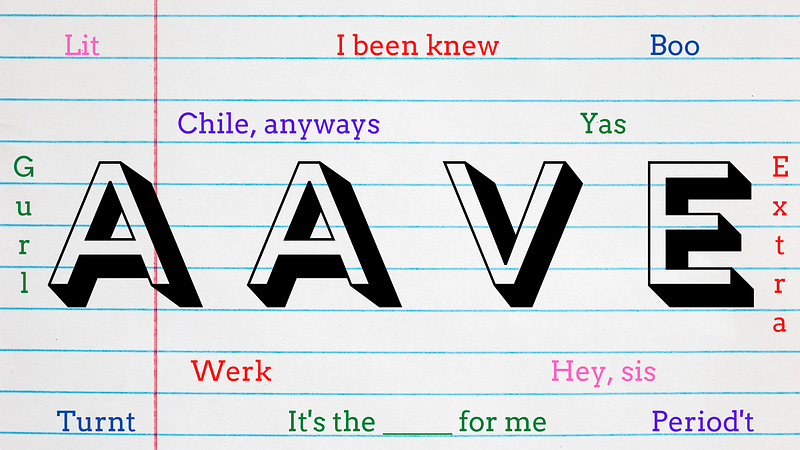
(Disclaimer: This article focuses on the white appropriation of Black culture because of the problematic history that whiteness has imposed on Blackness. But yes, non-Black people also appropriate AAVE. If you’re a non-Black person who can see themselves in what I’ve written, I encourage you not to look away and reflect on this critical issue).
“Hey, sis!”
I know this will be a tough pill to swallow, so resist the urge to “cancel” me, white people. We need to talk about one of the ways anti-Blackness casually manifests itself, and that’s through our use of African American Vernacular English (AAVE). We’ve become too comfortable in our appropriation of AAVE and ignorantly take its rich history for granted.
Everyone in our society is conditioned by a white hegemonic culture that dictates the bits and pieces of Blackness we engage with. Though it’s not our fault, it’s no coincidence that the primary method of engaging with Black culture for white people is to imitate AAVE.
(Please note that I am using the term AAVE, however, not every Black person identifies as American. For instance, there are Black-Latine, Black-Canadians, etc.).
“Gurrrrrrl.”
What is AAVE?
One of my favorite people on Instagram, Ebony Donnley, is a writer, audio engineer, UCLA alum, and a badass DJ who expanded on AAVE on an Instagram live during Black History Month. Although the roots of AAVE are intensely debated, Ebony described AAVE as a language rooted in Black solidarity between Black people of different national origins. He added that the Transatlantic slave trade violently grouped various African ethnic groups with different languages — colonizers didn’t want enslaved Africans communicating with each other. Though white supremacy pathologizes AAVE as “Non-Standard Negro English,” Ebony articulated that AAVE developed as a coded tool for survival from oppressive white supremacist people and systems. White supremacy would have you believe otherwise; however, AAVE is not just some fun way to talk, but a language rooted in Black Liberation.
“Chile.”
I’ll be honest with you, I also appropriate AAVE, and I catch myself imitating what is socially known as the “Black voice” from time to time. It’s difficult to refrain from using words and phrases like, “Yaas, gurl!” “Werrrrk!” “Hey, sis.” It’s particularly challenging to break away from AAVE as a gay man because the gay community fiercely — in the literal sense, not the white watered-down figurative sense — appropriates Black drag culture. We feel more entitled to AAVE now that Black drag culture has become more mainstream thanks to Rupaul’s Drag Race. AAVE is embedded in the media we consume, and we continue taking a piece of Black culture, bastardizing it, white-washing it, and using it for comedic value.
AAVE is ubiquitous and often called “internet culture” today; however, dominant white culture has a history of appropriating Blackness for comedic capitalistic currency. As I continue evolving in my antiracist journey and listening to our most minoritized communities, the following notion is crystalized: white people who appropriate AAVE preserve the anti-Black legacy of minstrel shows.
“It’s the ______ for me.”
What are Minstrel Shows?
Minstrel shows were a popular problematic form of entertainment across the Americas in the 19th century. White actors and actresses, including Shirley Temple, Judy Garland, and Mickey Rooney, painted themselves in black make-up (made with burnt cork, greasepaint, or shoe polish), overdrawn red lips, and portrayed bastardly caricatures of imaginary Black people. These performances ultimately stereotyped Black people as one-dimensional subhuman creatures with overdramatic mannerisms. According to the National Museum of African American History and Culture, “white Americans were able to codify whiteness across class and geopolitical lines as [the] antithesis [to Blackness].”
Although the minstrel shows of the 19th century were more overt in their racism, an evolved version of the legacy continues today. As the late great Malcolm X. said, “Racism is like a Cadillac; they bring out a new model every year.” White people, actors or not, still imitate “Black voices” and claim that it’s ok because it’s part of the larger (white dominant) culture. However, I believe the only difference between white people imitating Black people in the 1850s and now is the lack of Black-face. The similarities are too alike to ignore: emulating Black mannerisms, imitating AAVE, appropriating Black hair texture, and darkening white skin to look Black is still the same. Not much has changed.
“Gag”
It’s historically evident that AAVE (and Blackness in general) is something to be both afraid of and aroused by in the white imagination. It’s frightening because it threatens the “validity” and “purity” of whiteness, and it’s provoking for those very same reasons. AAVE is not devoid of substance, though. It has a rich history that we’re ignorant to because we’re constantly encouraged to engage with a ridiculed version of AAVE by white popular culture. Again, AAVE carries the historical preservation of Black people from oppressive systems. Therefore, white people who appropriate AAVE only preserve the legacy of minstrel shows.
There’s a strong historical parallel between how AAVE was used in the 19th century and how it’s still used today by our white hegemonic culture. It’s imperative for us to actively listen to the people most affected by our oppressive appropriative actions. Therefore, the question should not be, can I use AAVE or not? Instead, the ultimate question — given the contextual history — is how can I ethically engage with Black culture moving forward?
Joey Pierre is a race & class researcher, scholar, writer, and an amateur astronomer. You can also be in community with him on Instagram.