
How we went 0 to 1 on a 4-week build sprint 🚀
How we went from just an idea to a program that brought together the best early founders in our community to take their startups to the next level.
The backstory
I help run a pretty large CMU alumni community called CMU T&E. My team is focused on delivering value for builders, and we ran a couple of separate initiatives like masterminds, idea jams, etc. A couple months ago, we pitched to the team a new direction:
“Let’s come together and deliver a more cohesive experience. An intense program that accelerates early founders and empowers them to leverage our platform. Our magnum opus, if you will.”
It didn’t take long before the team entire was fully bought into this. Fast forward to today, we just wrapped up the inaugural Build Sprint cohort. Demo Day was a massive event within the CMU T&E community, and we plan to ride the amazing momentum we have to run another cohort in July/Aug 2022.
This post is a reflection on how we went from 0 to 1 on Build Sprint. How we pulled together founders, mentors, and investors in the community when we really had no idea who would be interested in something like this. My hope in writing this is that another community builder will see this one day and be able to use this to build an even crazier community 🌎
Let’s dive in.
The program
Our thesis was simple: building a startup is hard, but the period before hitting your first major milestone (ex: seed round) can be extremely lonely. That’s why we designed this program with a heavy emphasis on 2 values:
- Community — surrounding yourself with other strong builders
- Accountability — setting ambitious goals with the community and holding each other accountable to them
More concretely, that translated to 4 key components of the program:
🎯 Build Sprint goal — Cohort members had an idea of what they wanted to do before the program, but we helped them finalize this during the kickoff. We encouraged the cohort to give regular progress updates on these goals, to share them publicly, and to be as ambitious as possible.
🤝 Accountability groups — Hosted once a week, these were moderated meetups with 5–6 other founders at a similar stage. Each session spotlights individual or common challenges, and the group comes together to brainstorm and solve these problems collectively.
👥 Mentor check-in’s — Also once a week, we paired each cohort member with a pre-matched mentor in the beginning of the program. We sourced each mentor based on what cohort members needed. More on that later.
🎉 Demo day — A massive virtual event bringing together the entire community — investors, founders, startup operators, etc.–to showcase and celebrate CMU founders.
And the success criteria?
Maximizing the number of founders who could achieve their Build Sprint goal in 4 weeks. It sounds simple, but in reality committing to this was what led to the most complex and interesting challenges of running this program. Everyone came in with a very different idea of what they wanted to do in a different industry. But nonetheless we believed this to be a North Star, and putting your foot in the ground and taking the correct first step is what puts you on the right path.
Our success = max(founders achieving Build Sprint goal)
The preparations
Founders
From the beginning I knew that an excellent group of founders would be the key foundation on top of which we could build the program. But the biggest question in joining any community is “who is already there?” and we didn’t have anyone yet.
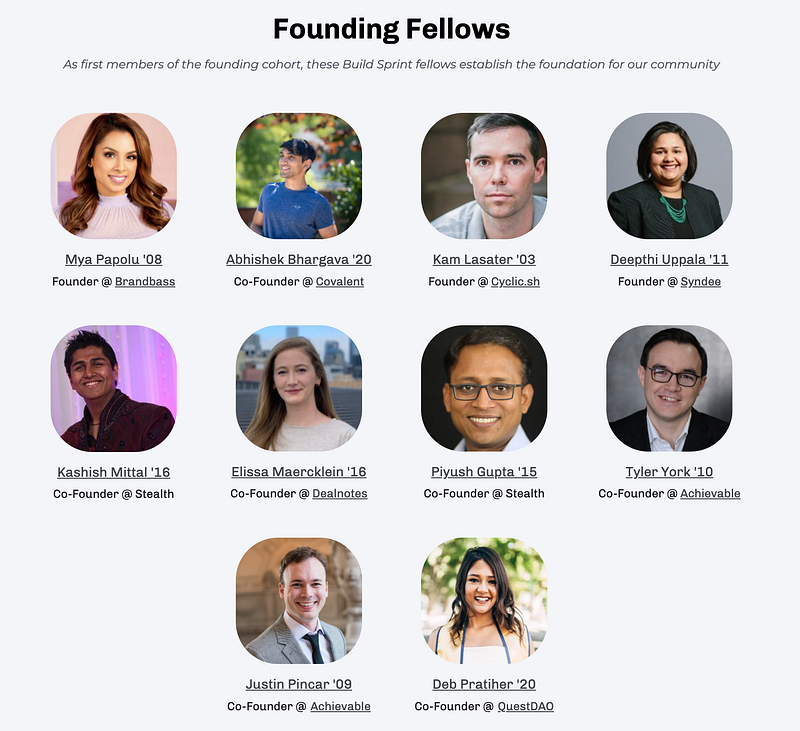
Our approach to this was to seed the cohort with a group of 6–8 founding fellows. To find these founders, we relied heavily on our immediate network. Thankfully, we had hosted many events in the past before where we’ve crossed paths with some of these amazing early founders. These founding fellows helped us tremendously to bootstrap the program’s credibility and generate some buzz within the broader community, and we launched our new landing page with their faces front-and-center.
Mentors
Sourcing good mentors for every founder proved more challenging than we thought. We started by reaching out to everyone we could think of because applications closed only a week before program kickoff. The idea was to build up a pool of mentors that we can tap into and match founders to once we finalized the cohort.
But once again we had to take a step back. If our mission is to maximize the chances of founders achieving their Build Sprint goals, then shouldn’t we focus on finding mentors who can do exactly that? We knew this would be more logistically challenging because we’d have to take a much more catered approach, but we decided it was the right thing to do. For every founder, we:
- Took time to understand their Build Sprint goal & ideal mentor persona
- Translated this to a queryable LinkedIn title (ex: CTO @ Coursera)
- Cold outreached a ton of people until someone said “yes”
Sometimes what you have to do behind-the-scenes ain’t pretty, and this was definitely one of those things. Huge shoutout to the team for committing to this and going the extra mile. We didn’t tell anyone in the cohort we did this, but I think it clearly showed. One of the cohort members sent us this note:
I think Marilyn will be a great advisor for the stage I’m at and my goal. Thanks for being so thoughtful with the pairing!
Member Portal
On top of the Slack community we set up, one of our team members Barun also built a custom Bubble app! So much work went behind this, and it was a great way for the community to give progress updates on their Build Sprint goal and share wins throughout the week . I wasn’t sure initially how many people were using it, but then we created a Slack channel for feedback and boy was there feedback!
Check out this thread to see everything else that went into planning this👇
Demo Day
When I look back at it, we built this plane while flying it. I don’t think I’m exaggerating when I say that because my Build Sprint goal was to plan demo day. All we knew was that we wanted to cap off the program with a huge event, and that it’d be…
- Virtual
- The largest event for early CMU founders
- An opportunity for the cohort to present their startups to VCs, angels, folks who want to work at startups, etc.
None of us had any experience doing this, but we drew a lot of inspiration from YC & OnDeck. A couple key design decisions worked out better than others, but I’ll just share some of the most interesting ones here:
Splitting into 2 sessions
We asked founders 2 key questions when we were planning Demo Day:
- What do you want to get out of Demo Day (raise seed round, hire 1st employee, etc.)?
- What level of visibility are you comfortable with (publicly promoted vs. invite-only)?
What we realized from this is that our cohort generally fell into 2 groups:
- New founders — just finished MVP, looking for feedback on product & early users, not comfortable demoing in public
- Early founders — solid initial user traction, looking for fundraising to scale, wants as much exposure as possible
It just so happened that we had around 10 in each group so we decided to host demo day in 2 sessions. In terms of timing, we figured giving each founder 10 mins total was reasonable, and we played around with the structure to try and keep the overall event within 3 hrs.
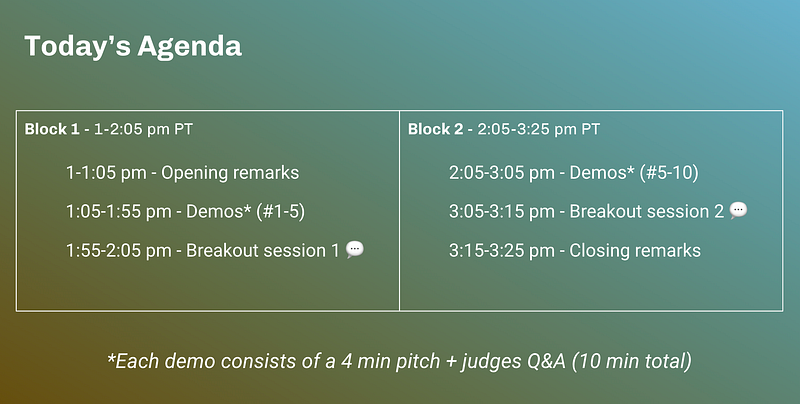
The main rationale behind the breakout sessions was that we wanted to give audience members an opportunity to interact directly with the founders. But a secondary function it served was as a buffer. In case individual founders spilled over their allotted 10 mins, we could always absorb the 2–3 mins we fall off track during these breakout sessions.
Recorded pitches
A somewhat controversial call I made in the beginning was that I wanted everyone to record their pitches. I’ve always hated seeing pitch competitions struggle through their inevitable technical difficulties soI knew that giving someone on our team full control over screen sharing would be the right call.
It was also more obvious that this was the right move once we decided this would be more of a founder showcase than a pitch competition. That meant we shouldn’t index as much on giving founders the opportunity to pitch live as allowing judges & the audience to interact with them.
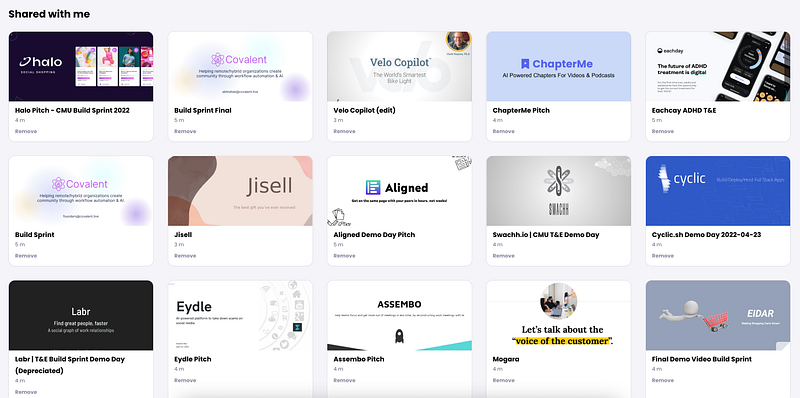
Recording these pitches also served as a natural forcing function for founders to practice their pitches more. We used a platform called Rhetoric to record these pitches, and a core part of their UX is built around sharing timestamp-specific feedback. This was great because it helped us iterate on some of these pitches within the community before we showed them in public.
In our debrief after demo day, a fellow shared how surprised they were that we had no technical difficulties! That’s super rare for an event like this! Biggest learning here: minimize the variables when you’re hosting an event like this (structured, allotted timing, lots of chance for spillover).
Zoom backgrounds
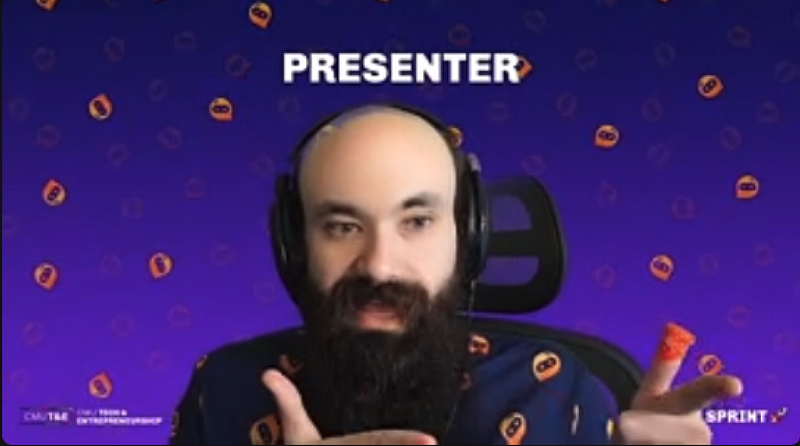
During one of our planning calls, I made a note to myself to make custom Zoom backgrounds for Demo Day. Wouldn’t it be nice if everyone else can see who’s in the Build Sprint community?
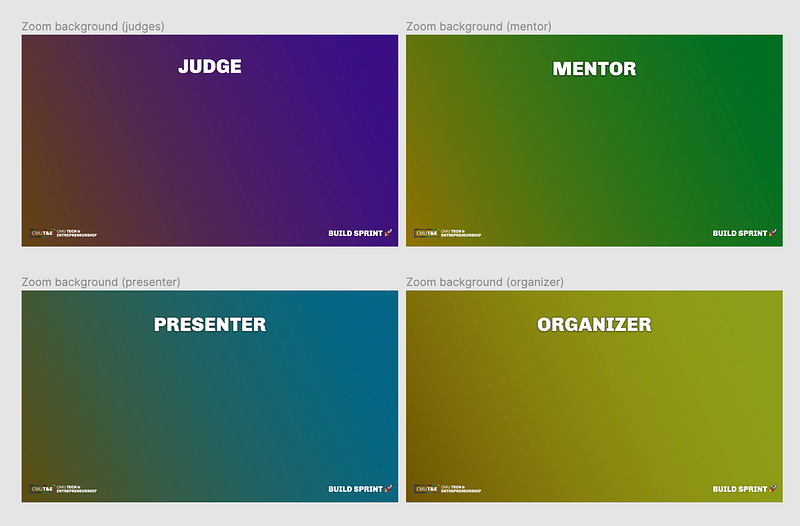
It took me <10 mins to create these Zoom backgrounds on Figma. They all had a simple color gradient with a title like “Fellow” centered on top. Spent the least time on this, but people loved it. 10/10 would recommend for any virtual event where you want attendees to feel your community’s presence.
For more details on Demo Day and which companies presented, this blog dove a little deeper into each startup and the profile of the judges: https://cmubuild.substack.com/p/build-sprint-demo-day-
Acknowledgements
Hosting this program was such an incredible experience, and I still can’t believe how much we were able to accomplish in such a short time.
Would just like to quickly thank all the people involved:
- Organizing team (Rachel, Barun, Qin, Steven, Anant, Greg) — for working so hard to make Build Sprint a reality
- Our cohort fellows — for agreeing to join us in this experiment and taking a chance on us
- Our mentors & demo day judges — for generously giving their time, experience and expertise to this community
- CMU T&E board (Kishan, Emily, Nick, Daniel) — for helping us with other aspects of putting this together (strategy, design, marketing)
- Demo day attendees — thanks for showing support for these early CMU founders!
First cohort was great, but this is just the beginning. Stay tuned for cohort #2 (cmute.io/build-sprint) 👀