
How We Survived Lockdown in a Major Chinese City
Two Years After the Pandemic Started
March 2022
The news broke from multiple sources. All of them from WeChat. None from our school. We lived on-campus and were therefore subject to the stricter rules that came with living in a space routinely occupied by children.
We were not in Shanghai.
The day before, my wife and I, one of whom is Asian, went to celebrate our anniversary. At least we tried. When we arrived at the historical yet trendy pedestrian street of bars, cafes, and restaurants, it was blocked by temporary plastic red walls. We had seen these legendary dividers in online photos and videos.
It was our first time seeing them with our own eyes.
Others more fortunate (less fortunate?) than us had already seen them from their apartment windows and balconies. These colleagues and friends and acquaintances did not live on-campus.
Upon seeing the closed-off street, we immediately called another taxi and went to Coco Park, the most popular shopping mall in Shenzhen, a city in the south of China that might not have the same name recognition as Beijing or Shanghai but is home to China’s Silicon Valley.
It’s also right across the border from Hong Kong. There might be a connection to the surge in covid cases.
The shops at Coco Park were open. All the restaurants were closed. Takeout was available.
As much of a first-world problem as this may sound like, I must say that the disappointment did go the extra mileage by taking place on our anniversary.
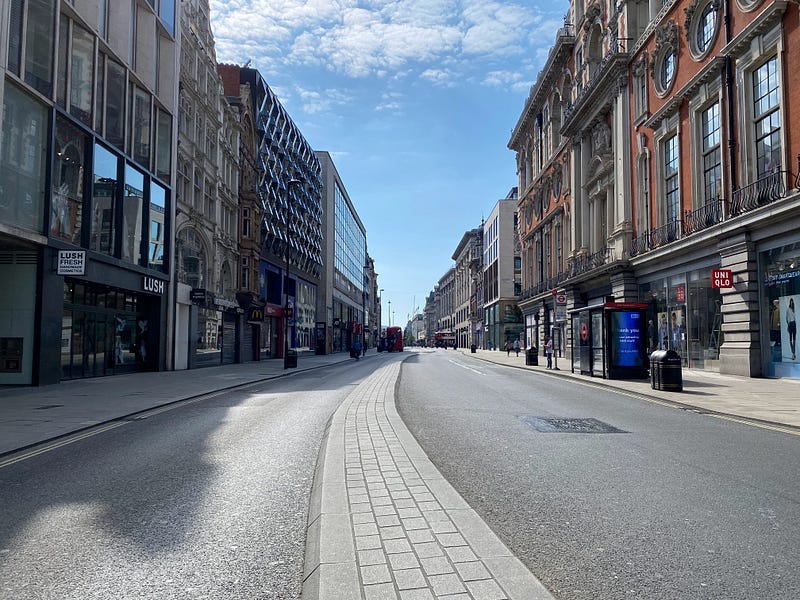
China is the world’s most populous country. It was unsettling to see a usually bustling place of commerce mostly devoid of people.
So we taxied back to our apartment and celebrated with a late takeout lunch of sushi that was surprisingly good. I read up on the news, which I should’ve done before we left the apartment a few hours ago, which would’ve saved us time and trouble and distress.
It had been announced earlier that morning that all restaurants would be forbidden from offering dine-in options. This policy would be in effect till the following Friday at least. Residents of Shenzhen should await further notice.
We thought, “Oh, okay. A week with no restaurants. That’s not so bad.”
How wrong we were.
The next evening, we received breaking news via the various WeChat groups my wife follows. Communities across the city were going on lockdown. Public transportation would be shut down.
My wife and I rushed to Ole, the second closest supermarket to us. On the way there, we asked the guard at the gate of our school whether we would be allowed back in, emphasizing that we would return before midnight, when lockdown would technically start.
The guard had no idea what we were talking about. To be more accurate, he had some idea what we were talking about. He just didn’t know the answer to our question. He had received no instructions from the school.
Why did my wife and I rush to the second closest supermarket? Two reasons: We feared that the closest would be packed to the brim with panicked last-minute shoppers, and Ole is my wife’s favorite supermarket chain in all of China. It specializes in foreign goods.
The supermarket, like most in China, is inside a shopping mall. Not as part of a strip mall with its own parking lot like in the States. When we entered the shopping mall from the metro, the two of which are connected, we flashed our health codes to the guard and were let through.
So far, so good. The corridors and lines of shops ranging from those selling tea leaves to those offering manicures were eerily quiet.
Then we got to Ole.
It looked like every shopper was awarded a free shopping spree.
We loaded up our backpack and two reusable shopping bags with meats, which we could immediately throw in the freezer, and food items with a long shelf life like nuts and oatmeal. We already had enough fruits and vegetables back home. Those don’t last long anyway.
Our lockdown did.
Though, I suppose, it depends on whom you ask.
For a month, we were not allowed to leave our community. I feel weird using the word “community” like that. But it’s the English-language word used around here for what I would usually refer as to “apartment complex.” Small matter.
Technically, we weren’t allowed to leave. Technically, we could leave once a day for an emergency and stay outside for no longer than two hours. Apparently some teachers felt going for a run was an emergency. Or going to the grocery store.
It took us a while to figure it out, but once we did, we depended on deliveries for groceries, which was an available option for us, unlike in certain communities in Shanghai. They had it much worse. I didn’t experience lockdown there, but I got firsthand accounts from plenty of friends there.
Fortunately, our school cafeteria served breakfast, lunch, and dinner. We really couldn’t complain. The food wasn’t great, but it was welcome sustenance for families with dwindling fridges. Although we could get grocery deliveries, cooking three times a day could be a pain. (Again, first-world problems.)
We stayed physically active. There’s a yoga mat at home, and there’s a gym on-campus. In some communities, they weren’t allowed to leave their apartments at all. We had it easy. We had the entire territory of the school to use.
Too bad the pool closed, but that happened about a week before lockdown started.
At this point, we had been teaching online for a month already. We taught online for another month.
Then lockdown ended unexpectedly quickly, and kids were allowed back on-campus. This happened a week after school administration telling us that there was no official indication lockdown would end anytime soon.
My wife and I haven’t left China since March 2020. Either lockdown really wasn’t that bad, which explains why this article is definitively not spectacular, or we’ve just gotten so used to life in China that it was not a huge shock.
We’ve been out of lockdown for nearly two months (while Shanghai is almost beginning to ease its own lockdown), and it almost feels as if lockdown didn’t happen at all. Life goes on.
Dash Ip did not use his time in lockdown to write another novel.


