
COVID-19; Retirement in The Villages, FL
How We Do Social Distance Dancing at City Fire!
Dinner, live music, & dancing, with some unusual adjustments, during the partial-shutdown and later at 100% seating only.
Synopsis
City Fire has been innovative during the entire crisis. That one restaurant has kept their 40 employees from starving and provided some relief for their customers.
In December, an update for 100% seating capacity was added to the end of this article.
City Fire at half speed
The economy can’t tolerate being shut down for a extended period of time. Just the number of employees at one restaurant shows that.
The food supply, utilities, and people’s sanity will eventually hit. Sooner or later, things must start back up so people will have money when the food is available. The problem facing everybody is how to do it and spread the inevitable increase in cases without huge spikes.
Although Florida is a hot-spot for COVID-19, The Villages, a gated retirement community 60 miles north of Orlando with a population of about 125,000, has an incidence rate less than 20% of the state average. That’s an incredibly low percentage, considering the median age of the population. One reason may be that people are not travelling and don’t have to go to work.
The shutdown, partial shutdown, and social distancing has had a major impact on life there, just like everywhere else. Outdoor non-contact sports, like golf over the 54 golf courses, continue with minor adjustments. Others, like most of the 3,000 clubs, stopped meeting or meet over Zoom, just like the schools. Major places where people congregate, like theaters, are still shut down because new films are not being released.
Even the town squares, a unique highlight of The Villages, are shut down until further notice.
Most businesses are hunkered down, just trying to survive. Restaurants, bars and night clubs with live music, have reopened with some really major changes. Movie theaters tried to reopen, but shut down again when they could not get any new movies to show.
Following the rules
City Fire, a nightclub and restaurant on the Sumter Landing town square, has been a great example to track throughout the crisis. They’ve been anticipating each phase of the shutdown and reopening.
Before the crisis, the restaurant provided indoor and outdoor bars and restaurant seating, live entertainment, trivia, karaoke, and dancing. The dance floor was packed.
They added a drive-up takeout service just a few days before the shutdown announcement for all bars and indoor dining. They partially reopened at one-quarter capacity and a limited menu a few weeks ago.
Upon reopening, the staff wore face shields or masks. Patrons were encouraged to wear masks when not eating or drinking. Some booths were closed and tables were spaced at 8 feet. They even socially distanced pairs of bar stools.
We’d be hermits if we didn’t go there
Half capacity — learning curve
Now, they have restarted trivia, karaoke, and dancing, along with opening half of the restaurant with a limited menu. Not all tables are available.
For karaoke, the MC cleans the microphone between singers and gives the singer a tiny shower cap for the microphone. Each singer keeps their shower cap to use if they sing a second time.
They’ve limited live music to one entertainer, instead of full bands like they had before.
Live music: one singer only, no bands
Dancing is still available, with social distancing. At first, they asked couples to stay 6 feet apart and to wear masks. People couldn’t wear masks while eating dinner, but were required to do so while dancing.
That didn’t work very well. People got too close together and had to be reminded to wear their masks. The restaurant even supplied masks if someone forgot theirs.
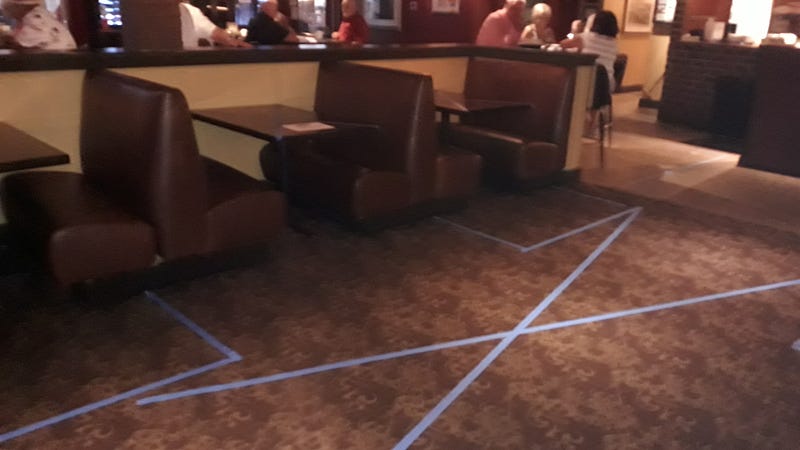
So, the next time we went there, management had rectangles marking areas on the dance floor that would hold two couples, one at each end, with space between the rectangles. That was better, but not much.
The next week, they had put a table in the middle of the dance floor. The regular dance floor closed!
You were supposed to dance next to YOUR table. The singer announced that between songs and the long-suffering staff had to constantly remind everybody.
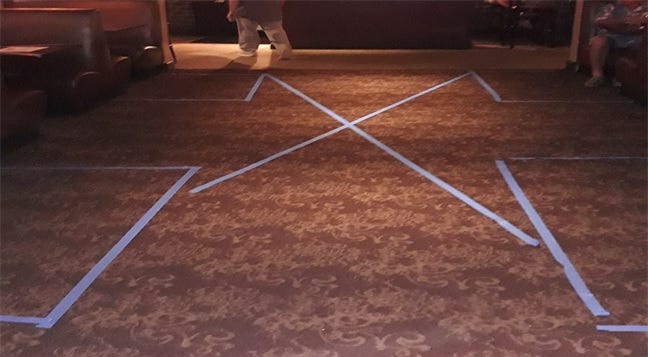
Last night, they gave up on that idea. The dance areas were invisible, left to the imagination of the dancers.
People didn’t pay attention. The owner had to herd people back to their table when they strayed.
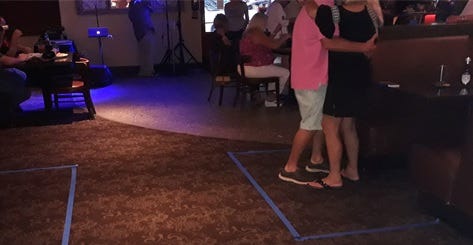
During the first break, the owner and staff marked all dance areas with blue tape.
Each table had its own dance floor.
There were no questions. Management still had to tell some people not to stray, but far less often.
As for the bar, patrons still moved their chairs closer together or pulled in other chairs.
Management finally removed all bar stools and put tall tables against the bar.
Walk-up service was no longer available — just table service with the regular wait staff.
Conclusion
We still go there about three times a week, just to get out and do something.
It’s been fascinating to watch people who are oblivious to the club’s efforts to provide entertainment and, intentionally or unintentionally, flout the extra effort by management in addition to the rules imposed upon the restaurant.
It’s a microcosm of our entire society.
Update for “100%” capacity:
Before COVID, 100% meant as many as would fit inside the building. Until the vaccines take effect and while the number of new cases remains high, it means less than that. Here are a few things to look for before frequenting a restaurant or night club:
- Is it in a high COVID infection area? If so, best not try it.
- Do they have good ventilation? Regular ceiling fans don’t count. A German study showed that they push the air back down, thus increasing the risk.
- Are the tables well spaced? Chairs and corners should not be almost touching.
- Are bar patrons spaced, not shoulder-to-shoulder. They don’t have to be six feet, but not packed, either.
- Does everybody have a place to sit? People standing around drinking overload capacity and increase risk.
- Are most patrons local regulars? A lot of new walk-ins increase risk.
- Is there space between dancers? Collisions indicate too many on the dance floor at this time.
This isn’t as good as social distancing, but it is much better than a night club with a packed dance floor, a walk-up bar, and other overcrowding. (Dec 13, 2020).
Disclaimer: The author is not connected with City Fire and has received no compensation of any kind. The author is using City Fire as a first-hand method of following one response to COVID-19.
Other COVID articles:
Many bars, unlike City Fire, have failed to follow such rules and patrons have paid the price.


