
How We Come to Love and Lose Hamlet in the Graveyard Scene
Formal play analysis
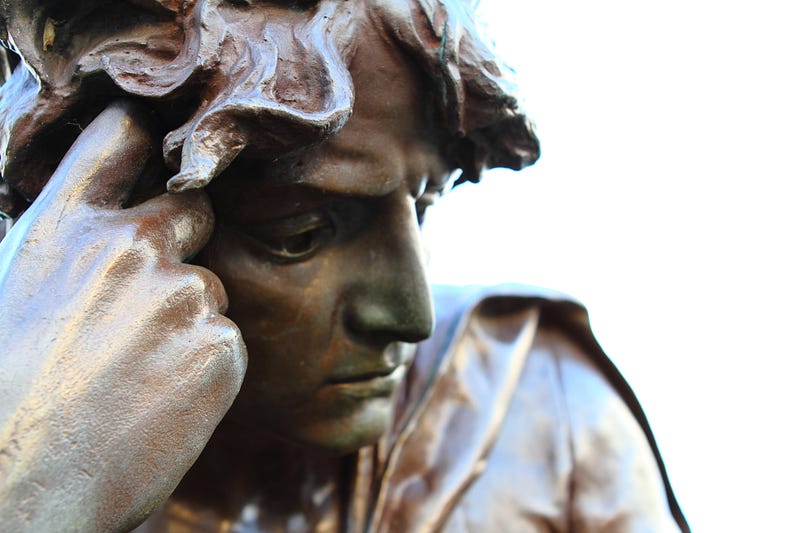
In the first scene of the last act of William Shakespeare’s Hamlet, which I will refer to as “the graveyard scene,” the audience’s relationship with Hamlet undergoes two major shifts. Upon Hamlet’s reentry into the play in Act 5, Scene 1, the audience finds newfound hope and love for Hamlet, but by Hamlet’s exit the audience is ready to wash our hands of him; we will accept his loss. In fact, we are ready and willing to witness the bloodbath that ensues in the very last scene of Hamlet.
This second-to-last scene is fascinatingly packed with newly introduced characters, a reintroduction of Hamlet after a lengthy absence, and a reopened investigation of several relationships that Hamlet is part of throughout the play. The graveyard scene begins in an entertaining fashion with witticism between two gravediggers that continues between the main gravedigger and Hamlet as the scene progresses. It is only at the point, much later in the scene, when Hamlet discovers Ophelia’s suicide and begins his drama-king style grieving competition with Laertes that we are willing to toss aside our sympathy for Hamlet once-and-for-all. The graveyard scene not only encapsulates two major emotional shifts of the audience toward Hamlet but also represents the emotional shift of the audience’s relationship with Hamlet throughout the play.
When the graveyard scene opens, Hamlet has been exiled for several years to England from Denmark by King Claudius. The audience knows before the graveyard scene opens that Hamlet has stowed away on a pirate ship in order to make his return. We anxiously await what will happen while romanticizing Hamlet’s pirate-hitched ride. His actions are simultaneously dangerous and invigorating. As an audience, we are more than willing to share Hamlet’s adventure, although we do not gain much more entry into his current circumstances. Hamlet is absent at the beginning of Act 5, Scene 1, which opens with two clowns digging Ophelia’s grave in a churchyard and discussing her burial.
Structurally, the graveyard scene is divided into three major parts: 1. The gravediggers converse and dig Ophelia’s grave; 2. Hamlet and Horatio spy on the gravediggers and then engage in a conversation with them; and 3. Ophelia’s funeral procession enters the graveyard where Hamlet and Laertes proceed to have a battle of bereavement. The scene is practically an ensemble of the remaining living cast with a few new characters introduced, two clowns and the Doctor of Divinity. In addition to Hamlet, Horatio, Laertes, Ophelia’s body, Claudius, Gertrude, and the lords attendant, there are many skulls, especially that of Yorick who was the King’s jester when Hamlet was a boy. Perhaps this skull in particular represents a life lived to the fullest.
In fact, we are ready and willing to witness the bloodbath that ensues in the very last scene of Hamlet.

The graveyard scene is a microcosm of the play in its entirety — technical details
There are a total of 301 lines in the graveyard scene. 56 lines are spoken by the clowns before the appearance of Hamlet and Horatio. Hamlet finally speaks at line 66 and Hamlet, Horatio, and the Clowns exchange dialogue from lines 66–223. Toward the end of this conversation, Ophelia’s body appears onstage in the funeral procession. Laertes enters the dialogue at line 224, and from line 224–295, the cast of speaking characters is comprised of Laertes, Hamlet, the Doctor of Divinity, Gertrude, Claudius, and Horatio. After line 295, Hamlet and Horatio exit the scene, leaving us with Claudius saying the scene’s closing lines:
“This grave shall have a living monument. / An hour of quiet shortly shall we see;/ Till then in patience our proceeding be.” (5.1 299–301)
The graveyard scene represents a microcosm of the entire play, in which the Clown and the Other have a relationship that seems to mirror the friendship of Hamlet and Horatio. This is apparent in the first part of the scene when the Clown begins asking Other riddles:
“What is he that builds stronger than either the mason, the shipwright, or the carpenter?” (5.2 44–45) to which Other replies, “The gallowsmaker, for that frame outlives a thousand tenants (5.2 44–45). The Clown and Hamlet are both smart and witty to use their friends, Other and Horatio, to test their jokes and entertain. Hamlet echoes this behavior later in the scene when he reflects on the skulls, with wit that seems to be for Horatio’s benefit:
“Why may not that be the / skull of a lawyer? Where be his quiddities now, his quillities, his cases, his tenures, his tricks? / […] This fellow might be in’s time a great buyer of land, with / his statues, his recognizances, his fines, his double / vouchers, his recoveries. Is this fine of his fines, / and the recovery of his recoveries, to have his fine / pate full of fine dirt?” (5.2 99–101, 104–109)
The Hamlet we love to love
His wit in scene 5.2 re-endears the audience to Hamlet. Playfully, Hamlet reminds us that we all become dirt in the end, using the word “fine” with the double meaning from medieval Latin, in which “fine” could mean “death” or “end.” “Pate” means head or brain. Our skulls will end up in “fine dirt” one day. There is multiple meaning with “recovery” also, in which it means both to make returns, to return from the dead, and to recover from illness or deceit. The importance of Hamlet’s wit throughout the play is emphasized in this scene when his wit is referred to four times.
Shakespeare implicates the audience in the graveyard scene by inviting us to spy on the Clowns and then on Hamlet and Horatio as they spy on the Clowns. To carry the spying sentiment even further, we are titillated when Hamlet goes undercover to grill the Clown for intel on Hamlet. Because we know what Hamlet is up to, we are involved in the deception. This appeals to our sense of voyeurism as well as the adrenaline from the danger of deception.
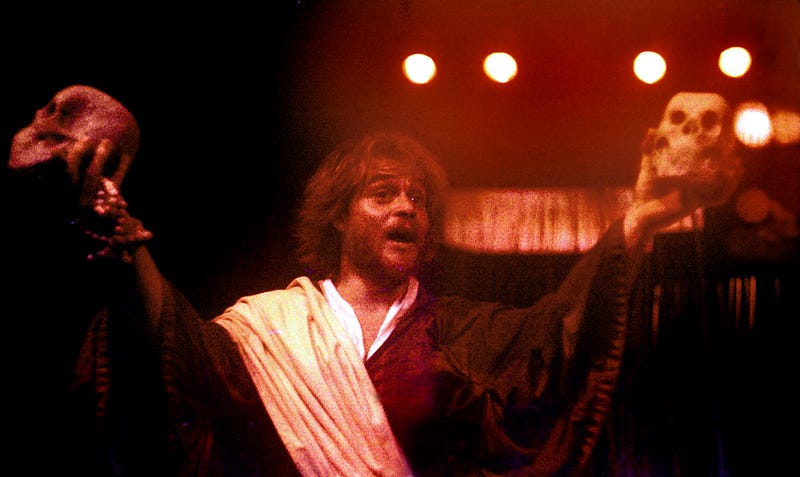
We resume our love affair with Hamlet while Shakespeare creates an audience onstage as he continues to involve the theatre audience in the plot. Hamlet and Horatio begin as the audience of the entertaining, yet clueless gravediggers. The theatre audience watches Hamlet and Horatio in audience to the gravediggers and then interacting with them, allowing us to spy and deceive; the plot device invites us to accept the tragedy in exchange for our entertainment.
To discuss how the graveyard scene ends, we must go back to the beginning when Ophelia’s burial is discussed. The topic of Ophelia opens and closes the scene and represents the cycle of life Hamlet ponders in the graveyard. At this point, Hamlet has sunk further and further into a quagmire of greyness and confusion. Maynard Mack explores this ambiguity in his essay, “The World of Hamlet.” The audience is not gifted any great moral conclusions or answers to the philosophical questions presented in the play. Although this scene does not offer solid answers, the Clowns set the tone for what the scene will offer us: a much-needed realistic investigation into death that has been absent throughout the play.
The two Clowns discuss whether or not Ophelia will be granted a Christian burial, the main Clown saying, “Is she to be buried in Christian burial when she willfully seeks her own salvation?” and the Other replying, “I tell thee she is. Therefore make her grave straight. The crowner hath sate on her, and finds it Christian burial.” (5.1 1–7) Here, the audience gets to take a break from Hamlet’s intensity to relax and laugh while the gravediggers entertain us. This creates a diversion from the unstoppably tragic ending revealed in the next scene. The gravediggers shovel dirt, toss skulls about, sing, and philosophize. Perhaps digging deep into the dirt is a metaphor for taking a good, hard look at life’s tragedies.
The jovial and philosophizing attitude maintains until the appearance of Ophelia’s funeral procession when her brother, Laertes, grieves in a strangely lover-like way (line 220). We experience a second emotional shift when Hamlet seeks to upstage Laertes. This creates a disconnect with the audience — we are swiftly distanced from the Hamlet we are happy to take back into our good graces. Hamlet looks ridiculous as he competes to achieve “best griever” status. We further distrust Hamlet when he tells Laertes he loves him. We aren’t so willing to believe Hamlet loves the man whose father, Polonius, he stabbed to death. Maynard Mack asserts this is the scene in which Hamlet accepts responsibility for his actions and is therefore ready to sacrifice his own life in the next scene. I heartily disagree with Mack’s sentiment that:
After the graveyard scene and what it indicates has come to pass in him, we know that Hamlet is ready for the final contest of mighty opposites. He accepts the world as it is, the world as a duel, in which, whether we know it or not, evil holds the poisoned rapier and the poisoned chalice waits; and in which, if we win at all, it costs not less than everything. (212)
At this point, the audience is ready to dismiss Hamlet. University of Central Oklahoma professor, Dr. Christopher Givan, stated in a 2005 lecture that giving up on Hamlet is permanently sealed in the following scene when we discover Hamlet orchestrated the deaths of Rosencrantz and Guildenstern. This plot device distances and disassociates the audience from Hamlet before we become hopelessly invested in his character. Because we are less sympathetic at this point, the character of Hamlet doesn’t feel entirely tragic. Our feelings give way to frustration with Hamlet for catalyzing most of the vents which lead to most of the cast’s deaths. Hamlet falls back on the ghost-dad and crazy-acting for too long — it’s time for him to wise up and act sensibly. He is trapped in a confusing web of his own making.
The many interpretations of Hamlet
There are multiple interpretations of the graveyard scene. In order to get a better grasp on this analysis, on a wintry day in 2005, my mom, INFJ Elder, and I recited the scene together. It was obvious we had different interpretations. The modernized 2000 adaptation with Ethan Hawke and the 1996 adaptation with Kenneth Branagh are vastly different.
When we read the graveyard scene, my mom played Hamlet. Instead of making him the quick, witty, and over-the-top fellow I would have played him as, she read Hamlet in a woe-is-me tone, only to stop and titter at lines like, “Why not imagination trace the noble dust of Alexander till ‘a find it stopping a bunghole.” (5.1 205–206) It seemed that for mom, Hamlet is already lost to his own narcissism by the time we reach the graveyard scene.
The 2000 Ethan Hawke Hamlet adaptation falls short in recognizing the importance of the graveyard scene and how it mirrors the entire play. Unfortunately, the scene is cut short, showing only Hamlet and Horatio stopping by the grave for a moment while they are out for a ride anyway on a motorbike. This interpretation belittles the importance of the graveyard scene and does Hamlet injustice by taking away the very scene that emotionally glues the play together.
The 1996 Hamlet directed by, and starring, Kenneth Branaugh, delivers on the graveyard scene. It opens with an image of Ophelia, her hair loose about her face, floating dead in a body of water. The camera cuts to a wide view of a forested area and then closes in on the gravediggers digging Ophelia’s grave. The Other is portrayed as a slow and loyal person while the main gravedigger, played by Billy Crystal, is witty. The scene is shot in dusky light that deepens as the scene progresses. Eventually, we see that we’ve been observing the graveyard scene along with the characters, Hamlet and Horatio. Hamlet is unable to resist the temptation to start a conversation with the gravediggers about what they are doing. A battle of wit ensues.
While the main gravedigger holds the skull of Yorick in his hands, Hamlet observes the many skulls lining the rim of the open grave. Hamlet reflects on the cynical nature of life and death, now holding Yorick’s skull in his own hands, raising the skull to face him at eye level. As Hamlet looks at Yorick’s skull, the scene goes in and out of a flashback to Hamlet as a youngster kissing Yorick and riding on his back, achieving the effect of informing us this is the skull of a person he knew and loved. It also foreshadows the body of another person he possibly loved, Ophelia, appearing in the scene.
Hamlet and Horatio jump out of sight when Ophelia’s funeral procession enters the scene. Laertes preaches to the Doctor of Divinity for being so judgmental about the way in which Ophelia died. Laertes, overcome with grief, jumps into the grave with Ophelia, pries open the casket and hugs her body. At this point, Hamlet emerges from his hiding place to claim that he always loved Laertes, and his sister, Ophelia, at which point he says the famous line, “This is I, Hamlet the Dane!” (5.2 258–259) while competing with Laertes for who is more bereaved.
As in the reading of the play, Branaugh’s rendition has Hamlet acting foolish and even mean. His interpretation is more similar to my analysis than to Maynard Mack’s: How dare Hamlet profess his love for Laertes after he has killed Polonius, Laertes’ father, and driven Ophelia to her bout of craziness and eventual suicide?! Like King Midas, everything Hamlet touches seems to turn into something; unlike King Midas, it always seems to be something terrible, not gold. The Branagh version ends with the King sending Horatioto to deal with Hamlet and telling Laertes that Ophelia will have a “living monument” within the hour, while sticking to the actual lines of the text, and staying honest to the emotional interpretation of the text; his graveyard scene is realist and haunting.
The audience is prepared for Hamlet’s death
To reiterate, there are two major shifts in audience attitude with Hamlet during the graveyard scene. Through the first two parts of the graveyard scene, we are drawn into the newly discovered, more realistic world, in which Hamlet finds himself:
“That skull had a tongue in it and could sing / once. How the knave jowls it to the ground, as if / ‘twere Cain’s jawbone, that did the first murder! / This might be the pate of a politician, which this ass now o’erreaches” (5.276–80).
Upon Hamlet’s reemergence into the play, the audience has a favorable view of Hamlet and his wit. However, when Hamlet jumped in Ophelia’s grave with Laertes to claim he loved her more, Hamlet said:
“Forty thousand brothers / Could not with all their quantity of love / Make up my sum.” (5.271–273)
With these lines, the audience realizes Hamlet is still self-centered. We never believed that Hamlet loved Ophelia as much as he wants us to believe, especially after earlier telling her to get to the “nunnery.” Gertrude and Claudius both call Hamlet mad (crazy) at this point. It is at this point that I believe the audience sides with this take and is emotionally prepared for Hamlet’s death. Hamlet serves us these strange lines, “The cat will mew, and dog will have his day,” before the following and final scene, in which he finally dies. The blow isn’t so striking though, as our emotions have been toyed with through the entirety of the play.
Works Cited
Hamlet. Dir. Kenneth Branagh. Perf. Kenneth Branagh, Kate Winslet, Derek Jacobi, Julie Christie. Videocassette. David Barron, 1996. Hamlet. Dir. Michael Almereyda. Pef. Ethan Hawke, Julia Stiles, Kyle MacLachlan, Bill Murray. Videocassette. Miramax, 2000. Mack, Maynard. “The World of Hamlet.” The Tragedy of Hamlet: Prince of Denmark. Ed. Sylvan Barnet. New York: Signet, 1998. 191–213. Shakespeare, William. The Tragedy of Hamlet: Prince of Denmark. New York: Signet, 1998.
This is a revised version of a graduate school essay I wrote in 2005.
For another Shakespeare analysis, see my article“Stasis and Sexuality in Shakespeare’s ‘Twelfth Night’”To find more of my eclectic work, visit my profile here, Aimée Gramblin If you’d like to support my writing habit by becoming a Medium member, I’d be ever-grateful. You can do that here.