
Diversifying Revenue Streams: How Venture Studios Can Fund Operations

Venture Studios, the driving force behind innovation and entrepreneurship, have been at the forefront of reshaping the startup landscape for quite some time now. These powerhouses take promising ideas and transform them into thriving businesses, providing these new ventures with expertise, funds, and a wide variety of resources.
But, the intriguing question arises: how do Venture Studios themselves secure the resources needed to fuel their operations and foster these budding companies?
How Venture Capital Firms Fund Operations
Venture capital funds are set up in a way to make sure the partners earn a steady income as they work on investing and generating returns.
In these funds, partners usually promise to pay back all the investors’ money before they get a cut of the profits. But here’s the deal: the fund covers the cost of running things each year.
Typically around 2% to 3% of the total pool of money is paid to fund firm operations.
This money is referred to as a management fee — and they get it whether the fund is doing well or not.
So, if a firm raises a $100M fund, they can expect to acquire $2–3M which is used to pay the investors and for the activities involved in running the fund.
This works for most venture capital firms because they usually have low overhead costs and only a few partners to split the money between.
Why VC Structure Doesn’t Work For Venture Studios
Venture Studios are similar in nature to venture capital firms in the way they provide capital to emerging startups — but unlike VC firms, the work doesn’t stop when the check is written.
John Carbrey, Managing Director of Future Sight, wrote an excellent article breaking down the numbers behind the value creation of Venture Studios versus venture capital firms.
“As shown above, even at the early stages of an investment, there is a huge value creation difference between a traditional venture capital firm and a venture studio. In this case, there is 3.4x more equity value in the studio vs. a traditional venture firm. In terms of created value (beyond the initial capital investment), the studio has created 14x more value than a venture capital firm.” — John Carbrey, Managing Director of Future Sight
In order to create such an increase in value, Venture Studios do what venture capital firms won’t — they get at the earliest stage and build.
Venture Studios have high overhead costs.
Studios are involved in everything from founder recruiting, ideation, validation, building, sales, hiring, fundraising, and go-to-market activities.
This kind of hands-on work takes dozens of people per startup in addition to the costs of building and launching the venture itself. These activities are expensive and very time-consuming thus, unlike venture capital firms, Venture Studios have high overhead and operating costs.
Studios Don’t Raise Big Funds Like Venture Capital Firms
In addition to having higher operating costs than typical venture capital firms, Venture Studios face an even more significant challenge — fund size.
Because venture capital firms raise huge funds, often in excess of $50M, the management fees cover their operating costs.
But Studios raise much smaller funds — if they can raise a fund at all.
Typically, new Studios can only secure funding in the range of $1–5M dollars which leaves most in a situation where depending solely on management fees is an insufficient means of covering the high overhead and operational costs.
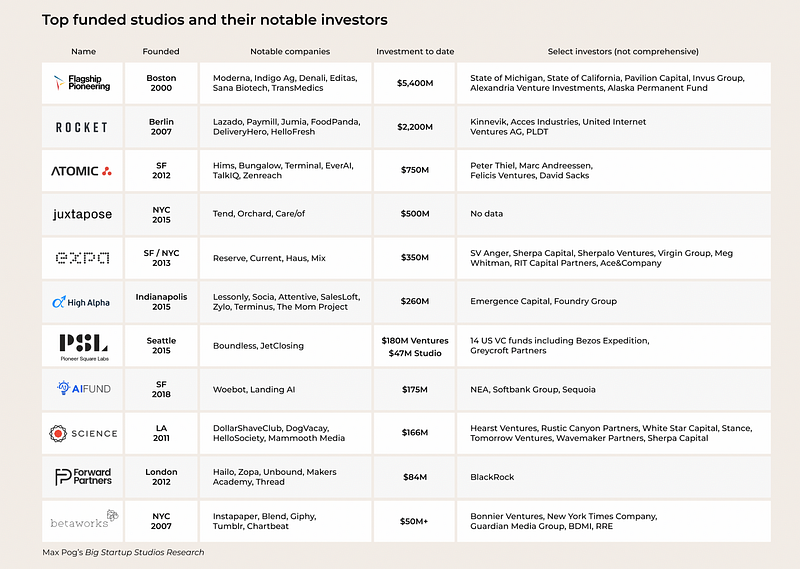
This is not to say that Studios can’t raise big funds (see below) but even established Studios have a hard time and when they do the rounds are often few and far between.
Take a look at some of the top-funded Studios to date (and be sure to check out the Big Startup Studio Research Paper by Max Pog if you haven’t already!)
Studios Need Support: Alternative Revenue Generation
Given that management fees are unlikely to cover the costs of running a Studio, creativity is demanded.
Let’s explore a few of the most effective practices Studios are using to supplement management fees and in some cases eradicate them altogether.
Yes, eradicate.
In my experience with emerging Venture Studios, I’ve learned that you don’t need to raise a fund to run a Studio. You just have to think outside the box.
Corporate Innovation Deals:
One avenue that Venture Studios frequently explore is corporate innovation deals. This involves partnering with corporate entities that fund the development of new ventures. These corporate partnerships can take various forms, ranging from outright acquisition to equity stakes held as the Studio shepherds the venture to commercial success. By entering into such strategic arrangements, Studios not only secure funding but also gain access to invaluable expertise and resources.
Agency Services:
Another intriguing strategy adopted by Venture Studios involves offering agency services. Depending on the Studio’s expertise, it can provide a range of specialized services, such as design, software development, marketing, validation testing, and more. These services are provided in exchange for funds. This diversified income model has proven to be a lucrative source of revenue, particularly when these services are aligned with the Studio’s core competencies.

Consulting:
For studios that have a niche they’re expert in — such as AI, Web3, sustainability, healthcare, real estate, etc. — they can leverage their internal resources to advise organizations on innovation strategies within their sphere. Often these entities are corporate organizations but the range spans from academic institutions to governments and non-profit organizations. These deals often follow the typical structure of how consulting firms work with clients.
Innovation Programs:
Venture Studios also explore the realm of innovation programs, collaborating with cities, governments, academic institutions, and more. These programs, often structured as startup accelerators or events, serve a dual purpose. They not only foster innovation and entrepreneurial growth but also generate revenue that supports Studio operations.
Selling Access:
A final revenue generation tactic frequently used by Studios involves leveraging their extensive networks and expertise to sell resources and access. Studios unlock this opportunity by sharing their knowledge and connections with the people who want them. Think of who might want early access to new innovation in a specific field. Or which parties may need an introduction to forge a deal or partner together? If a Studio can be the conduit between two groups that want to do business, they have the potential for a lucrative revenue stream.
The Possibilities Are Endless
In conclusion, the art of achieving sustainable operations in the Venture Studio realm lies in creatively leveraging people, assets, connections, and resources to deliver innovation to those entities that aren’t equipped to attain it on their own.
It’s a dynamic dance between building your innovation arsenal and establishing relationships with outside parties who can benefit from your expertise — this dance is propelling Venture Studios into a future of boundless possibilities and pioneering entrepreneurship.
To learn more about what Venture Studios are up to these days and how you can get involved, I encourage you to subscribe to Studio Stack or connect with me on LinkedIn.