
How Universities Can Make Education More Affordable

The higher education system needs to change.
You have probably heard or read that line one too many times before.
But how does it need to change? And to what?
- Fewer institutions? Possibly.
- New ways of teaching and learning? Often the case.
- Different courses? Probably.
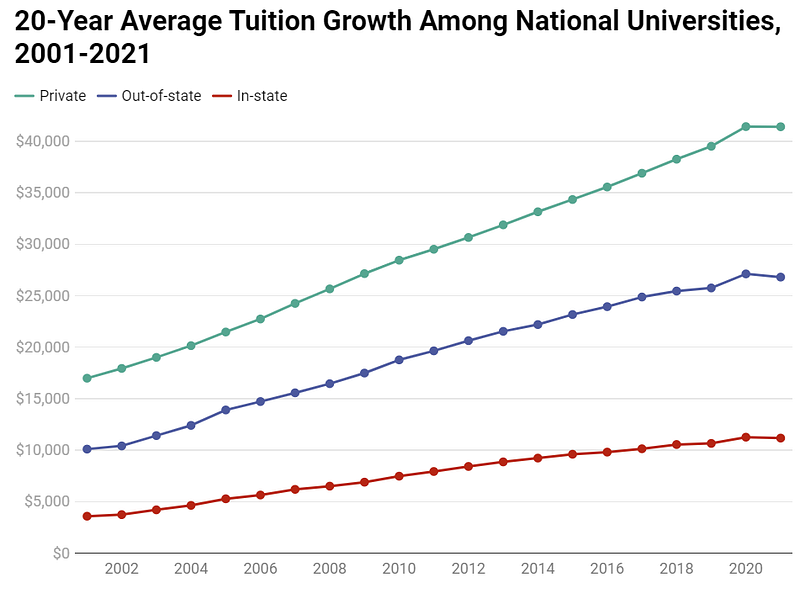
Those are all great potential problems for the system to address. However, one that is only getting bigger and bigger, and even more so now with the impact of COVID-19 on the economy, is the increase in tuition fees.
In the last 20 years the average tuition fees for each year have increased significantly in the US:
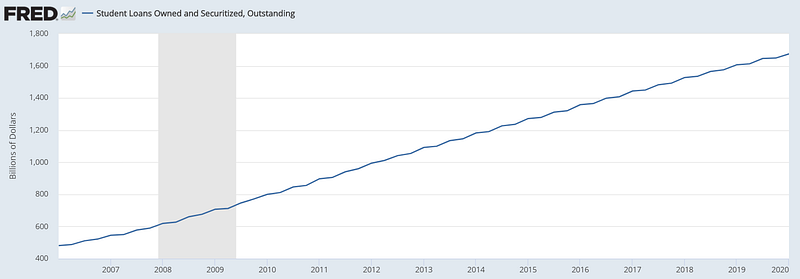
And student loans have followed suit.
It only takes a few clicks to learn of a new round of layoffs due to COVID-19 (the most recent being American Airlines and United Airlines announcing 32.000 lay-offs). Surely, the economy will ultimately get better. However, it is unclear how and when.
In the meantime, millions of students are or will be enrolling at institutions that boast great employment prospects, along with the hint that there is direct correlation between them and those stats. Something that students need to wait until the end of their studies to validate. However, fees are charged whilst the course in on-going.
What if it could be different?
What if higher-education institutions charged per outcome — after students graduated and landed a job?
Charging students only after they start working can be an effective way for parties to share risks and rewards, aligning interests and addressing other problems, too.
- Universities may innovate their courses more quickly, ensuring their students can be best equipped to be as competitive as possible in the market.
- The landscape may change from either consolidation among institutions or an outright reduction in number of universities — only the ones providing relevant education would survive.
- Institutions may become more proactive, getting closer to the market and forging new partnership with employers to ensure students find a employment route more smoothly.
For example, Strive School is a rising coding courses provider that adopted an income-sharing agreement (ISA) model. Its students start paying back the cost of their education only after they find employment, at a % of their gross salary that is agreed at the outset and for a period of time only. In that way, Strive has skin in the game and works very closely with students to ensure they graduate from the course with all the relevant skills needed to succeed as developers, and that they have a job to use those skills at. This model could be applied to other fields of studies, too.
Of course, as ISA models are fairly recent, they are far from being perfect and being widespread yet. In fact, critics have been quick to point out their flaws, arguing that the risk is not truly shared between parties and that in the end students end up paying more.
But that is because income-sharing agreement terms vary from one school to another. What if
- There were regulation in place to ensure fair practices?
- What if there were a clear governance structure?
- ISA models became a complementary tool for students to finance their education, on top of scholarships and other loans?
Just because a model is not perfect, it does not mean it cannot help in tackling a problem
Education is an important part of anyone’s personal and professional development path and money should not be the deal breaker. It should be an enabler. The concept of ISAs can play a key role in transforming the education industry and it would be a missed opportunity for governments and universities in any field to not explore them further.


