
How Traveling to India and Mexico Helped Heal My Relationship with Myself and My Mother
When I was a first-year college student, a mentor asked me to create a vision board.
A few weeks later, I showed him my vision board, which featured images of famous destinations in various countries — the Great Pyramids of Giza, the Taj Mahal and the like.
The summer before my first year of college, I received a scholarship to study across three cities in Spain. At the beginning of this trip, I found myself crying, longing for home. By the end of it, three weeks didn’t seem like enough and I wondered when I’d have the opportunity to travel again.
Since that trip, I’ve been grateful to have had the opportunity to travel to 35+ countries. I’ve been living nomadically for almost two years and have a whole slew of reasons for doing so:
You don’t know what you don’t know.
Traveling, as it’s done for many people, has really broadened my perspective and helped me see that there are other ways of living and thriving. Living abroad has made it a lot easier for me to just be. In the United States, I feel like I’m easily sucked into productivity/achievement culture where I feel guilty if I want to rest. When I’m abroad, I find it easier to just be because people in the different countries I’ve lived in are more laidback than people in the United States.
Another beautiful thing about traveling that I didn’t expect is how instrumental it has been in my healing journey. In this piece, I want to share with you my experiences in India and Mexico that have contributed to my healing:
1) Yoga Teacher Training in India
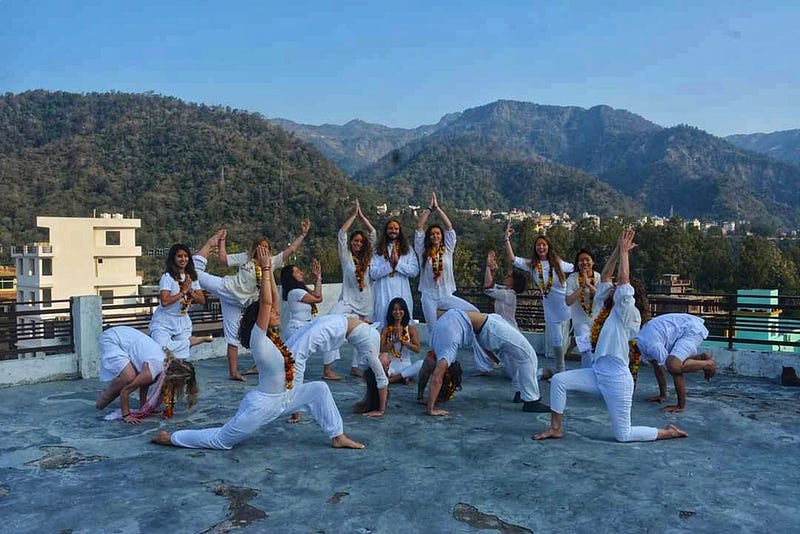
By the time I decided to do Yoga Teacher Training (YTT) in India, I’d been practicing yoga on my own for ~2.5 years. I decided to complete YTT not necessarily to become a yoga instructor but more so because I wanted to deepen my own yoga practice and go to the original source of yoga: India. Yoga Teacher Training, in addition to helping me deepen my own yoga practice, also enabled me to make peace with myself.
During YTT, I learned about the concept of ahimsa, non-violence. We usually think about it in relation to other entities, such as animals. (E.g.: Individuals practice ahimsa towards animals by choosing to be vegetarians.) I learned that before we even think about ahimsa towards others, we get to apply ahimsa towards ourselves:
What are the thoughts we have about ourselves?
Are they kind thoughts?
If not, what type of pain are we inflicting on ourselves?
Once, during YTT, I found myself crying — In listening to my yoga instructor talk about the importance of living in the present, it suddenly dawned on me how much of my life and energy I had squandered because of this incessant feeling I had that I was not doing enough in my life.
Although I was sitting in front of my instructor crying, he didn’t try to console me, as most people do in the West. Instead, he just let me cry, without asking why I was crying and in not making a big deal out of it, I feel like I was able to complete my crying session in its entirety, thereby releasing stuck emotions in me. I’ve forgotten the majority of the Sanskrit names for many of the yoga asanas I learned, but these memories of healing have remained with me.
2) Temazcal Ceremony (Sweat lodge) in Mexico
Whilst living in Oaxaca, Mexico, I befriended a woman who recommended Juanis, her masseuse, after I told her I was looking for one. Whilst giving me massages, Juanis and I started chit-chatting about life, especially because she and I recognized the mind-body connection and how the thoughts we have impact what shows up in our bodies. I told her that I was working on forgiving my mother and she gently told me “poco a poco,” which in English translates into “little by little.”
Juanis and I ended up being good friends and one day she invited me to a temazcal ceremony she was hosting with local Mexican families. The temazcal ceremony took place in a pitch black sweat lodge where we all sat knee-to-knee, sweating it out whilst experiencing a metaphorical rebirth in the darkness of Mother Earth (just as a fetus emerges from the darkness of a mother’s womb into the light). As we all piled into the sweat lodge, a young child had been separated from her mother and in the middle of the ceremony, she started crying out for her mother, who was seated on the other side of the sweat lodge.
Due to the darkness and the heat, it was impossible for the child and the mother to make their way to one another. I started worrying for this child — What type of trauma was going to result from this distraught separation from her mother? Juanis started to console the child and whispered that her mother wanted to be with her, but just couldn’t at that point. Instead, we could all join hands in a circle and her mother would send her energy and love in this way.
Hearing all of this play out in the darkness was profound for me — I felt like it symbolized my relationship with my own mother who, along with my father, sent me to live with babysitters shortly after I was born. Maybe my mother had wanted to be there for me growing up but for whatever reason, she didn’t have the capacity to do so. However, this doesn’t mean that she didn’t want to and maybe she was there for me in the ways that she knew how, even if it wasn’t what I wanted. And in that moment, I further understood what Juanis meant when she said “poco a poco.” Forgiveness didn’t have to happen overnight, but instead in these little moments that I was making sense of and piecing together.
How incredibly fortunate I have been to be able travel and experience the wonders of the world and at the same time, journey inward to better understand myself and the relationships that have impacted who I have become. As much as traveling has enabled an external journey, it has facilitated a deep inner one which is equally, if not more, important.
Thanks for reading! If you enjoyed the article above, you might enjoy this one too: