
How Tracking Your Mood Can Improve Your Mental Wellbeing
The ultimate guide to utilising mood diaries

Our mental wellbeing is being affected more than ever right now. Recent evidence has found that depressive symptoms experienced in young adults have now doubled to 1 in 5 compared to the previous 1 in 10.
It’s evident that there are so many worries surrounding the pandemic — worries about our jobs, families, lifestyle, health, going out etc. This can make our mood fluctuate heavily!
Forget the pandemic for a second — life, in general, is a pain. All those worries mentioned above affected our moods before the pandemic hit anyway — it’s just intensified now.
I work with very stressed family members who are currently trying to cope with and care for their loved one who is experiencing severe mental health difficulty right now.
A massive strategy that I recommend, that is receiving a lot of supporting research is tracking your mood to see how this affects your overall wellbeing. Trust me, you’ll be amazed at how you can use some simple tracking to improve your mental wellbeing.
Let's dive into my guide to utilising mood diaries!
The Mood Diary
A mood diary helps you keep track of the triggers that can make your mood fluctuate. It helps you identify different events, situations and interactions that make you feel jubilant and that can make you feel upset.
It helps you see what makes you happy, excited, relaxed, sad, annoyed, worried, stressed, or any other negative/positive emotion you can think of.
The idea behind the mood diary is that by looking at these factors that influence your mood, you can achieve a better mental state. You have a better idea of what influences your mood and how. You can then try to implement more of the factors that make you feel great!

For many of us, we are on auto-pilot mode.
Day by day, we are in an automatic, habitual routine. We don’t really know what affects us and why it affects us.
A mood diary helps you bring these automatic, unconscious behaviours to the conscious, where you can think and reflect on your day to see what affected your feelings.
Research published in the Journal of Affective Disorders, in 2018 found that engagement with a mood-tracking app, known as ‘MoodPrism’, predicted increases in mental wellbeing and predicted decreases in depression and anxiety.
The only problem with certain mood-tracking apps, is they don’t allow you to be as reflective. They will often only allow you to track where you were, who you were with and what your mood was like at the time and then give you some feedback.
Research that has looked into more reflective practices of mood tracking, has found even better outcomes.
Researchers in 2013 found when individuals were tracking their moods in a more expressive form, such as writing in a more deep, meaningful and reflective way about different events, there were “significant decreases in depression” in individuals with major depressive disorder, just 5 days after their mood tracking.
It’s evident that mood tracking, in a more reflective manner, looking at how the events and interactions around you have affected your mood can have significant impacts on our thoughts, feelings and emotions.
How To Create and Complete Your Own Mood Diary
Creating and filling out your own mood diary is simple and easy.
In short, there are tons of online mood diary templates/trackers that you can use.
However, there is something about creating and writing it out yourself that can have a massive impact on your wellbeing too.
To create your own, make a column for ‘Day Of The Week’, ‘Sleep’, ‘Mood’ and ‘Comments’. The comments section is where you will make note of the activities, situations, events and interactions that occurred during your day. It will encourage you to think more deeply and be more reflective.
Here’s a picture of my own mood diary that I created:
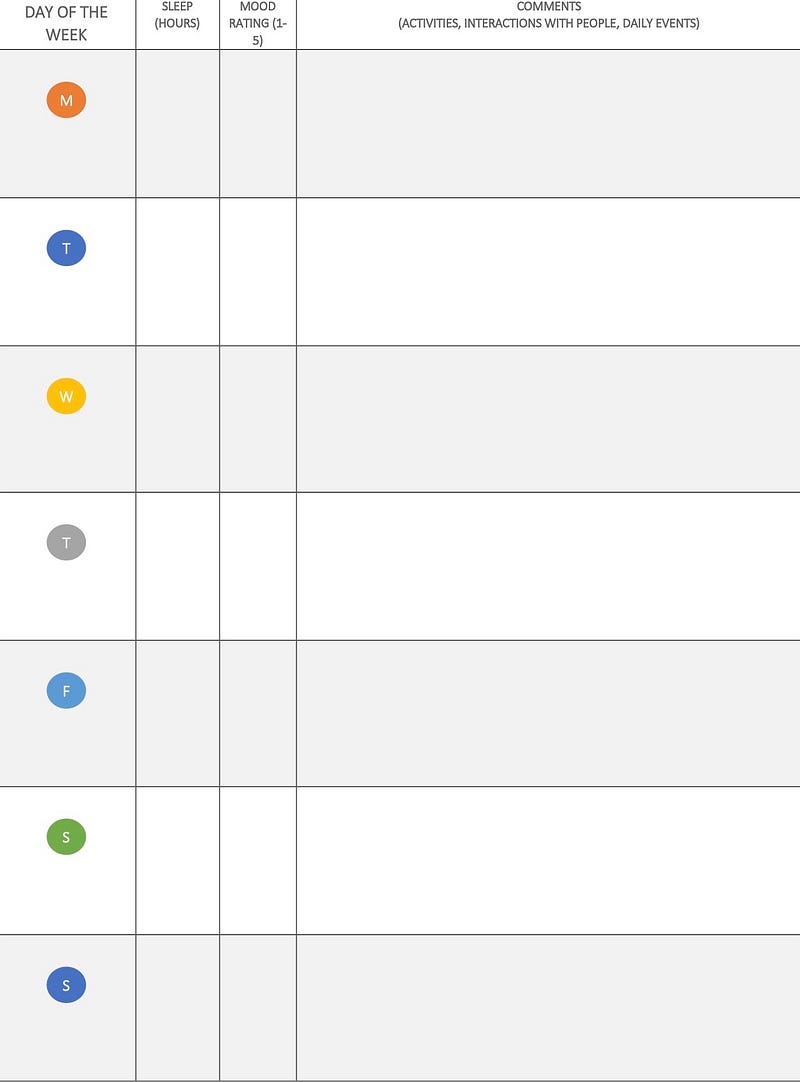
Feel free to use this as your own mood diary too!
Filling our your mood diary is very simple too:
- Sleep — Input how many hours of sleep you had that day.
- Mood — Enter on a scale of 1 to 5 with 1 being poor and 5 being fantastic, your mood level. As it is your own mood diary, you can use a scale that will resonate with you. If you prefer a larger scale of 1–10, use that.
- Comments — Make note of any activities you completed during the day and any interactions you had. Note down anything you have completed in your day, whether it is going to work, for a walk, doing gardening, if you sat on the couch or watched a lot of TV. Anything you feel is relevant and that you did, make a small note of it.
Once you have filled out the mood diary for that day, it’s time for some reflection.
Examine the factors that made you feel both good and not so good.
If you noticed you didn’t get much sleep that day and it could have affected your mood, try and get some extra sleep the next day.
If you identified that seeing your friend and going to the park or lunch with them helped your mood, try and see them more frequently.
If you noticed that a particular event at work made you feel upset, you can try and take steps to improve the way you felt about the event, such as speaking to your manager, other work colleagues, friends or family.
You can start to implement more of the activities, situations, events and interactions with people that helped you feel good and it can help you take steps to reduce some of the negative moods you may be experiencing, which will all help with improving your mental wellbeing.
In simple terms — Create, Complete and Reflect!
Final Comments
With the pandemic and life being very stressful, we can often overlook the internal and external factors that can influence our emotions.
Tracking your mood is a great way to improve your thoughts, feelings and emotions.
It can help you focus your attention to all the situations and events that can affect you in day to day life.
By taking note of these factors and our mood on a daily basis, we can take steps to improve our mental wellbeing by tackling the difficulties that we face and implement more of the activities, events and interactions that can make us feel more positive, optimistic and enthusiastic.
Creating your own mood diary and completing it is simple, easy and quick to do.
Have fun and let me know how you get on!