
How Tourism Killed Tourism and How the Pandemic May Revive It
Welcoming more sustainable and respectful globetrotting
“What is it with people?”…
…was the statement that most exited my mouth during my recent-ish backpacking adventure in Southeast Asia. This journey began and ended, in a time before anyone might have conceptualized ‘social distance’ and in a land where there simply isn’t enough space to distance, even if it were life or death.
My tourism gluttony epiphany
It was a dark and humid 4 am when the alarm clock so rudely interrupted our sleep. I splashed some water on my cheeks, grabbed my day pack that I readied the night prior, and stumbled down to the pier to meet the captain of our chartered long-tail boat.
It was a day we had been anticipating since eyeing the Thai map. We were headed to a majestic bay on a tiny island off the beaten path. That is until Leonardo DiCaprio leaked it to the paparazzi.
You guessed it. We were headed to “The Beach” on Phi Phi Island.
After the film had popularized “The Beach” as the epicenter of hedonism, it had become a destination so heavily touristed that we were advised that the only time we might be able to relax there would be at dawn- 5 am to be exact- about one hour before the first scheduled tour boat would arrive.
The night before our voyage, hoards of tourists were participating in full debauchery, what was seemingly a celebration for stomping all over endangered sea coral during their day tour. So, even at 5 am, I was surprised to see so many other colorful boats chartered by tourists whose alarm clocks synchronized with my own.
I had assumed the rest of the tourist town was doing ‘walks of shame’ and drunk hand-poked tattoos while the locals were hosing down the puke in the streets with exhausted, empty eyes.
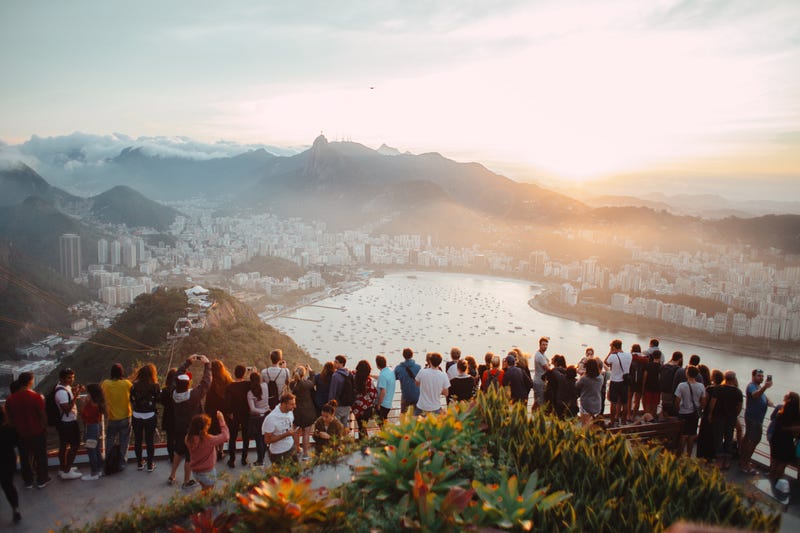
I would have never imagined the scene to come when the tour boats started to shore. It was only a matter of a few minutes until there was barely any beach left of “The Beach.”
It could have just as well been called “The Grasslands” since the sand was gobbled up by thousands of sarongs. I recall floods of tourists trying to model for bikini photos and floods of others in the background of such photos.
There were branched-off barriers where tourists were not allowed to enter to encourage the regrowth of native plants. But, the majority of tourists could not resist hopping over the separation to snap an Insta-shot with fewer humans in the background.
It was a scene from a tourist Zombieland movie. We couldn’t help but sit back and laugh. Cue the popcorn, Captain.
Was tourism always so dirty, invasive, and entitled?
Let’s rewind a bit.
I am equal parts humbled and privileged to identify as a seasoned world traveler, having visited over 50 countries over a span of 2 decades.
I prioritized understanding other cultures and getting to know people from far away lands when I was young, and these virtues continue to guide me today.
My first solo trip was an expedition to South America for a full year. I immediately fell in love with Brazilian culture, food, music, and people -metaphorically and literally- and never really left Brazil that year.
When I traveled to Petra in Jordan in 2006, I was very early on the tourist train. At the border, the Jordanian customs agent looked at my passport and said doubtfully, “You are from Canada?”
“Yes, sir.”
He displayed his sparkly off-whites and said “Welcome to Jordan!” with physical open arms and excitement so sincere, I nearly expected him to invite me to meet his family. We took photos together.
Before the tourism boom, remote travel was like a choose-your-own-adventure novel. Many short-haul flights did not exist as tourists were sparse and locals could not afford them. To border cross from Brazil to Peru through dense forest, the only option was to ride in a wagon pulled by a water buffalo due to thick claylike mud roads that wouldn’t even accommodate a 4x4.
When I arrived in Peru, I ate the only dish that the only restaurant was serving that day- turtle stew. Regretfully, the owner showed me the bloody turtle shell in the back of the shack to whet my appetite.
But remote villages were not the only destinations devoid of globetrotters back then. Long before Instagram induced travel FOMO, there I was, at the Pyramids of Giza. You might have thought I was a celebrity with the number of times Egyptian women would ask to take photos with me, being the first Western woman they had seen off-screen.
Tourism self-sabotage
More recently, tourism has flooded and pillaged those sacred, innocent lands. Admittedly, tourism in and of itself is an economic backbone to many places worldwide, but the style of tourism that has developed over the past decade is not only unsustainable but it is often disrespectful and pretentious.
Overtourism has destroyed natural environments beyond repair and heritage sites beyond restoration. Overtourism has over-demanded generosities and patience from the local people.
People often travel to seek inspiration, beauty, and meaning. People often seek travel to feel something special or to meet someone, unlike anyone they have met before.
But much to their chagrin, upon arrival they find a sea of people just like them who are seeking to feel the same special thing, thereby negating the inherent uniqueness of their quest.
In this vein, tourism has destroyed tourism.
Can tourism flourish again?
We need to re-establish some basic tourism ground rules- about respect, cooperation, and mutual understanding with the locals. We need to be mindful of carbon footprints and physical footprints in conservation areas.
We need to enjoy ourselves freely, but not foolishly.
If you wouldn’t do X in your home country because it is disrespectful, maybe 10,000 miles from home is not the appropriate setting for a trial run.
The pandemic has put the brakes on tourism and over-tourism, and often to an economic breaking point. But it is also a time of reflection about the potential sustainability for the future of global tourism.
When tourism starts to pick up speed, we need to better balance our needs with that of the local people and their environment to earn their respect as we once did.
Maybe one day, I can return to “The Beach” with pride and awe. Maybe one day, I will see that spark again in the villagers’ eyes.
Thank you for reading, clapping, and following my work.
Not a member of the Medium Partner Program yet? Your $5 membership fee gets you full access to every story on Medium and the opportunity to get paid to write. This referral link directly supports Shira Packer and other writers you read: https://getlearnt.medium.com/membership