
How Top Consulting Firms Do Strategy

Some say strategy is vision, others say strategy is process and tactic. It’s one of those things everyone has a different take on.
To pin down what strategy is, I started by looking at how today’s thought leaders — McKinsey, Harvard Business Review, and Monitor Deloitte — see strategy, and I’d like to share those insights with you.
McKinsey’s Take on Strategy
Strategy is… 1. An integrated set of actions to create a sustainable competitive advantage over competitors. 2. A way of thinking, not a procedural exercise or a set of frameworks.
The 4 Lenses Framework
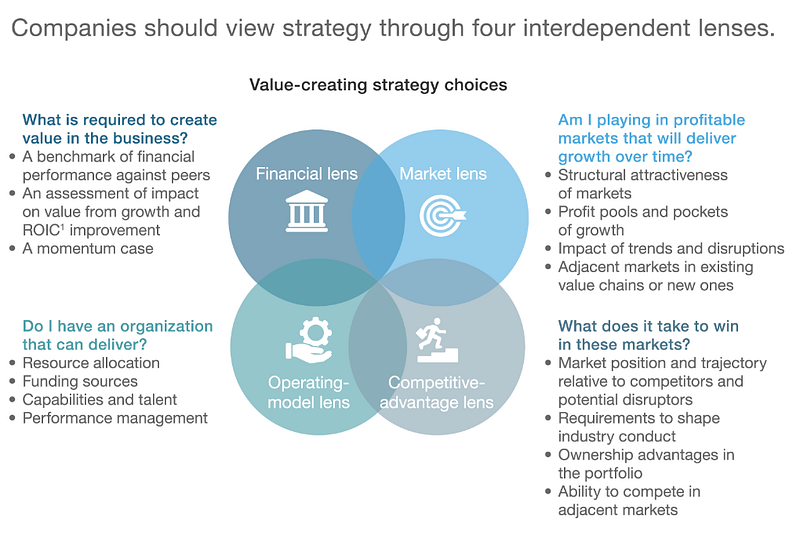
McKinsey believes a firm should look at strategy from four lenses: financial, market, competitive advantage, operating model.

Through the financial lens, we benchmark our financial performance against peers. It’s an objective baseline for us to assess and prioritize new initiatives, and to understand what the future looks like if we follow our current trajectory.
Through the market lens, we consider:
- Which market segments we can grow profitably in over time
- Other attractive markets we should consider entering
Through the competitive advantage lens, we try to figure out what it takes to capture value and win in our current markets. We determine if we can win, win quick enough, and win sustainably.
Finally, through the operating model lens, we allocate and design our people, process, and technology resources to inform strategic objectives.
The Building Blocks of Strategy
Below are the core building blocks McKinsey identified.
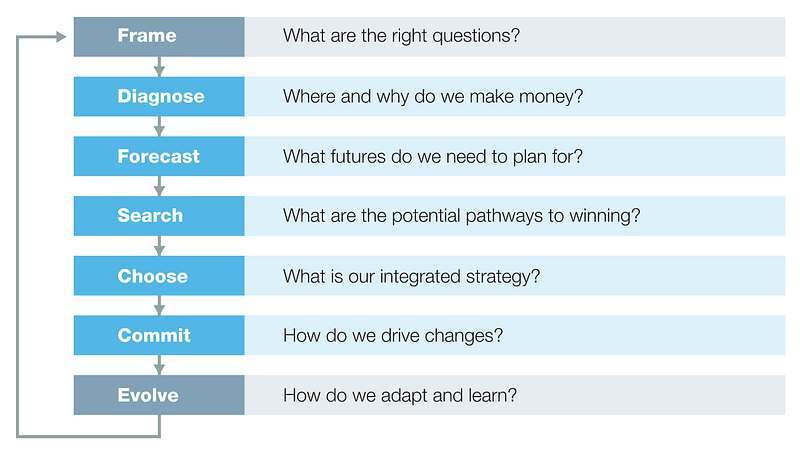
They will ensure alignment on key decisions and that the company is prepared and willing to act on the strategy adopted.
HBR’s Take on Strategy
Strategy is… 1. A plan to create value. 2. Choices to do some things and not others.
The Big I
Harvard Business Review (HBR) says strategy is about expanding the top side and the bottom side of the Big I:
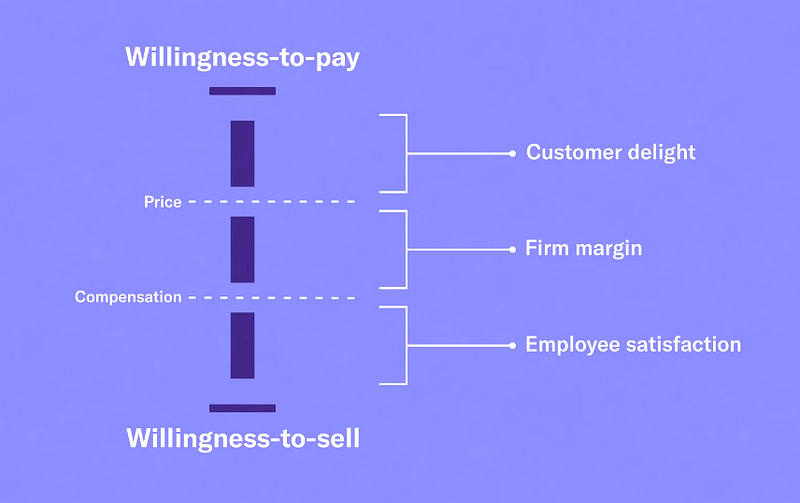
To capture additional value, a firm must either expand willingness to pay (raise the top bar) or expand willingness to sell (lower the bottom bar).
Ways to raise WTP
- improve product quality
- expand product complements (ex. printer + cartridges)
- build network effect
Ways to raise WTS
- make employees’ jobs better
- make suppliers’ lives easier
If the I is not expanded, value is merely shifted from the firm’s margin to their customers, their suppliers, or their staff.
Monitor Deloitte’s Take on Strategy
Strategy is… An integrated set of choices that positions the firm in its industry, to create sustainable advantage relative to competition and superior financial returns.
Deloitte’s Strategic Choice Cascade
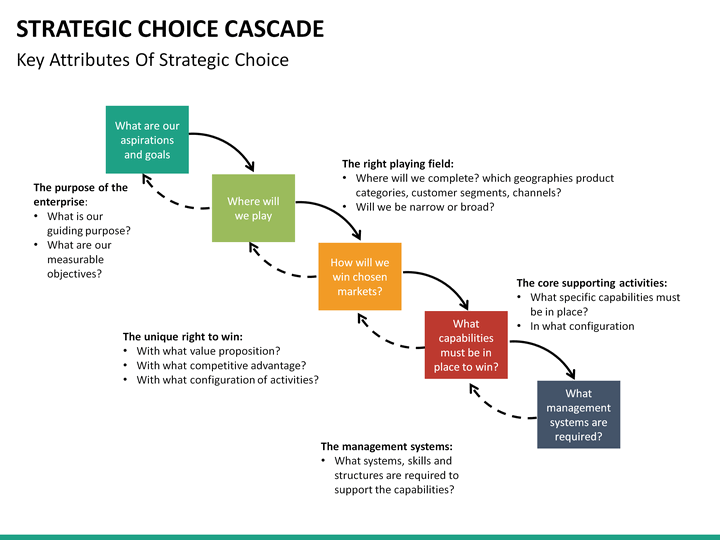
Their iterative “cascade” to strategy development has 5 steps:
- Define your purpose (goals & aspirations)
- Pick your market (where you’ll play)
- Determine how you’ll win in your chosen markets
- Understand how you need to configure (capabilities needed to win)
- Decide what you’ll invest in (to support the capabilities you need)
I hope these comprehensive frameworks gave you a good overview of what strategy is and how it’s developed in the business context.
Not a Medium member yet? Consider joining 60+ million active readers with unlimited access. I’ll receive a small fee at no added cost to you.
Click here:


