
How to Write SMART Goals for Performance Reviews
Turn work objectives into SMART Goals quickly

We’ve all heard of SMART goals and know we should set them for our team at Performance Review time, but do we do it?
Probably not.
Even though the importance of SMART goals is drummed into us regularly, more often than not, our work goals just aren’t that smart. Because setting SMART goals takes discipline. Employees at every level have asked me for help with SMART goals. And yes, that includes Managing Directors and CEOs.
And that’s OK. As an experienced L&D Manager, it’s my job to know how to set SMART goals.
But ask me to do an operational task I learned a year ago, and I’d struggle. And that is what we ask of you at Performance Review time. To do a task — set SMART goals — that you do infrequently.
Don’t beat yourself up if you struggle to remember all the ins and outs of SMART goals. But do make sure you have some reference material about SMART goals handy for when you need it.
Get your free SMART goal-setting template here.
SMART Goals Explained
So, what does SMART mean? Most people remember that S is for Specific, but that’s where it ends. Again, that’s OK.
As Albert Einstein said:
“I make it a rule not to clutter my mind with simple information I can find in a book in five minutes.”
Here is what SMART stands for:
S — Specific
M — Measurable
A — Attainable/Achievable
R — Relevant
T — Timebound
Let’s have a look at a simple personal example. Imagine your goal is to lose 20kg of weight. Your goal could be, “I want to lose 20kg”.
But that’s wishy-washy.
If we make your goal SMART, it would look like this:
“Over the next 12 months I will lose 20kg in weight. I will do this by following the points system created by Weight Watchers and using the Weight Watchers app to keep track of my daily points. I will weigh myself every day and record my weight on the Weight Watchers app. I aim to lose 20kg steadily over the next 12 months, which is 380 g per week. Every week, I will review what I have eaten, how many points I have used, and how much weight I have lost.”
Why is this goal SMART?
Firstly, it’s Specific — You will lose 20kg over 12 months by using the Weight Watchers points system and recording your points and weight daily. You will also do a weekly review to see how you are tracking.
It’s Measurable — You know how much you aim to lose and can track whether or not you’ve done it. You can measure whether you’re succeeding or not. Also, you can follow your points on the Weight Watchers app.
It’s Achievable — 20kg is a reasonable amount to lose in a year, and you don’t have any health issues that would stop you from dieting or exercising. You can afford the Weight Watchers app and access the food you need. You’re computer literate and can use the app.
Relevant — In a business context, relevant means does the goal feed into the organizational goals. In a personal context, losing weight may feed into a larger goal of improving your wellness.
Timebound — This goal is to lose a set weight (20kgs) in a set time (12 months). The goal is to lose weight consistently, so it will be easy to track weekly and monthly.
Making goals SMART forces us to think about details. What exactly do we want to achieve? What are the parameters? What are the timelines? What does success look like? How will we know if we are on track?
Identifying SMART goals for your team
Planning your team’s goals should be straightforward — it’s simply the work you want them to achieve over the next year.
Goals come from:
- Business as usual tasks (BAU)
- Unfinished projects from last year
- New initiatives or projects from the organizational strategy
- Changes or improvements to systems and processes in your team
Make a list of all the work your team must achieve over the next year and write them in your own words.
Now that you’ve collated all the team goals, it’s time to turn them into SMART goals…
How to make your goals SMART
I like to use a spreadsheet that breaks down each goal component to make it SMART.
- Column 1: The goal in your own words
- Column 2: The specifics of the goal
- Column 3: How you will measure the goal
- Column 4: The recourses that will make the goal attainable
- Column 5: The part of the organizational strategy that makes the goal relevant
- Column 6: The milestones of each goal and when the milestones are due
- Column 7: Which team member you will allocate the goal to
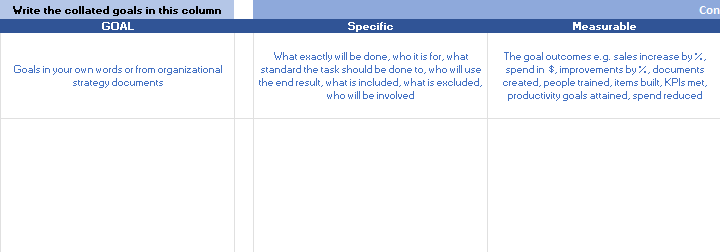
If you’d like a free copy of the SMART goal setting template above, click here.
Summary
Setting SMART goals is essential to provide a positive experience for your team at Performance Review time.
SMART goals provide clarity around goals so that you and your team members have the same understanding of what is expected, to what standard, and by when.
Once you’ve set the team goals, you can ensure your team is up to date by holding regular one-to-one meetings.
If you’d like your free SMART goal setting tool (shown above) click here.


