Tips to write content online
How to write on the Internet? Useful tips for beginners
Blogs, news stories, fan fiction, everything changes when you write it online

This is a different piece than what I usually draft online, I always write about stories, poems and literary pieces, so I thought let me share something useful with our medium folks. I have been writing content professionally for some time, especially web content and I can offer some of my insights that can help you write better for your blogs, personal websites and prominent online publications. The pattern and guidelines to write well on the Internet are a little bit different than in offline journals, newspapers and academic papers, this applies if you are not writing a thesis online, and the general content that we draft for the Internet. The writing process is a tad bit different and needs to be written to get more visibility by search engines.
A step-by-step guide to writing online content
When you draft online content you need to remember this 6-stop prolong process:
- Research the theme and topic.
- Prepare an outline of the article including markers of H1, H2, H3 and H4.
- Search for necessary keywords.
- See competition among top indexed websites on your keyword on Google and Bing, assess the topics covered and enhance your content.
- Start writing.
- Reread and make necessary changes to the topic by editing your first draft.
Voila! if you have attentively done all 6 steps there is no way your content won’t catch eyeballs, however, Rome was not built in a day, the content ranking also depends on other factors like Domain Authority, Internal and External Linking and similarity of subject matter to get a strong index rank. With time, patience and consistency it can take off easily.

1. Start with solid research
Research is often the backbone of what you write, you need to look for written pieces on the covered topic. Usually, the first 5 articles need to be opened in separate tabs and a brief read of all of them gives you an idea of how you need to move forward and what kind of research you need to do.
2. Create a rough outline of your piece
Once your research is complete, you need to have a specific outline in your mind and jot the structure down on a doc. The structure’s outline is the same which is the introduction, body and conclusion just as you write any normal article or essay. You need to have an introduction that catches the audience’s attention. In the body you need to be informative, the use of headings is a great essential pre-requisite in online writing. If you want to mention the steps in helping guides you need to use subheads, in the outline you can mark various headings as H1, H2, H3 and H4 respectively. H1 being the main title, H2 being the subheads or paragraph heads. H3 being the subparagraph heads. And if there are more divisions further you can include H4 as well. The conclusion should summarise the topic and your opinions or well-concerned assessment.
3. Search keywords for better SEO
What we had discussed until now was all in a similar linear progression which coincides with offline journalism, SEO changes that equation. ‘Search Engine Optimization’ or SEO is the process of making your website easily indexable in Google’s directory. Now, imagine Google is a public library and thousands or even millions of readers come to read something that they like, it helps them when the library guides them towards their book. For instance, if Angela wants to read a book on a ‘love story’, she needs to move into the ‘Literature’ section of the library or ‘Fiction’ to find a book of that sort, she will search for books based on genres. If the library is massive then she can even have a specialized book for ‘love story’ there.
In the same way, Google wants the reader to get the best quality information there is on any topic. So, Google uses common keywords or most searched sentences to display their results. If you rank high on Google’s search directory on a particular keyword or keyword sentence that means the entire world will find your piece at the top or in the top 10 depending on the rank Google allotted you on that keyword.
Performing SEO starts by looking for keywords on a topic. For instance, if you want to write something on ‘lemons’, you need to type in ‘lemon’ on the Google search bar. Google will auto-suggest many vogue topics choose one and see the relevant sentence keyword or any keyword that can be an article topic.
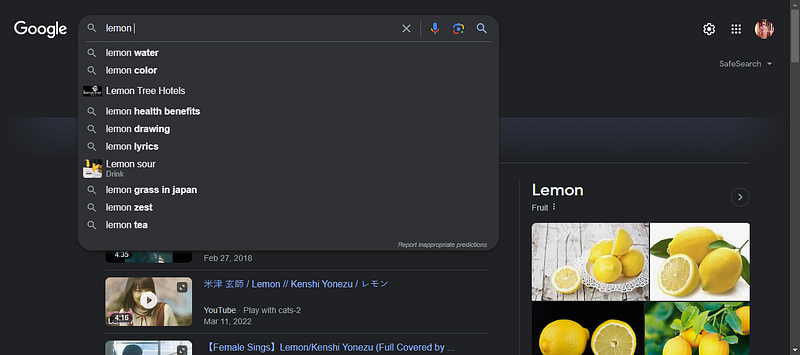
As suggested by the above image, from the above-mentioned results of lemon let me choose ‘lemon water’.
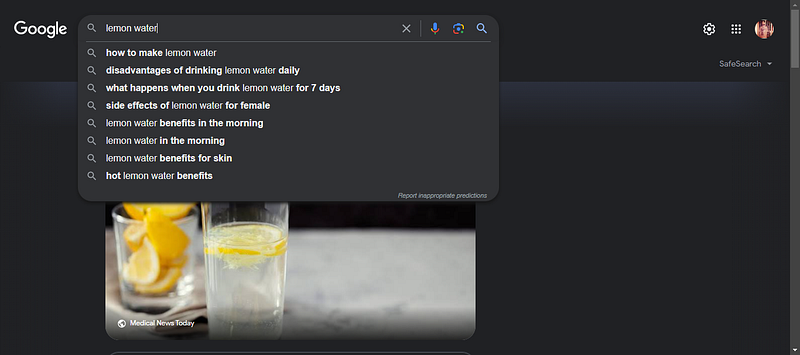
There are many sentence keywords available on this topic, so it's advised to use a topic that is fairly easy to rank, from this list let's choose “hot lemon water benefits” as it appears in the end indicating less competition. You can use free keyword tools like Uber suggest to see keyword volumes and asses the competition, but even this way it will work.
Look for relevant answer targets and add them as FAQs that bring a lot of traffic. Answer Targets are the snippets that Google helps someone with when they search for a topic. These can be also called common prompts for a given topic. This is done at the very last of your article but it's a common SEO booster.
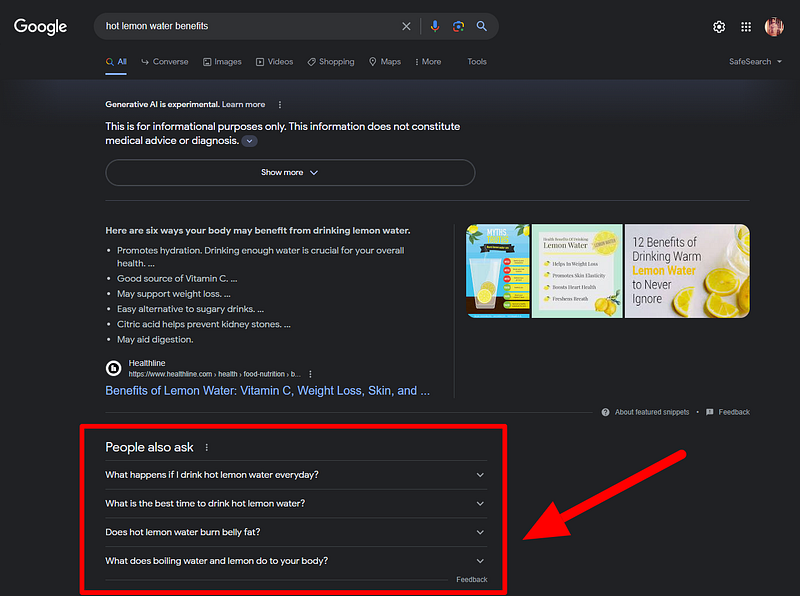
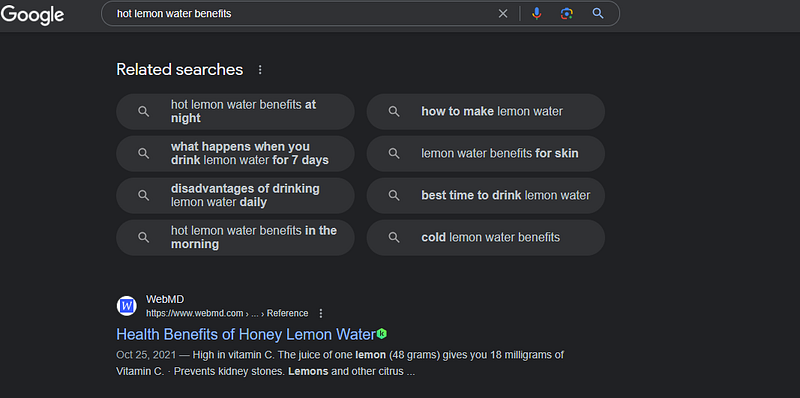
In the above image, you can see the kind of answer targets are there on the topic. You can use these as FAQs to get more visibility in query resolution. You can also create subheadings of what queries people are searching regarding the topic in the related searches section. You see related searches at the mid-section or the very bottom. Look at the below image to see some common related searches.
4. Assess similar articles
Before getting ready to write some awesome content you need to check out your competitors. Open the 1st 5–6 ranked pages in different tabs on your keyword sentence and check for the topic coverage they have done.
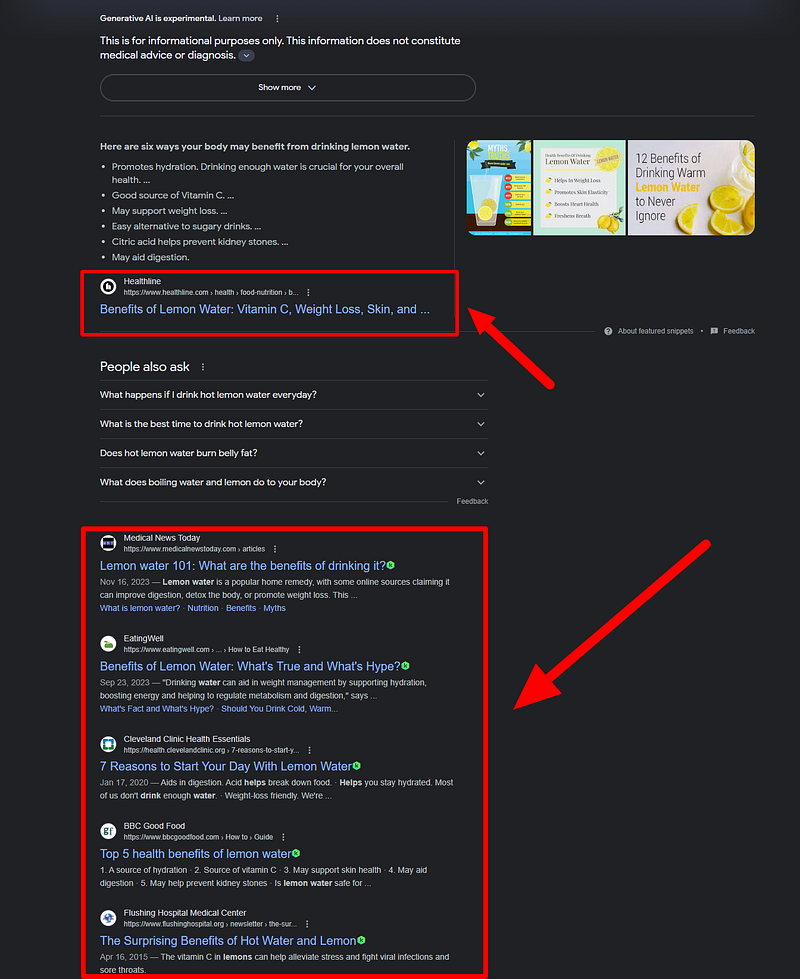
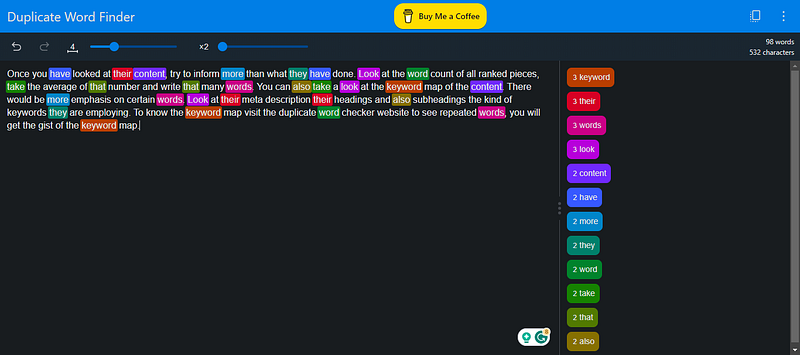
Once you have looked at their content, try to inform more than what they have done. Look at the word count of all ranked pieces, take the average of that number and write that many words. You can also take a look at the keyword map of the content. There would be more emphasis on certain words. Look at their meta description their headings and also subheadings the kind of keywords they are employing. To know the keyword map visit the duplicate word finder website to see repeated words, you will get the gist of the keyword map.
5. Start writing
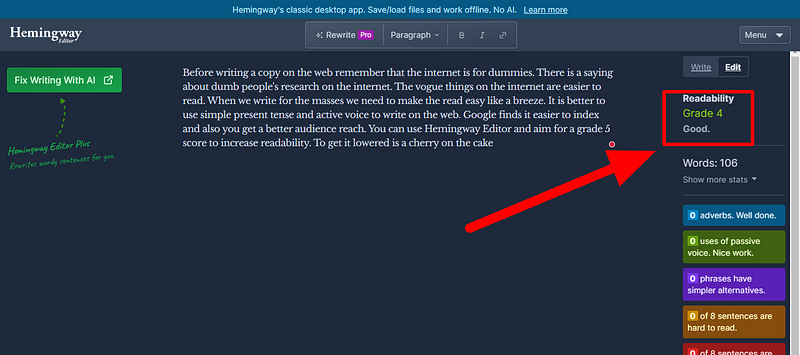
Before writing a copy on the web remember that the internet is for dummies. There is a saying about dumb people's research on the internet. Yes, the vogue things on the internet are easily readable, consumable and absorbable like a soaking sponge. When we write for the masses we need to make the reading easy like a breeze. It is advised to use simple present tense and active voice to write on the web. Google finds it easier to index and also you get a better audience reach. To check the readability aspect of your writing, you can copy your drafted piece to the Hemingway editor’s interface and make sure the article piece scores a Grade 5 score. To get it lowered is a cherry on the cake.
For instance, the above paragraph showed Grade 9 on the Hemingway editor, I made the read easier to bring the score to Grade 4.
6. Edit your piece
Editing is the manual routine work of your reads. It's time to get back to the basics and check for the flow, continuity and cohesion of your piece. Editing is all about concentration and attention to detail. I hate sitting at the Edit table as it feels like doing something technical where your logical mind needs to work more than your creative mind. Not only grammar errors which include just a section of your edit. You need to check paragraphs and other continuity in ideas. Do not write everything in 1 paragraph, divide your content into different paragraphs which is also the sentence keywords as para heads or headings.
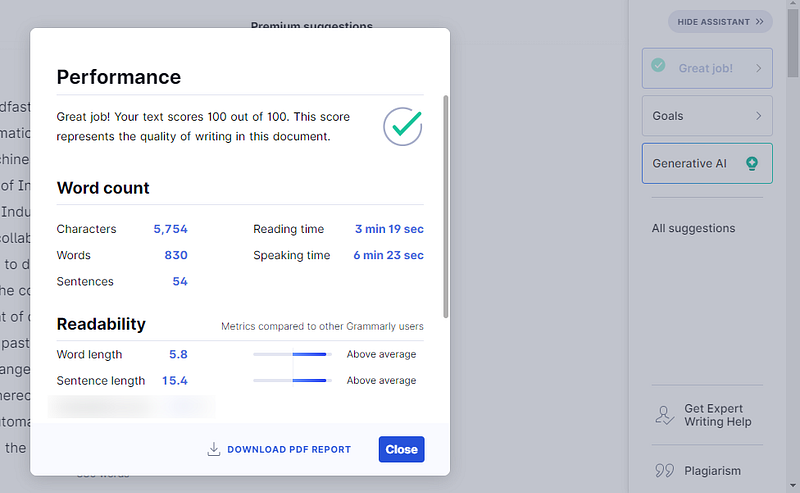
For Grammar correction, you can use Grammarly. For professional writing, it's advised to get the premium version to remove errors and make the writeup to the point and error-free. Grammarly is not 100% perfect but it is the best option to take care of grammar errors. Try to get a 100 score especially when you write for freelance paid work. If you do not have the premium version you can manually rephrase the yellow-marked sentences and get your score to a clean 100. I wrote a piece on ‘Machine Learning and Industrial Automation’ yesterday and manually removed the premium suggestions and scored a 100.
Competitiveness in content writing
Content writing today has become synonymous with web writing and it has been saturated when content quality and quantum are concerned. Don’t expect feasible results for your websites hosted on any webpage hosting platform instantaneously. Wait for at least 6 months to get Google to recognize your pieces and try sticking to 1 niche or a sub-niche. For instance, if you advise on ‘weight loss through lemons’ that will fall into the health niche. So, try sticking to that niche for the time being.
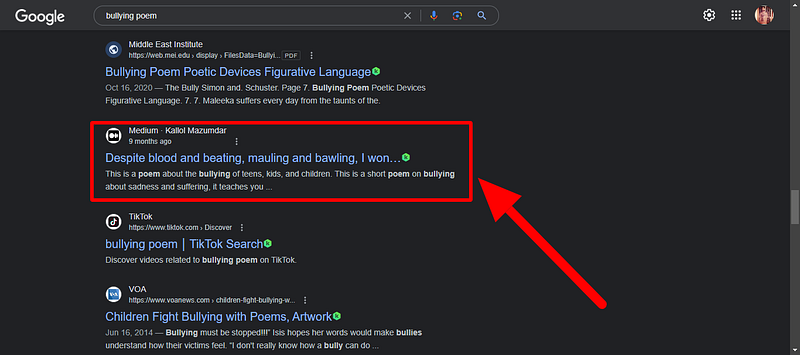
Other factors include Domain Authority back links and external links, Root domain rank etc. Writers on Medium have this advantage as the website’s domain medium.com has a strong DA automatically. Some of my Medium pieces got ranked initially during publishing. I don’t remember exactly but under the moderate keyword ‘bullying poem’ my piece appears on the 1st page.
Conclusion
Through this piece, I intended to share with my readers some insights and nuanced information on content writing on the web. I have listed the step-by-step process to initiate writing and also elaborated on each step. Hope you liked this piece!
Hello everyone! Hope you all are doing alright. The Medium Partner Programme will take some time to be launched in my demography. If you can and are willing to, do consider sending me a tip; any amount is appreciated; it just helps me keep my motivation intact to write better and think better, form ideas better. You can also support me by buying me a book out here. Irrespective of the assistance, Thanks regardless for reading my piece!
Thanks a lot for taking some precious time out of your schedule to read my work. If you like it, you can read some of the other writeups I have linked below. You can also subscribe to my newsletter in case you want updates on my new posts. I hope you have a great day! Thanks for stopping by!!!