
How to Write More Effective and Successful Blog Posts on Medium
Do you need a Medium checklist?
As a full-time writer who’s mostly on Medium, I don’t have a ton of side gigs. This is a personal preference as an Aspie single working mom who isn’t the greatest juggler of tasks.
Among my shortlist of side gigs, I lead two blogging workshops each week over video chat. This is something that I have really grown to enjoy despite all of my shyness, awkwardness, and introversion. It’s great working with writers of all backgrounds and stages to help make their stories better before they hit Publish. Or after, if they’re doing a full rewrite.
Recently, one of the writers in my workshop requested a Medium Checklist, and I have to admit that it’s something I have never even thought about doing. Which is a little bit ironic because I am big on checklists for pretty much everything else in my life.
But that’s one of the most valuable things about writing workshops. They help everyone (including the mentors) look at their work through new eyes.
If I was teaching a “Success on Medium” class, this is the checklist I would use for writers who worry about missing a step on any given piece.
Checklist for Success on Medium
Does your story have a clear point or message?
Nine times out of ten, a successful Medium story makes a clear point. There’s a beginning and an end. The reader doesn’t have to wonder what the writer was trying to say because they know. The writer was clear.
In the world of blogging and online writing, most stories need to be direct. Yes, there are exceptions. There will always be exceptions, just like there will always be unicorn writers who have a certain sort of magic that the rest of us lack. You don’t need to sweat it when another writer succeeds at being indirect on Medium.
But the first rule to fully understand before you ever decide to break it is this one: Say something, and say it clearly.
Is there a takeaway for the reader?
Many, if not most stories on Medium will need a solid takeaway for the reader. If you’re writing an informational or educational piece, the takeaway is typically whatever research you cover within the body of the post.
If your story happens to be more personal, you might need to be more creative. Most folks can’t get away with blogging about their everyday lives unless they attach some sort of takeaway that adds value for the reader.
That takeaway might be very simple, like the message that the reader isn’t alone in their struggles. It might be more practical, as with a lot of life lessons or advice stories. And it might be more direct, as with any how-to story.
At a bare minimum, good stories should inform, educate, or entertain.
If you happen to be a more humorous writer, you may not need a takeaway at all. But it should certainly be entertaining.
Have you read the story out loud?
When Shaunta Grimes and I lead blogging workshops, we have the writers read their own stories out loud in front of the group as we all read along. It’s amazing how many issues can be resolved by simply reading your piece out loud.
When you read a story out loud, it’s easier to hear the clunky and awkward phrases. You’re more likely to notice those spots that sound confusing or require more explanation, plus the little places that drag or would do better with some sort of pause.
Reading your work out loud is among the best ways to test your pacing and your voice.
Have you given your piece an appropriate title-case headline?
Headlines are hard for many writers, so please don’t feel bad if headlines are tough for you. The main thing to remember about headlines for Medium is that they are headlines on Medium.
Crafting headlines for this platform isn’t like creating a book title or even a magazine headline elsewhere. In most cases, you need to be direct, and even a tad boring.
The point of a headline on Medium is to get readers to click on your story by telling them what it is about. A big caveat, however, is that your title should not be clickbait. Remember, clickbait titles fail to deliver on their promise.
You want to ask yourself if your headline is going to be a letdown for your readers. The headline ought to tell readers what your story is about. It’s often a letdown when that doesn’t happen.
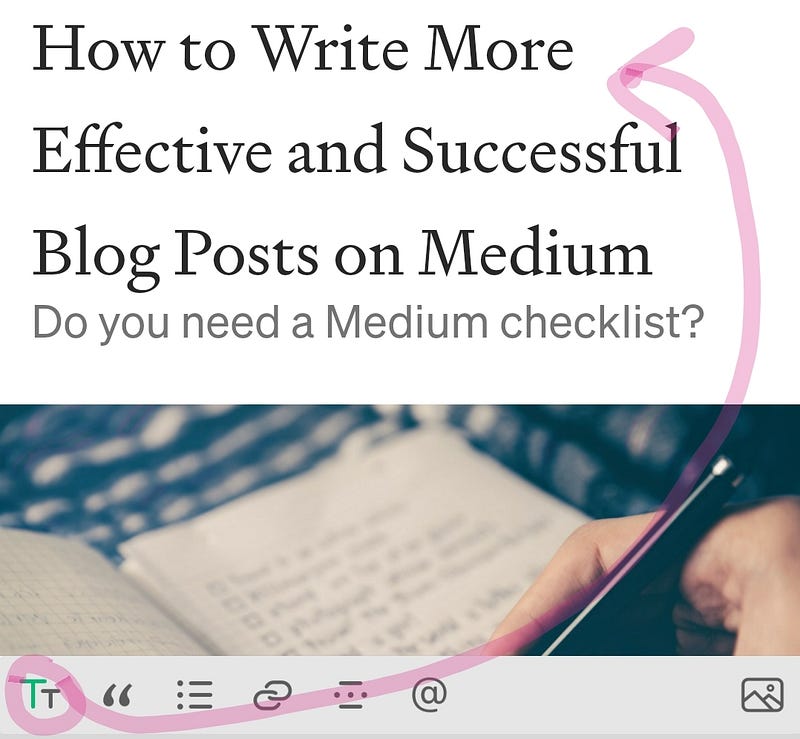
On Medium, your headline should be presented in title case, which means most words are capitalized. You also need to format that headline properly. The headline comes first unless you’re using a kicker, and the headline needs to be formatted with the big T.
Did you add a sentence-case subtitle?
First of all, your subtitle is an opportunity to further explain your story and set the tone for your reader. But there’s no one way to do a subtitle right since it can serve so many different purposes.
I often tell folks to reverse their headlines and subtitles simply because they tried too hard to be clever first and then told us what the story was about in their subtitle. Which is to say, you frequently have more leeway to be creative in your subtitle than your actual headline.
Most words in your headline should be capitalized. The first word should be capitalized in your subtitle. It’s a style choice whether or not you use punctuation in your subtitle. I typically do, but many publications will remove the period. Personally, I don’t sweat that piece.
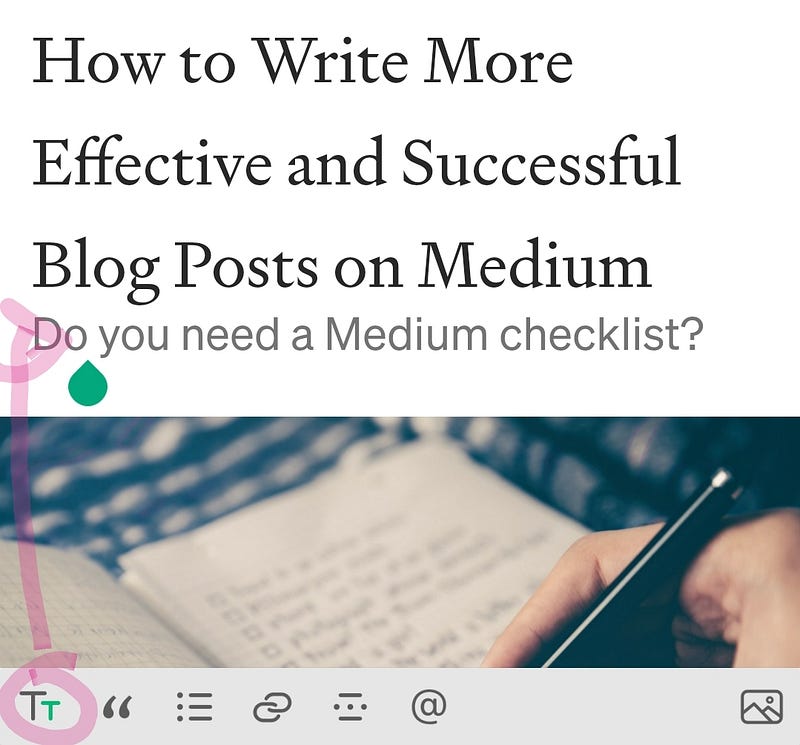
Keep in mind, however, that your subtitle should be formatted correctly. I don’t know why, but this is among the most common errors we see in our blogging on Medium workshops. Most often, folks forget to use the little T.
So, your subtitle should look like this:
But when folks forget to use the little T in their draft, it looks like this:
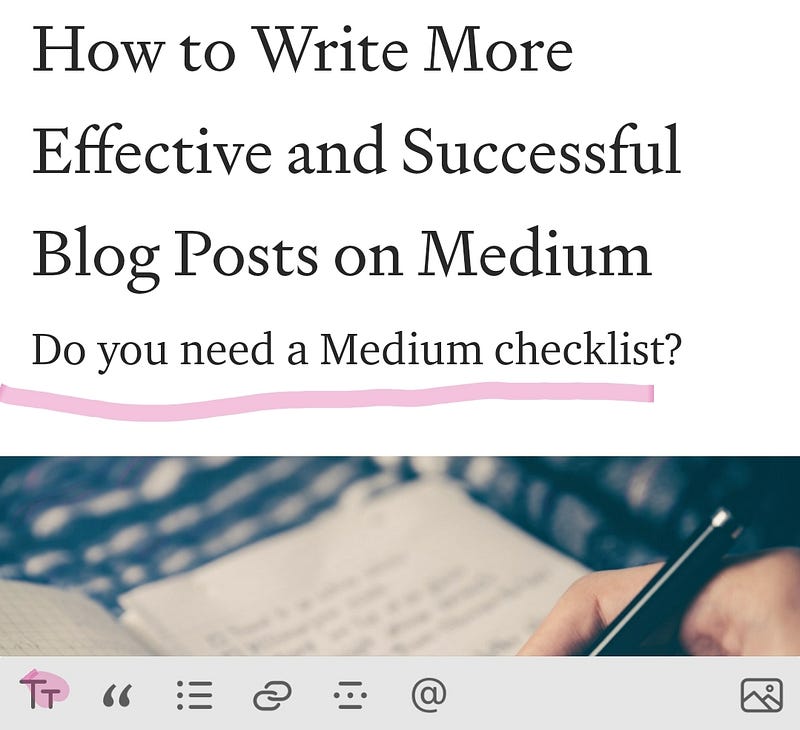
It just looks like regular text. The real problem is that when you publish the story, your subtitle will show up in the wrong spot. Instead of neatly resting beneath your headline, it will look like an extraneous opening sentence in your story after (below) your byline.
Do you have a properly cited image?
This is another common user error among newish writers on Medium. Some folks fail to use an image at all, which is a damn shame because the picture is intended to help draw the reader's eye to your story, and to once again set the tone. If they use an appropriate image, it’s also common to forget to credit it and indicate that they have the rights to its use.
Now, when it comes to finding the right image, obvious isn’t always best. Sometimes the obvious images come across as juvenile or goofy. A little too on the nose. Instead, consider choosing an image that evokes the mood of your story without sending the completely wrong message.
I’d also suggest that you keep your eyes peeled for popular images on Medium and try to avoid using the same ones that you keep seeing on the platform. You could unintentionally push readers away from your story just because they’re so sick of that image or they think they know what your story is all about.
Ultimately, your cover image should be cited to indicate that you really do have permission to use it. If it’s your picture, say so. You can simply write “Author’s image,” “Photo by author,” etc. If it’s from a friend and not on a site like Unsplash, you can say something like “Used with permission from so-and-so.”
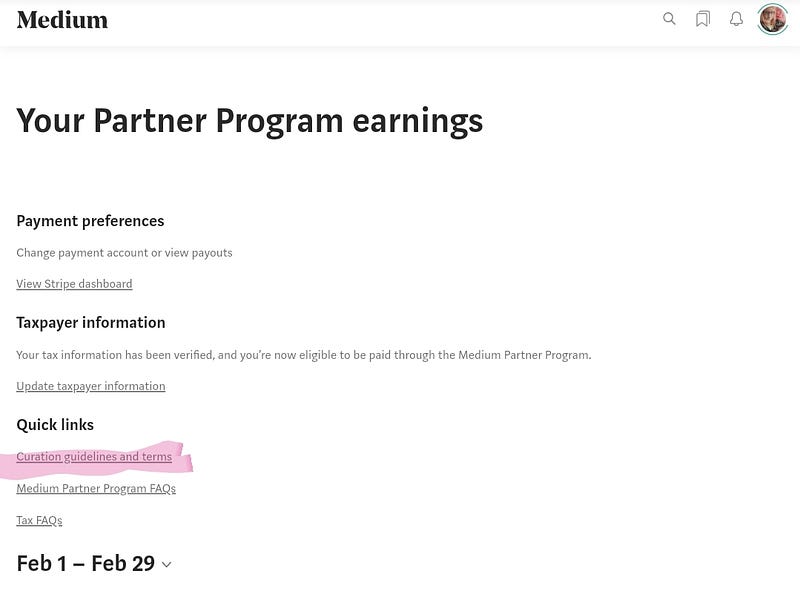
Have you checked the curation guidelines?
Part of the learning curve here on Medium involves getting to know the rules and regulations. No, curation isn’t your golden ticket to earning big bucks on Medium. But it’s going to be very challenging to do well without curation unless you are driving some serious traffic to your stories all by yourself.
Do yourself a favor and check the curation guidelines periodically. They’re easy to find: Just go into your Medium Partner Program dashboard and there’s a link toward the top, before you see your earnings.
Did you run the story through a grammar and spelling program like Grammarly?
Some folks swear by the Hemingway editor. I don’t. For me, I’ve found that too much of my voice seems to get lost and I wind up second-guessing everything.
Instead, Grammarly is much more my speed. And no, they don’t own your work if you drop your writing into their website.
Let’s be honest. Grammarly may not catch absolutely every error, but it will catch a lot of them. It’s worth using to save some trouble and avoid a silly typo.
Has it been peer-reviewed?
Back in the day, a lot of writers on Medium used to email the support inbox to get a second look at their stories that had been passed for curation. That inbox no longer accepts curation inquires, but among the more common responses Medium Support gave was that writers should have their stories peer-reviewed before publishing.
It’s one thing to throw your draft link out for some fellow writers to critique. That’s certainly one effective way to get feedback. But I find it even more effective to workshop your draft. Reading it out loud with a group of people and discussing it together brings up so much more information than having it looked over from a distance.
Part of what makes our workshops so effective is that Shaunta and I facilitate the sessions to teach the participants how to critique a blog post. And it’s always exciting to see when folks make connections on their own because they’ve truly learned something through their workshop experiences.
At the end of the day, Medium is right. Peer reviews work.
Is the body of the post formatted for reading on Medium?
Unless you know your piece is going into a specific Medium-owned publication like Human Parts (where they have their own editing style), it’s important to format the body of your post in a deliberate way. For the most part, you need to keep in mind that many Medium users are reading from mobile devices, and they’re likely on the go.
Online readers have a tendency to skip big walls of text or only catch bits and pieces as they skim through a story. Good writing is rarely enough to keep your reader interested today.
You’ve also got to format it in a way that’s easier on the eye.
Usually, this means shorter paragraphs and fewer spindly sentences. Don’t be afraid to use page breaks, subheadings, and plenty of white space to encourage your readers to slow down and pause at the right points.
I am notorious for one-line paragraphs to add impact and necessary pauses.
That’s because it works.
Are you going to add the piece to a publication?
As you’re polishing off your draft, it’s time to think about publications, if you haven’t done so already.
Every writer on Medium has a different strategy about publications and I don’t believe there’s any right way. The reality is that some publications may work better for you than others. And some publications might feel like perpetual flops.
Your journey isn’t going to be the same as any other writer’s. You’ve got to own that and figure out what works best for you.
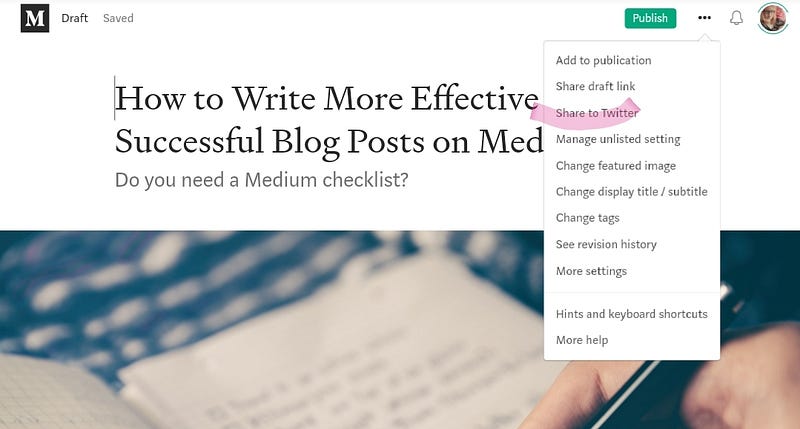
Will you share it on Twitter?
In case you missed it, Medium gives you the opportunity to automatically share your story to Twitter upon publishing. Click the three dots that appear next to the Publish button, and select “share to Twitter.” Do this step after submitting a story to a publication if it’s an unpublished draft.
If you’re publishing the story without a publication, select the Twitter feature before you publish the story.
Is it effectively tagged with five tags?
Medium gives you up to five tags per story and my recommendation is to always use all five.
In most cases, you want to tag your stories with the tags more people care about. A tag like pets will go further for you than a tag like gerbils.
It really only makes sense to use niche tags if you’re categorizing stories for a certain publication, or if you know you’re going to use that tag often.
Otherwise, I’d say stick to the big tags that best match your story.
How will you promote your story after publication?
Shaunta Grimes is the queen of reaching out to her email list. She directs a ton of her own traffic to her posts on Medium. Tara Blair Ball has built a great brand for herself on Instagram. I love seeing what she’s doing with her account through eye-catching or thought-provoking quotes and images.
I will be the first to admit that I am one of those writers with every good intention to market myself better, but I suck at the follow-through. For somebody with a background in social media marketing, I am routinely dropping the ball.
That said, after you publish a story, your work isn’t necessarily done. You have to decide how you will market your piece. Will you send out a newsletter or post your links to a Facebook author page? Will you head over to Instagram? I am convinced that you’ll do yourself a big favor to figure out the marketing piece sooner rather than later.
Make it a habit to market your work from the get-go and you likely won’t be such a slob about it like me. Seriously, guys. To this day, I am all over the place on this one.
Is there another story you ought to write after this one?
People often ask me how I write so much. I’ve been on Medium since April 25, 2018, and I quickly became a daily publisher. I do occasionally miss a day, but it’s extremely rare.
It’s not as if I never get stuck in my writing process, because I do. But I’ve learned how to move forward through most any writer’s predicament. What’s helped me the most is to keep moving forward, as in to keep writing. It helps to look at whatever you just published and then jot down several other parallel story ideas.
Even if you aren’t ready to tackle those side pieces today, they might be good for you to touch upon next week, next month, next year.
How will you manage the comments?
I want to be very clear. If you don’t interact in your comment sections on Medium, you will very likely piss off some readers. Medium is something like a social media platform in that respect. People do expect community.
I’ve been very vocal in the past, however, that I’ve decided to quit worrying about the comments. There were many reasons for this, but the two longstanding issues are that the comments can become a serious drain on my mental health and I’m a single working mother (so, time is at a premium).
You have to decide for yourself how to handle the comments you receive on your stories. Ultimately, I suggest you make some sort of plan and then periodically revisit it. If you have no plan, you may very well drown in frustration, guilt, or self-loathing.
Do you need to look at your stats?
Many Medium writers find themselves obsessed with their story stats. They wind up mindlessly checking their stats page throughout the day, hoping for a sudden spike in traffic.
The funny thing about constantly checking your stats is that there’s always something more effective that you could be doing. Like, ahem, writing. Nobody really needs to check their stats more than once a day, and less often is probably more beneficial.
Your stats are most beneficial from a long-game view. It helps to understand which stories seem to resonate most with your readers over time. And it’s important to understand that Medium often changes the algorithms and how it distributes your stories. It’s all subject to change, but if you’ve got a high-level view of your stats, you can better adapt to those changes.
I quit my social media job in December 2018 to take Medium full-time. I’ve had my highs and lows but I’ve never regretted my choice to go all-in on the platform. Last month, I wrote about how I was still struggling to find my footing with the changes under the new earnings system. I was still earning a full-time income, but it wasn't as good, and I had a genuine fear that my numbers were going to keep going down as the months passed by.
Within a week or two of opening up about those fears, a few of my stories in my own publications picked up significant traction, and January wound up becoming one of my best months on Medium. I never could have predicted what would happen, but it also wouldn’t have happened if I wasn’t focused on moving forward.
This checklist is my most basic, “rules of the road” method for writing successfully on Medium. And I really believe it will help you move forward too.
You can go through the checklist for your next few stories on Medium and see how it helps you. Here’s a quick recap:
□ Does your story have a clear point or message?
□ Is there a takeaway for the reader?
□ Have you read the story out loud?
□ Have you given your piece an appropriate title-case headline?
□ Did you add a sentence-case subtitle?
□ Do you have a properly cited image?
□ Have you checked the curation guidelines?
□ Did you run the story through a grammar and spelling program like Grammarly?
□ Has it been peer-reviewed?
□ Is the body of the post formatted for reading on Medium?
□ Are you going to add the piece to a publication?
□ Will you share it on Twitter?
□ Is it effectively tagged with five tags?
□ How will you promote your story after publication?
□ Is there another story you ought to write after this one?
□ How will you manage the comments?
□ Do you need to look at your stats?
Happy blogging, friends!