
How to Write a Whole Book in Two Weeks
Redefine the scope, and stagger your outlining

It’s a bucket list item for eight out of every 10 people…
But still, some people will never write a book. The problem isn’t that they don’t have anything to write about. Even the most average individual has a story to tell.
No, people don’t write a book because they don’t have a plan for doing so.
What if writing a book didn’t have to be a massive chore, though? A concrete plan can move this particular project from the “one-day” column to “right now.” Since you’re likely spending more time indoors than usual, there is no time like the present to make this dream a reality. It’s possible to put together a whole book in just two week’s time.
For the sake of this example, let’s pretend you’re writing a nonfiction book based on either your knowledge or your experiences. I find this is the best path for new writers.
(Otherwise, you’ll spend the first eight days trying to decide what you should name your main character.)
1. Redefine Your Concept of a “Book”
If so many people think they can write a book, why don’t more people actually do it?
One reason — writing a book feels like it should take forever. Tell me you haven’t had an experience of holding a book that’s heavy as a brick and thinking, “Geez. How long did it take to put this together?”
Most publishers will suggest your book be at least 50,000 words. This leads to inflated chapters and redundant case studies. I won’t say the name, but one popular blogger published a book with the words, “My editor made me add these chapters.”
Silly.
Books can be short. This is not my opinion. Amazon’s Kindle store has entire categories dedicated to books that only take 15, 30, or 60 minutes to read.
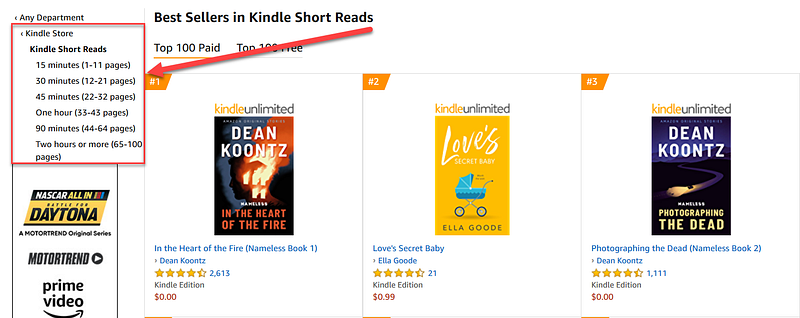
For the sake of your two-week project, aim for 15,000 words in 14 days. Each chapter will be 1,000 words.
The average person types 40 words a minute. Even if you are only able to write one hour per day, you can probably hit this goal. Any more is icing on the cake.
2. Day 1: Write 2,000 Words
“But, Todd, shouldn’t I make a plan first?”
No.
If you could plan your way to a book, you would have written one already.
The second reason more people don’t write books is because they never actually start typing. They never engage their emotions. They don’t find momentum. Writing, like everything, is a head game. In order to write, it helps to feel like a writer.
You’re still reading this. That means you probably already believe you have something to write about. Do me a favor: stop planning. Sprint as fast as you can away from the threat of the blank page. In our example, 2,000 words is two separate chapters. On most word documents, that’s less than 10 pages. You can write 10 pages.
Do not waste time choosing a writing software, a font, or a name for your book. Do not right-click those miserable red squiggly lines.
Get to 2,000 words as fast as you possibly can. Take advantage of the energy you have while you have it.
A rocket needs a lot of fuel to get off the ground.
3. Day 2: Write an Outline
Before, you had a dream… now, you have words.
Incredible!
There’s a problem, though. Words get unruly. Left unchecked, you’ll have a collection of paragraphs, not a book. Emotion gets you off the blocks. Outlines keep you in the lines.
Outlines can get complicated. In fact, I have a whole course dedicated to crafting the perfect outline. Since you’re writing a book in 14 days, though, you don’t need anything close to complicated. Your outline for this project should be only 15 bullet points. Each will have the title of a potential chapter. You can think of 15 topics. If you wrote 2,000 words on day one, two of those topics are already finished!
Don’t spend any more than 30 minutes on this outline.
4. Day 2–8: Write 1,000 Words Every Day
As the author, or ghostwriter, of four books, 1,000 words doesn’t seem hard. But I remember when it felt impossible. Here are a few thoughts on keeping momentum.
First, remember your only goal is to write 15,000 words. Your goal is not to rigidly follow the outline you just wrote. Many good ideas weren’t initially planned for. When you feel the tug of a potential new idea, follow it.
Second, combine your writing with creative triggers. A creative trigger is any stimulus to your senses paired with your creative work. Once these triggers become familiar, they will help you get in the writing mood all by themselves. I explore creative triggers a little more in my first book, but here are some ideas to get you started.
Pick one or two of the following and use them every time you write. The goal is to couple the sensation of these triggers with the act of writing.
Smell triggers:
- Tea or coffee
- Candles (grab a Woodwick for the double sensory effect)
- Air fresheners or plugins
- An open window (inconsistent, but can be effective)
Sight triggers:
- A single room dedicated to writing
- The last sentence you wrote the day before
- Your perfectly arranged desk
Touch/feel triggers:
- Your writing chair
- A space heater for your fingers
- Your favorite pen tucked behind your ears
- Lotion on your hands
Taste triggers:
- A specific kind of gum
- Wine or beer (can also help quiet that inner editor)
- Tea or coffee (again)
Sound triggers:
This might be the easiest one. Google “writing playlist.” You’ll likely find an infinite amount of two or three-hour tracks on YouTube. Listen to the same one every time. Here’s my favorite.
One final tip: If you feel yourself stumped on one section, check your outline and move to another one. Readers have to go from beginning to end. Writers don’t. Build momentum by writing what comes most easily.
5. Day 8: Re-Write Your Outline
An outline serves two real purposes: reminding you what you’ve done and telling you what to do next.
Unless you are a machine, some of your paragraphs will have wandered off track. They won’t follow the outline. This is fine. Tangents are a natural consequence of speed. Don’t adjust your manuscripts. Instead, re-write the outline to match what you have.
Just like your book, an outline can be fluid. Look over it once more. Are there any bullet points you haven’t written fully yet? Are there any gaps in your ideas or story? What do you need to spend more time on?
Creative work is a series of unchecked creation and then strict reorganization. Make time for both.
6. Day 9–14: Write 1,000 More Words Every Day
There’s not much more I can say about getting through the last part of your book.
Finish the job.
You can do it.
Writing a book doesn’t have to be daunting. In fact, it can be downright reasonable, especially if you break the work down. Once more, here’s the path to a complete book in 14 days.
- Write 2,000 words on the first day
- Create a 15-bullet outline to help guide you
- Write 1,000 words on days 2–8
- Re-write the outline to help guide you forward
- Write 1,000 words on days 9–14
In life, many things are out of your control. Writing is the easiest way to take it back. Writing keeps you hopeful.
You’ve put off writing a book for far too long. Now, in the span of two short weeks, you’ll be able to check off that bucket item list and claim, “I am an author.”
It’s time to make it happen.


