
How To Write A Story That Works
Comparing The Story Grid and Save the Cat
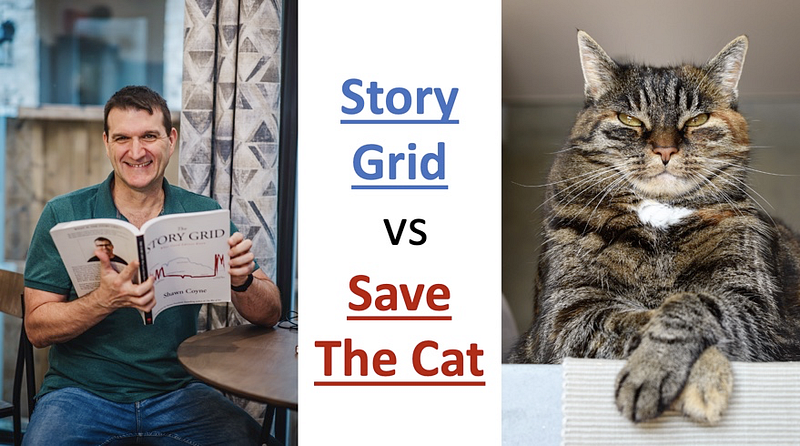
I read The Story Grid: What Good Editors Know by Shawn Coyne about five years ago while pushing through my creating writing thesis for my MFA. It really changed the way I thought about how stories were constructed, and I never watched a movie or television series again in the same way. A couple of years later, I read Save the Cat Writes a Novel: The Last Book on Novel Writing You’ll Ever Need by Jessica Brody. It was all the rage among my writing peers, so I wanted to see if I was missing something. I found that the Cat brought some different techniques to the table which I began to incorporate into my own writing. As an editor, my author clients often ask which writing method I prefer. The truth is that while both methods have interesting differences, they are very similar overall.
First, let me address the elephant, or at least the large cat, in the room. Many writers (mostly pantsers) claim they use their own muse to write and that these methods are formulaic. That’s fine. I’m just here to say that whether you are a planner, a pantser, or a muser, I think it’s great that you’re putting words on the page. Still, you’ll undoubtedly start editing at some point, and that’s when you might need a process to help identify plot holes and strengthen scenes. If that is the case, then I think that either The Story Grid or Save the Cat might be of some assistance.
For the rest of this article, I’ll compare and contrast the two methods using three elements:
- General organization
- Genre Categories
- Core Scenes
General Organization of Both Methods
Both methods use a three-act organization. Story Grid has stated in their podcast and some of their articles on their website that they are breaking the three acts into quadrants (basically splitting the Middle Build into two parts to make four acts), and this will be added when the updated book is published. So, for the sake of this article, we’ll keep to their original three-act format.
Story Grid calls their Acts the Beginning Hook (about 25% of the total story), Middle Build (about 50%), and Ending Payoff (about 25%). Each act has five core scenes, for a total of fifteen.
Save the Cat breaks its three acts as follows: Act 1 (about 20%) Act 2 (about 60%), and Act 3 (about 20%). This system also breaks the acts into fifteen core scenes, but they are distributed differently: five in Act 1, seven in Act 2, and three in Act 3.
Genre in the Story Grid
Both methods divide stories into genres but use different classifications. Both methods also claim that when authors choose a specific genre for their stories, there is a list of specific elements that most stories in that genre contain to fulfill the reader’s expectations. However, the methods list different elements for each genre in their format.
The core of the Story Grid method is in the genre of the story. Story Grid divides all fiction stories into the following Genres: thriller, action, western, love, society, worldview, performance, horror, crime, war, status, and morality. I’m not going to explain the differences in this article, but there are tons of free information on the Story Grid webpage. The key thing to know about the Story Grid method is that all of the other aspects of the story depend on the story’s genre: Theme, Objects of Desire, Point of View, Obligatory Moments, and Conventions. This article will only cover the Obligatory Moments and Conventions of the plot as grounds for comparison with the Save the Cat method.
Once an author chooses their story’s genre, the Story Grid calls the list of genre-related specific elements Obligatory Moments and Conventions for that Genre.
For example, in the Crime Genre, stories will usually include the following:
Obligatory Moments for the Crime Genre:
- An Inciting Crime with victims
- A Speech in praise of the victim
- A point of discovering and understanding the antagonist’s MacGuffin
- Progressively more complicated clues
- Exposure of the criminal
- The villain is brought to justice or escapes justice
Conventions for the Crime Genre:
- A MacGuffin — the villain’s object of desire
- Investigative Red Herrings
- Making it personal between the villain and the protagonist
- A clock or countdown (a time constraint)
- Specific sub-genre conventions
These are the basic ingredients for a crime genre story in the Story Grid system.

Genre in Save the Cat
Save the Cat divides plots into the following genres: whydunit, rites of passage, institutionalized, superhero, dude with a problem, fool triumphant, buddy love, out of the bottle, golden fleece, and monster in the house. Like the Story Grid, the Save the Cat methodology teaches that almost all stories within a specific genre have certain repeating elements or conventions.
An example of the Save the Cat conventions for a whydunit genre story (equitable to a Story Grid Crime Genre) is as follows:
- A detective
- A secret
- A dark turn
These are the basic ingredients of the Save the Cat whydunit genre, but the book gives multiple examples and actually breaks down a bestselling book for each genre beat by beat.
The Story Grid core scenes
As we already mentioned, the Story Grid breaks the story into three acts of five parts each for a total of fifteen core scenes. The five parts of each scene are called the 5 Commandments of storytelling and include the following:
- Inciting Incident: This is the thing that knocks the world out of balance for your protagonist. It can be causal or coincidence.
- Turning Point: This is the thing that forces the protagonist out of their status quo and causes them to make a decision. This can be caused by a revelation or a character action.
- Crisis Question: This is the question the protagonist asks themself based on the Turning Point. This is defined as a best bad choice or a best good choice? The answer to this question will show the reader the character of your protagonist. It’s important to note that the stakes of the decision must be clear to the reader, and the stakes should be near equal for both decisions.
- Climax: This is the decision made by the protagonist.
- Resolution: This is the repercussions of the Protagonist’s decision.
Related to the 5 Commandments is the Global Value of the novel, which depends on the core emotion the reader will elicit from reading the novel. In a thriller or action genre novel, the reader wants to be thrilled and in fear for the protagonist’s life. The global values for types of stories are Life and Death. So, each of the core scenes of the story should revolve around the protagonist being close to dying or surviving.
The Story Grid book uses the thriller The Silence of the Lambs by Thomas Harris as an example, and I have an article that breaks Star Wars down into the 5 Commandments if you need more examples.
Save the Cat core scenes
When I reread the Save the Cat book, I was amazed to notice a ton of similarities between the two methodologies.
Act One has 5 core scenes (called beats):
- The opening image (1%) — This is a single scene that shows the protagonist at the beginning of his journey before his adventures change him. Think of Star Wars when Luke Skywalker is stuck on a farm on the desert planet looking at a space battle in the sky.
- Theme stated (5%) — Brody suggests that a character tell the protagonist how to solve all their problems at the beginning.
- Setup (1–10%) — This is pretty much the Inciting Incident in the Story Grid and the setup for the future payoffs of the novel.
- Catalyst (10%) — This is the same as the Turning Point in the Story Grid Method.
- Debate (10–20%) — This is equivalent to the Crisis and Climax of Act 1 in the Story Grid method.
Act Two has 7 core scenes:
- Break into 2 (20%) — This is the Resolution of Act 1 in the Story Grid method when the results of the protagonist’s climactic decision cause them to cross the threshold from the ordinary world into the extraordinary world.
- The B Story (22–25%) — Brody suggests that once the protagonist breaks into Act 2, they are in a new world with new friends and new enemies and new problems that will highlight the protagonist’s flaw. The B story should be the inverse of Act 1. This is the Inciting Incident of Act 2 in the Story Grid method.
- Fun and Games (20–50%) — these are the scenes that the reader is waiting for, what was promised on the inside cover of the novel (depending on genre).
- Midpoint (50%) — Brody describes this as the dynamic pivotal point of the novel where the stakes are raised.
- Bad Guys Close In (50–70%) — These are the most exciting scenes of the novel where the bad guys come back even stronger.
- All is Lost (75%) — This is the turning point where the Hero must change. This is also the turning point of Act 2 for the Story Grid.
- Dark Night of the Soul (75–80%) — This is the Crisis and Climax of Act 2 in the Story Grid method.
Act Three has 3 core scenes (actually 7 because she sneaks in a 5 part finale):
- Break into 3 (80%) — This is the resolution for Act 2 in the Story Grid, where the hero finally figures out how to fix things the right way.
- Finale (80–99%) — The protagonist resolves all their problems and finally learns the theme. This beat can be conducted in a 5 point finale structure:
- 1. Gather the Team.
- 2. Execute the Plan.
- 3. High Tower Surprise — The protagonist’s initial plan doesn’t work. This is the Story Grid Turning Point for Act 3 and also one of its obligatory moments.
- 4. Dig Deep Down — The protagonist has tried everything and now must dig deep to try something new. In Story Grid terms, this is the Crisis and Climax of Act 3.
- 5. Execution of the new plan — The protagonist triumphs. This is the Story Grid Resolution of Act 3 — the results of the protagonist’s decision.
- Final Image (99–100%) — This is the reader's final image of the protagonist, showing how the protagonist has changed and what he has learned on his journey.
And the winner is?
As you can see, there are a lot of similarities between the two methods. I’m sorry for the hard-core believers, but I believe they both have some merits. It couldn’t hurt to apply both methods to the massive task of writing a novel.
If you haven’t read one of these books, I would definitely recommend them. Both websites offer classes, free information, and examples of their methods. You can never learn too much about writing, so take what you can use and discard the rest.


