
How to Write a Great Opening Paragraph in 3 steps
Reader’s attention spans are short, so you need to provide them a reason to stick around

Bloggers in 2020 have to deal with two contradictory truths. Well researched and in-depth articles provide the most value to readers and a better user experience. At the same time, the attention span of the average reader has never been lower.
How can bloggers convince readers that their long-form article is worth the time commitment required to read the entire article?
If you want readers to read your long-form article, it’s essential that you nail your opening paragraphs. This can be done through a three-step process.
- Set up the problem or issue your article will discuss.
- Provide immediate value to the reader by answering their main question.
- Make it crystal clear what they should expect if they choose to read the whole article.
In this article, I am going to review each of these three steps in detail and provide a few examples of how I structure the opening paragraphs on my long-form articles.
The two things you need to do before writing your opening paragraphs
If you have written a long-form article and you want people to read until the end, the first objective is to get them to click on your article in the first place.
That means your first step should be to focus on two things.
- Writing a compelling headline.
- Choosing an engaging cover image.
A good headline should provide a promise to the reader. For example, the title of this article is “how to write a great opening paragraph.”
That headline provides a clear promise to you as the reader that if you click on this article, you’ll learn how to write a great opening paragraph of a blog post.
Don’t be overly sensational or clickbaity with your headline. Advertise how the reader will benefit if they click on your article and be prepared to follow through with your content.
Another way to grab the reader’s attention is to use a cover image that will catch their eye.
There are many sites where you can get access to royalty-free stock images.
Here are a few that I use frequently.
Now, onto the three-step formula for writing great introductory paragraphs to your article.
Step 1: Set up the problem or issue your article will discuss
You only get one chance to make an excellent first impression. If someone reads the first few sentences of your article and they aren’t impressed, they will probably stop reading.
For every article I write, I use the first two to three sentences to set up the issue or problem that I will address in the article.
Take the first three sentences of this article as an example.
Bloggers in 2020 have to deal with two contradictory truths. Well researched and in-depth articles provide the most value to readers and a better user experience. At the same time, the attention span of the average reader has never been lower.
This short paragraph sets up the problem that this article will help solve; The difficulty of getting readers with short attention spans to stick around and read your long-form writing.
If you are a blogger who writes long-form articles, this is a problem that is very relevant to you, so you are likely to keep reading.
Step 2: Provide immediate value to the reader by answering their main question
Do you know what annoys me as a reader? When I click on an article looking for a particular piece of information, and I have to spend two minutes scrolling through the article to get the information I came for.
Anyone who has googled a cooking recipe knows what I am talking about.
I recently Googled “Instapot chili recipe.” What I wanted was simple ingredients and instructions on how to make chili in my Instapot.
Here is what I had to scroll through before I got to the recipe.
- The history lesson on chili in Western society.
- Six different ads.
- Three different pop-ups asking to join a newsletter.
- A list of reasons I will enjoy the chili I am about to make.
- Other recipes I might enjoy.
Put simply; it was a terrible user experience. It was clear that their main objective was not to help me make chili but to cram ads and keywords into an article so that they could maximize the money they make from the article.
I am all for writers monetizing their work. I mean, this publication is called “Writing For-Profits.” But I firmly believe the best way to build a sustainable brand is to focus on user experience first and worry about monetization later.
If you write great content, monetization will be a breeze.
So, focus on the reader and provide them the Too Long Didn’t Read (TLDR) answer to their question in the second paragraph.
Using this article as an example again, here is my second paragraph, where I give a very brief explanation of what I discuss in this article.
If you want readers to read your long-form article it’s essential that you nail your opening paragraphs. This can be done through a three-step process.
- Set up the problem or issue your article will discuss.
- Provide immediate value to the reader by answering their main question.
- Make it crystal clear what they should expect if they choose to read the whole article.
The three bullet points above are a quick summary of the conclusions I layout in this article. I also like to put this TLDR answer paragraph in bold so that it is hard for the reader to miss.
If I were writing an article about how to make chili in an Instapot, this is where I would write out the bullet point instructions and put it in bold.
Step 3: Make it crystal clear what they should expect if they choose to read the whole article
The reason many writers don’t provide value in the opening paragraphs of their articles is that they are worried that readers will get the information they came for and leave.
Which is a possibility. If you provide the TLDR answer right off the bat, some readers will leave if that was all they were looking for.
If that happens, it’s because you were able to help your reader in a very efficient way. This means they are more likely to click on your next article because you were so helpful the last time.
However, you can use the next two or three sentences after the TLDR answer to give the reader a reason to stick around and keep reading.
With the article you are currently reading, here is how I followed up the TLDR answer paragraph
In this article, I am going to review each of these three steps in detail and provide a few examples of how I structure the opening paragraphs on my long-form articles.
This set’s the expectation of what the reader should expect if they continue reading; more detail and examples that will teach them how to write their opening paragraphs.
An example of how I structure my opening paragraphs
Here is another example of the three steps to write compelling opening paragraphs. This is from an article I wrote about saving for a child’s education.
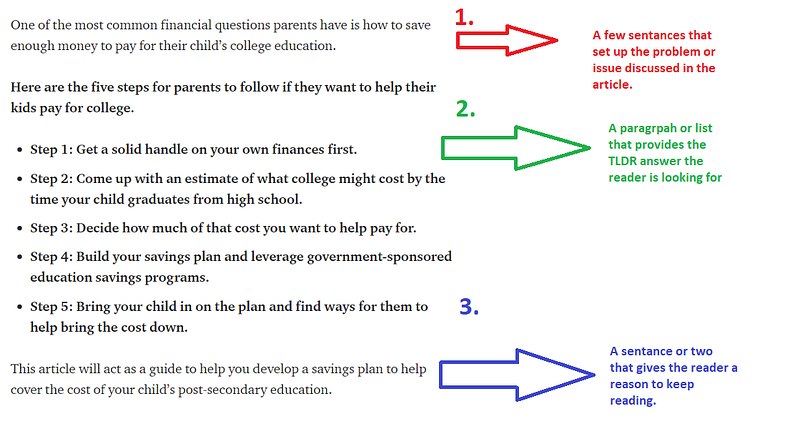
- A few sentences that set up the problem or issue discussed in the article. In this case, how parents can go about saving for their child’s future education costs.
- The TLDR answer, in bold. In this case, the fives steps parents can take to build a college savings plan for their child/
- Give the reader a reason to keep reading. In this case, if they want to learn the “how-to” of the TLDR answer, they will keep reading.
I use this formula at the beginning of every article I write
The three steps discussed in this article is the formula I use to write all of my articles.
By no means is this the only way to do it. I am sure other writers have a completely different way to write their opening paragraphs that have worked well for them.
This is the formula that has worked well for me. My goal of every article I write is to be crystal clear about what the reader should expect if they read my work and providing as much value to the reader as early as possible.
I am not here to waste anybody’s time.
If you like what you just read, sign up for my weekly newsletter where I provide more tips for creating a successful writing business.


