
How To Write A Book Review That Doesn’t Sound Like A Book Report
Four tips to keep your readers reading

Pretend you’re on a date, okay?
You’re a sixteen-year-old girl.
Your date picks you up in a nice car; he looks and smells good and takes you out to a nice restaurant along the beach with an ocean view.
You’re already thinking about kissing him.
But while waiting for dinner to arrive, there is an awkward silence because he is boring when and *if* he talks.
He is nice enough, but the conversation is lacking.
This is how I feel whenever I read a book review on Medium, and I usually don’t keep reading because they read like a sixth-grade book report.
So what’s the solution?
I think the standard structure of a book review needs to change, so we can make it through to the end. And a book review needs to have passion.
I just read one like by Linda Caroll with these ‘it’ qualities.
Here’s how she opens her review:
What do you do if you just lost your home, your money, your business, and your income — and your husband has just been diagnosed with a terminal illness?
Well, if you’re Raynor Winn — you go for a 673-mile walk.
The beginning made me sick …
Just sick. Angry at the world. Angry at the court system, judges, lawyers, and power trips. Angry at people who once called themselves a friend but stuck it to you so bad no one needs enemies like that, much less friends.
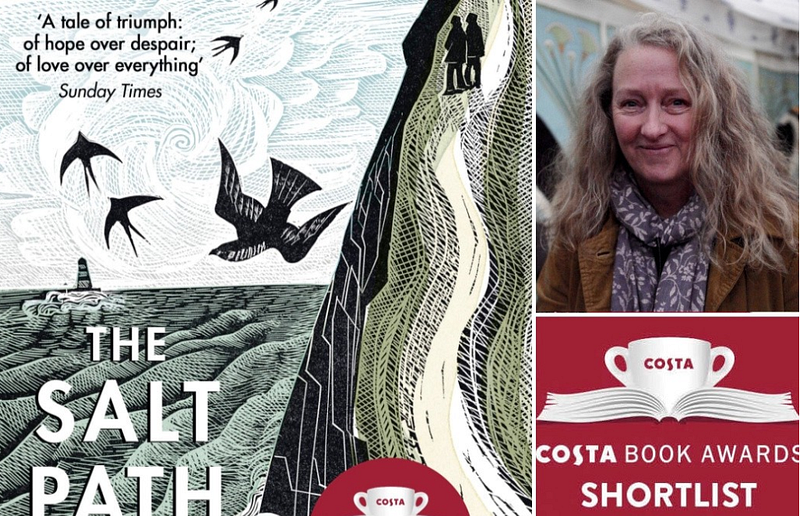
Can you feel the emotion in Linda’s writing?
I like how her opening allows us to see the situation the main characters are facing, and it pulls me in to want to keep reading about their circumstance.
Here are four tips on how to write a book review like Linda’s, one that readers will want to keep reading because it doesn’t feel like a book report summary:
Tip #1: Start with a scene from the book
Pick a key scene to focus on at the beginning of your story. Then slightly change and paraphrase the author’s words to let a reader experience the scene from the narrator’s point of view.
I saw another story Linda wrote where she does this by putting the reader in the circumstances of Nellie Bly in a 19th Century women’s asylum:
Her first night in the asylum, she laid in bed listening to a 70-year-old blind woman crying about the cold and begging God to just take her, already.
The bizarre and sick bedtime ritual was a big part of that.
Sometime after dinner, nurses would start dragging women away, one by one. At the sight of the nurses, women would begin to shake and cry. When they came for her, that first night, she didn’t know what was happening.
They dragged her into a room with a tub and told her to take her clothes off. When she asked for some privacy, they laughed and forcibly tore her clothes off. They told her to get in, or they’d put her in. She got in.
The water was ice cold.
Heck, yeah, I wanted to continue reading her story and the book.
Tip #2: Use key lines from the text
I like to continue with the same scene for the middle part of the story, alternating between quoting and paraphrasing dialogue and events to try to bring the main characters and their story to life.
This allows a reader to hear the story from the narrator’s voice, and this is better to me than getting a summary of the book filtered through the writer.
You could obviously jump to another scene too. But just try to keep the reader inside the narrator’s head whatever choice you make.
This is a great example of The Butterfly Effect theory where one small change — quoting and paraphrasing the text — can change the outcome.
People will actually want to read your story.
Tip #3: Give your opinion on the book
The good part about using this non-traditional format is you’re already three-fourths through your story — at the two to three-minute length — and you’re almost finished with your review.
So you’re story improves, and you save time.
And all you have to do is find a key scene in the book. One famous person is a dick to another person. Use it. Slightly change the words of the scene in your opening by using quotes or paraphrasing to get inside the narrator’s head.
Then you just have to give your opinion on what you liked about the book.
Do you recommend the book? Who is the ideal reader for the book?
Spit some fire and tell us why we should read the book.
Tip #4: Tell how you related to the book
This could go before or after your opinion on the book. I usually pick books that are related to some issue that I’m working through in my life.
Or a book may have no deep connection to my life, but there is some other reason why I’ve chosen to read the book at this particular time.
I think readers enjoy hearing the back story of why you’ve chosen the book and/or how you discovered it related to some parts of your life.
In other words, uncork a bottle of wine and get a little personal, so readers can get to know you better and want to click on your linked story at the end.
Final thought
Of the four tips I mentioned in this story, I think the most important one is to have passion when you are writing about a book you’ve just read.
Make us feel what you felt reading the book. Usually, this happens to me when I write my story fast with a pen in a notebook.
This helps me to capture my first thoughts. With fire and less cognition.
Give us those thoughts and make us feel what you felt about the book, and we will finish reading your story and, maybe, read the book.
I just bought The Salt Path, thanks to Linda’s story
Thanks for reading my story.
Click here to become a writer for The Book Cafe run by Linda Caroll.
Tagging a few of my fellow story nerds: Sandy Maximus, Lisa Osborne, Klara Jane Holloway, Jane Kelley, Janet Meisel, The Sober Vegan Yogi, Sreese, Lu Skerdoo, Melissa Marietta, Gerald Sturgill, Nicole Dake, Michael L Butler
You might also like:
Check out my YouTube video on 10 Publications to write for on Medium … or if you feel like buying me a cup of coffee, I’d greatly appreciate it : )


