
How to Work From Home Like a Pro
I’ve been working from home since the 1980s. Here’s everything I wish I could’ve taught my younger self.
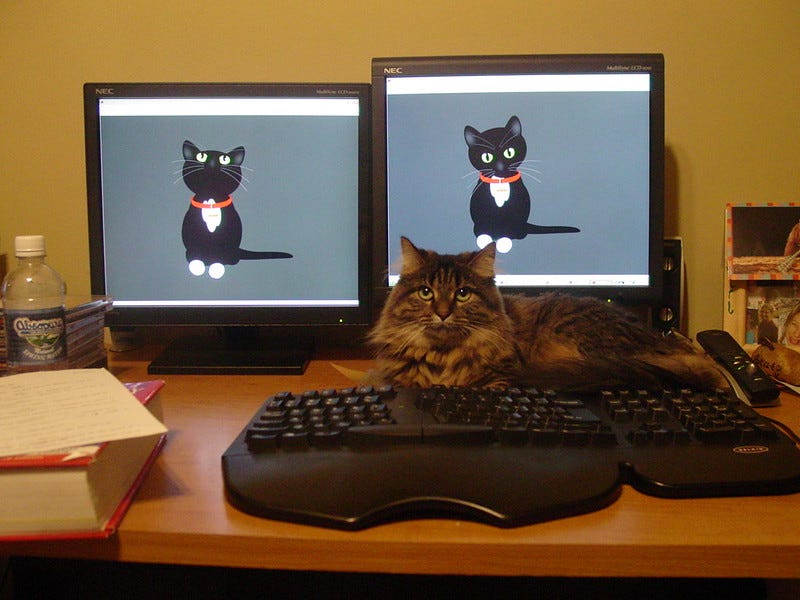
Social distancing has thrown millions of office professionals into the deep end of the working-from-home pool. Many feel like they’re drowning in productivity expectations and guilt. I’m also working from home these days. Unlike most, however, I’ve been doing it for long periods over four decades. Experience has helped me keep my head above water.
But when I started working from home back in the early 1980s — long before the internet, smartphones, social media, and Zoom — I found myself gasping for breath, too.
I had finished grad school in the middle of a nasty recession. Hiring freezes made getting full-time work nearly impossible. I did, however, find well-paying freelance gigs writing corporate brochures and articles for in-house publications.
Big companies had stopped hiring staff writers and started farming out work to freelancers like me. But I got no administrative support and no mentoring. To meet deadlines and get paid, I had to figure out how to work from home like a professional. I had rent to pay on my first apartment.
Today, I log in to my now-virtual office via my company’s virtual private network (VPN). At around 6 p.m., I sign off from the office and go online to do my creative writing. (I’m a published poet and just wrote my first play.) At the same time, my wife, an actor and singer, does online workshops, video auditions, and virtual singing gigs.
For the foreseeable future, working from home together is how it’ll be for us. As Dr. Anthony Fauci said, we’re not just going to flip a light switch and go back to the way it was. I’m just grateful we have the technology to work from home and stay out of the way of the essential workers whose jobs compel them to go on-site.
Time in a Bottle
“If I could put time in a bottle,” the late Jim Croce croons in his ‘70s heartbreak hit. But what makes the song so sad is that he can’t. None of us can. Time just flows along, oblivious to our great ambitions, best intentions, or work deadlines.
According to an often-cited University of Ohio study, productivity for most of us maxes out at slightly less than three out of eight hours per day. The study, however, doesn’t define productive activity—only unproductive ones, like gossiping and reading news websites.
As an information worker, I define productive activity as concentrated mental effort to achieve my priorities. (A trade worker would probably include physical effort, too.) For instance, I like my job, and my employer values my services and keeps paying me. So my job ranks high in my priorities. But I love writing poems, which pays nothing but rewards me spiritually and aesthetically. So my poetry ranks even higher.
Nor does that study mean that daily productivity is limited to three hours. It only observes what goes on over an eight-hour shift at the average workplace. The study notes, however, that “ideally, the human brain wants an hour of work and 15 minutes off.” So how many productive hours can we squeeze out of a day?
For me, each day contains no more than 7.5 hours of real productivity. Add to that 60 to 90 minutes of 15-minute breaks, and you get a nine-hour “work day.” Actually, “productive day” is more accurate, because everything I do that requires concentration comes out of that 7.5-hour time bank: job, writing poems, serious reading, family finances, etc.
I can spend less, but the hours don’t carry over. What I don’t use, I lose. Also, I find I can work no longer than 75 minutes at a stretch. Most times, however, I withdraw 30 to 45-minute chunks from the bank. It all depends on the task at hand.
Most people, I suspect, have the same bank, give or take 30 minutes. But size doesn’t matter. The trick is wisely choosing how to spend those hours. I learned the hard way that my concentration will focus on whatever I put before it. It has no sense of priority. In the old days, my girlfriend would call me in the middle of the day to argue. I’d squander an hour from my bank concentrating on winning a pointless debate.
Whether writing a poem or analyzing quarterly budget-to-actual numbers or bickering, everything draws from the bank the same. The lesson? My mind sets the priorities — or not.
Priority: The Big Cat
Priority is the king of beasts in the working-from-home jungle. Only one thing can be number one at a time. Two simultaneous priorities equal zero priorities, and multiple simultaneous priorities can seem less than zero (which amounts to chaos).
“Start your day with your most important task and block the time needed to accomplish it,” says Coach Tony in this article on setting priorities. Since it’s your day, you and only you can choose that priority, along with any secondary things you’d also like to accomplish. And one way or another, you do, whether by intention or reaction.
Like most, I set priorities by both intention and reaction. Neither is good or bad. Life and work are too dynamic to conform to any game plan. When either JT or Chikco—my cats adopted as foundlings—barf, I drop what I’m doing to clean it up and make sure they’re OK. When something urgent and important arises, I react quickly and reprioritize. Most of us know in our heart of hearts who and what is important. Of course, JT the cat likes to tell me that she always takes priority.
Whether she likes it or not, however, I decide what’s priority. Plenty of gurus and cats out there like to tell us what our priorities should be, but we don’t answer to them. (Don’t tell JT.) We all, ultimately, answer only to ourselves. Based on our values and goals, each of us knows what should take priority on any given day, week, year, or lifetime. To avoid energy-sapping guilt, I learned to own mine, to admit to myself what I consider really important. To be honest, JT and Chiko rank pretty high.
And I can change priorities. For instance, this article became my writing priority after I heard several public radio stories about people struggling with working from home. They were experiencing the same things I went through 35 years ago. I can offer some useful advice, so I thought and put aside two other writing projects. That decision went against the warnings of most writing coaches I know. And maybe they’re right. Maybe I lost momentum (though I doubt it). But I understood the risk and called it. My time bank, my decision — no looking back. And no guilt.
Telephone Tag, Not!
I learned early to put the kibosh on personal calls during time I withdraw from my 7.5-hour productivity bank. Nor do I take most business calls. I let them roll to voicemail. Call waiting makes it easy. I don’t pick up except for my wife and boss. And I rarely get calls from either. My boss and I communicate via email, and my wife and I text. If either ever calls, I know it’s urgent. (The cats never call.)
And you know what? More than half the time, the other callers don’t leave a voicemail. I discovered a lot of people call on impulse with only a vague notion of what they want. If it’s important, they’ll leave a voicemail or take the time to compose an email. That gives me the chance to gather the information they need and respond quickly and cogently, saving them and me time. If it’s not important, they’ll forget it, which is what usually happens.
Because I don’t play telephone tag, I avoid a lot of distracting calls that could eat into my 7.5-hour bank. And when you work from home, gossipy colleagues can’t drop in and waste your time with idle chitchat. Of course, the cats do like to drop into my lap now and then. Not for them, they say, but to relieve my stress. Always thinking of me, those cats.
Proof and Pleasure in the Dopamine
When I get my first priority done, I feel an intense sense of satisfaction. According to a Psychology Today blog post by Ralph Ryback, M.D., when we achieve what we want, our brains release dopamine, aka the goal-achieving hormone. This little neurotransmitter rewards us with pleasurable feelings, creating a feedback loop that motivates us to achieve more.
The resulting sense of satisfaction not only energizes me to tackle my next priority, but it helps me become more patient, focused, creative, and confident all around.
Whether it takes 15 minutes or two hours doesn’t matter, the feeling is the same. “What matters is not the number of working hours, not the quantity, but the quality of the job makes a huge difference to our mental health and wellbeing,” says Daiga Kamerade-Hanta, a work and employment sociologist from the University of Salford, in a recent article in the online trend magazine Inverse.
But quality isn’t objective. Your values define your priorities, and your priorities define quality results. Achieving what you want, your priority, wins the day.
Nor does placing quality over quantity mean you get to work half days and book full days when doing your job from home.
But not all job tasks require full concentration. For me, cleaning out my inbox, resetting passwords, keeping up with the company blog, sending courtesy emails, attending most webinars, etc. draw little if anything from my 7.5-hour bank. But they need to get done, or they’ll create problems that’ll eat into my bank. And sometimes they’re a welcome break from intense analytical and creative work (such as rewriting a poem).
Space to Work
“Space, the final frontier,” declared Captain Kirk at the beginning of each episode of the first “Star Trek” series. His words apply just as well to working from home except you don’t have the whole universe to explore. In my case, the final frontier ends at less than 700 square feet of a one-bedroom apartment in New York City.
A dedicated space is the key. Size doesn’t matter. A Google search will turn up plenty of clever articles on setting up a workspace in the tiniest of homes.
As for me, I keep it simple. I sit on a high stool at the bar in the cut-away between my living room and kitchen. It serves as a kind of stand-up desk, so I don’t have to sit all day. Being able to work standing up really helps reduce stress and keeps me from getting too sedentary. Information work, whether it be analyzing spreadsheets or writing poems, doesn’t call for any heavy lifting. Well, maybe the mental kind, but not the physical.
A clean, well-lighted place
I show up at the same spot every morning . I work there until I complete the day’s priorities or expend my 7.5-hour bank, whichever comes first. The sameness is what works. As soon I step into my space, I feel mentally and physically ready to work. I learned this by writing in cafés, a practice that predated working from home. Hemingway taught me how to do it.

As a graduate student in Paris in the ‘80s, I took to writing in cafés as he did back in the ‘20s. In a way, Hemingway was like a 21st-century mobile gig worker. Instead of a laptop, he had a notebook. As he wrote in “A Moveable Feast,” his memoir of being a young writer in Paris in the ‘20s, the key was finding a clean, well-lighted place to work and sticking with it.
“It was a pleasant café, warm and clean and friendly, and I hung up my old waterproof and ordered a café au lait. The waiter brought it and I took out a notebook from the pocket of the coat and a pencil and started to write.”
— Ernest Hemingway
In my café days, I’d sit at the same table every evening and write for 90 minutes. (I always save a portion of my 7.5-hour bank for writing.) As soon I got my coffee and strudel, I fell into my usual writing groove.
And I wasn’t the only one. At least three well-known published novelists — one a National Book Award nominee — were doing the same thing. And those were the only three I knew personally. A gallery of framed covers from books written in that café filled one of its walls.
After no more than two hours (including a couple of 15-minute breaks), I marked where I left off, made a few notes for the next evening’s session, and headed home. Almost everything I’ve published over the years was at least partially, if not mostly, written at that table.
But what matters isn’t the café, but having a clean, well-lighted place. Today, that’s my kitchen bar. I miss the café, but I still keep producing.
Neatness counts
In the café, I bused and wiped my own table. A messy, crumb-strewn, coffee-stained table didn’t feed my creativity. Neatness counts even more when working from home.
I make sure the bed is made, the dishes are done, the trash is thrown out, and the kitty-litter box is scooped. (JT maintains a high standard.)
In this social-distancing time, I’m obviously not worried about guests dropping by. WebMD cites over a dozen ways clutter and disorder can negatively affect mental and physical health. I just know they depress me. When I feel depressed, I don’t feel like sticking around, never mind working. And these days, there’s nowhere to go.
On the other hand, when my little apartment is neat and tidy, I feel good about myself and my home. I miss cafés and restaurants, but I’m happy to work from home and feel in no hurry to leave.
Like priority, we each determine our standard of neatness. I like what Marie Kondo, the Japanese tidiness guru, said in a recent #TheCallToUnite streamathon video:
“When tidying, the most important thing is to choose what sparks joy.”
— Marie Kondo
Joy is more important than ever in these difficult times. I’d even go so far as to say it’s a matter of survival, never mind productivity.
Dress for Success
Before logging into the virtual office, I shower, shave, and dress. And I always put on a pressed collared shirt. (I press them myself.) My employer instituted a business-casual policy a few years ago, and I follow the same policy when working from home.
Why? The boss can’t see me, right? Right, but I never dressed for the boss. I dress for myself. When I wear my business-casual uniform, I feel like doing business. When I wear a tux, I feel like partying. When I wear pajamas, I feel like sleeping. I don’t want to feel like partying or sleeping when I’m scrutinizing numbers on a 60-column spreadsheet or when I’m grappling with the 20th draft of a poem.
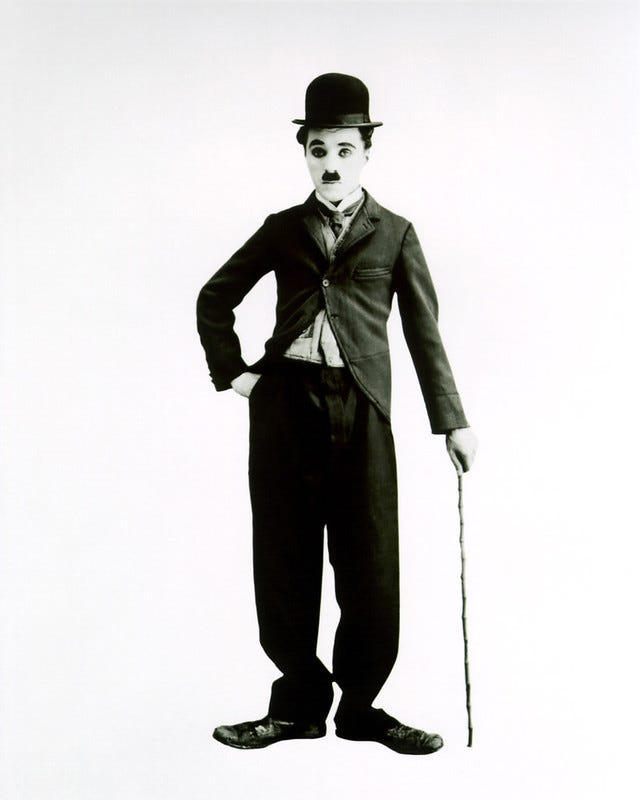
We do what we wear. Charlie Chaplin, a rather elegant fellow in real life, became The Tramp only when he put on the costume. My costume sets the stage for how I feel and what I’m ready to do. I would suggest this principle also applies to children doing school online from home.
Tools of the Trade
In the office back in the ‘80s, I could give my handwritten draft to the typing pool to turn into neat typewritten copy. No sweat! Working from home? Sweat. My drafts ran several thousand words, and the deadlines got tighter with every new gig. Without any editorial or administrative help, I had to turn in perfect final copy on time every time.
The solution? My first personal computer. I invested in one of the early IBM PCs. Clad in a putty-colored case, it came with a monochrome monitor and dual floppy disk drives. I also purchased a daisy wheel printer, a kind of automated typewriter that enabled my PC to literally type up my documents.
Not that I knew anything about computers to start. In college, I majored in English education. I took no advanced math, never mind computer courses. So I read personal computer magazines and studied the manuals that came with the equipment. A few years later, I was building my own PCs. I don’t like computers any more than I like wrenches, but I know how to use both to get things done.
Today, of course, most professionals have computers and high-speed internet access at home. And we routinely share and exchange documents electronically, making printers almost obsolete.
But what my daisy-wheel printer was to me in the early ‘80s, my wide-screen, high-resolution monitor is in the 2020s. I spend my day scrutinizing spreadsheets, reading and writing emails, and interacting with a dozen cloud apps, all open at the same time. Because my monitor allows me to easily see it all, I save time and work efficiently. The right tools, less sweat.
Sound of silence (almost)
You know what else is a great tool for working from home? A good pair of wireless earbuds, the kind with good sound and a snug fit. They make working from home in a small New York City apartment doable.
My wife and I live on earbuds. When she’s emoting and tearing up the virtual scenery doing her online acting workshop, I’m working happily along, news or jazz playing in my ears, in my own virtual world.
Yes, I can hear her — a trained opera singer, she knows how to project all the way back to the cheap seats — but my earbuds’ snug fit greatly reduces outside noise.
Earbuds keep the peace.
Power of the Catnap
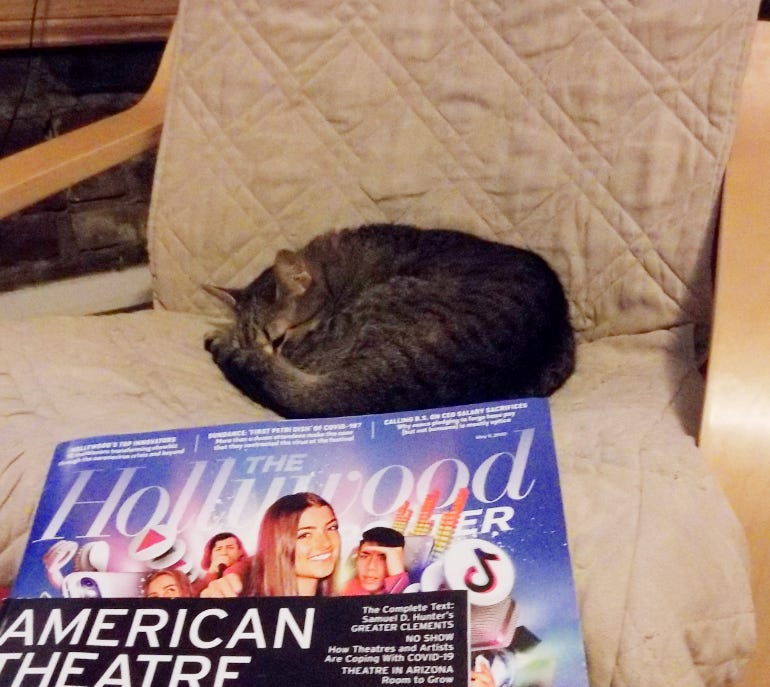
Working at home, I can take a catnap — aka power nap — something I could never do in the office. No, I’m not slacking off but recharging. “Don’t lean on caffeine,” advises WebMD. “A power nap will boost your memory, cognitive skills, creativity, and energy level.”
My own experience consistently bears this out. When I get the mid-afternoon blahs, I catnap through one of my 15-minute breaks — and no longer. I come roaring back with a second wind that lasts at least two more hours.
Catnapping sitting up, head against pillow, I don’t fully fall asleep. I just close my eyes and let the tension drain from my body. Afterward, I literally think and see sharper. JT highly recommends catnapping for people and cats. I take her advice. I figure anyone with nine lives must know what they’re doing.
Avoid All Work and No Play
Work never ends. I could work day and night seven days a week and never catch up. I’ve learned that everyone, especially the most successful, is in the same boat. When working from home in the ‘80s, I never left “the office.” Scope creep would slither over my nights and weekends.
I became miserable, lonely, and, oddly enough, unproductive. A 2014 Stanford University study pins 50 hours per week as the limit before productivity per hour starts to drop. My overwork hangover from Monday spilled over into Tuesday. I realized that working from home is a marathon, not a series of sprints. The solution? Playtime.
“To every thing there is a season, and a time to every purpose under heaven,” the Bible’s book of Ecclesiastes (3:1) tells us. The prophet adds “that everyone should eat and drink, and enjoy the good of all their labor” (3:13).
You don’t have to be a mystic to see this ancient advice applies especially well to working from home in the 21st century. Science says so, too. The venerable Mayo Clinic affirms that we need to make time for fun and relaxation in order to stay healthy and sane.
Growing up in our workaholic culture, I didn’t understand the value of enjoying the good of my labor. But I learned to shut down my computer and leave the home office, even if the day’s priority didn’t get done despite my best efforts. If I worked in an office, I’d have to go home to rest and recharge. Of course, physically leaving one place and going to another makes the shift easier.
So when working from home, I found physical ways to shift out of work mode. Back in the ‘80s, I’d take a long walk to my parents’ house for dinner. Today, I put away the computer and turn the bar back into an eating space. I still walk or do yoga. On some days, I cook for my wife and me. Whether she cooks or I do, we always spend the evening eating together. We often enjoy a glass or two of wine and talk until bedtime. On weekends, we’ll watch a movie or do a video call with friends.
That’s fun for us. However you define fun, make it a priority every day. Make it the thing that ranks number one above all others, especially work.
Going Pro at Home
So what would I say now to my younger self just starting out working from home? I’d offer that young man advice that’d save him a lot of trial-and-error hassles. I offer it here and hope it might help you instead.
- Start your day knowing your priority one, two, and three. Write them down the night before. (Plenty of good apps can help with this, but sticky notes posted prominently work just as well.) Have your breakfast, and then knock them off in order as best as you can. Even if life or the boss disrupts you, you stand a good chance of getting number one done, and you’ll get your dopamine reward for it. Remember that you determine your priorities. Some days, number one might be helping a child study for a critical test or taking a pet to the vet. Your life, your call.
- Determine your daily productivity bank. For a week, track how much time you actually spend concentrating on productive activity. That includes not just the job but time spent homeschooling children, working on hobbies, doing home repairs, making art, and even having important conversations with loved ones and friends. Budget your bank for life, not just the job.
- Find your clean, well-lighted place. Whether it’s at the end of a kitchen table or a second bedroom with an ocean view, show up there every morning. Success begins with showing up, even if it means just going a few steps in your home. As Hemingway shows, physical space helps create the mental space for good work.
- Tidy up. Just as you keep your mind clear of concentration-breaking clutter, keep your space clear of clutter. Neatness really takes little effort. You don’t have to win the Good Housekeeping Seal. Just make yourself comfortable enough to stay focused.
- Dress up. Dress all the way up, not just the top half that shows on a Zoom call. Dress comfortably, of course. If your employer maintains a suit-and-tie dress code, feel free to adopt business-casual at your home office. But wear the right costume for business. And when work ends, change your clothes as you would when you physically come home from work. That change will help you leave the virtual office and put you in the mood for well-deserved fun.
- Get the right tools. Working from home doesn’t mean you have to put up with substandard tools. Nor does it mean you have to spend a fortune to get the right ones. Check with your tech department about specs, security requirements, and deals. Your company’s suppliers may offer discounts. Some companies even lend equipment to mobile employees. (Mine does). Others will also subsidize Wi-Fi access and mobile phone service. (Mine does that, too.) If you use cloud apps and log into your company via VPN, you may find that upgrading your Wi-Fi alone will lighten your burden and increase productivity. Few things hold down the home-office pro more than slow, glitchy internet connections.
- Take a catnap. What’s better? Slogging groggily for two hours or taking a 15-minute catnap and getting a second wind? Grogginess won’t only slow you down, but it’ll also cause you to make mistakes. And fixing mistakes amounts to doing the same work twice, never mind the damage done to your credibility. Getting that second wind clears your head, which improves your accuracy and raises your energy. In turn, you get way more value out of your productivity bank.
- Make fun a daily priority. Set a date night with your significant other — or even with yourself. It can be just coffee or the classic dinner (homemade or ordered in) and a movie (streamed or DVD). Or even dancing. Light a few candles while you’re at it. If you have a family, play board games or cards (family poker, anyone?). You can also plan fun with friends and colleagues. My best friend and I meet for virtual dinner every Friday evening. My office has a virtual happy hour every Thursday promptly at 5:00 p.m. Planning fun only takes a little imagination.
Long after the Covid-19 pandemic follows the 1918 flu pandemic into history — the sooner, the better — working from home will have become an essential part of work. The trend started long ago with us freelancers. Digital technology and the internet brought it to the 9-to-5 world. Covid-19 lockdowns speeded it up. The office won’t go away, but we’ll likely see working from home and commuting blended as the economy recovers.
Over the years, I’ve worked from home as a freelance writer and full-time as an employee. When I got laid off from my full-time job in the early ‘90s, my experience working from home kicked in immediately. Getting a job became my new job.
Right now, I’m gainfully employed, but who knows how long that’ll last in this pandemic-devastated economy. If I lose my job, I’ll be working from home to get another one. Knowing how to work from home efficiently, effectively, and happily can provide the edge in tough times.


