avatarTarun Kataray

Free AI web copilot to create summaries, insights and extended knowledge, download it at here

2919

Abstract

our muscle tissues and reinforce our bones.</p><h2 id="aac5">Dream Sleep/ REM Sleep</h2><p id="d744"><a href="https://link.springer.com/article/10.1007/s11920-007-0065-z">REM Sleep</a> generally begins approximately ninety minutes after an individual falls asleep. REM Sleep comes in twenty to forty-minute cycles, for about 4–5 times in the night.</p><p id="3cdb">Every individual, during sleep, transits between these phases in cycles throughout their sleep time. Light sleep acts as a passage between the Awake phase, Deep Sleep phase, and REM Sleep phase.</p><figure id="4cdb"><img src="https://cdn-images-1.readmedium.com/v2/resize:fit:800/1*pgkaGBETJ3hu6kRrxu5NRQ.png"><figcaption>Hypnogram of an Ideal Sleep (Photo by <a href="https://medium.com/@tarunkataray7">Tarun Kataray</a>)</figcaption></figure><h1 id="3140">The Challenge/ My Self Experiment:</h1><p id="4992">This procedure was developed at the <a href="https://stanfordhealthcare.org/medical-treatments/c/cognitive-behavioral-therapy-insomnia/procedures/sleep-restriction.html">Stanford Healthcare Organization</a>. If you have problems with sleeping, then this is the challenge that will help you!</p><h2 id="06db">Steps to follow</h2><ol><li>Determine your wake-up time and set multiple alarms around that time.</li><li>Ask your spouse/Roommate/friend to wake you up if you don’t wake up with the alarms dispersed in the room. Take any necessary measures to wake up.</li><li>Work backward by 6 hours. This is your new bedtime. In other words, if your alarm is set for 6:30 AM, your bedtime is now midnight.</li><li>Rules are simple, as you can go to bed anytime on or after your bedtime. if you aren't sleepy at midnight, feel free to stay awake as late as you like.</li><li>You must be awake earlier or on the wake-up time.</li><li>Napping is not allowed. Neither is sleeping at your desks, falling asleep before dinner time, nor napping on the couch before evening. Sleep is not allowed at any time except for your sleeping period. In this case 1 AM — 6:30 AM</li></ol><p id="09cc">The technique applied in this challenge is called Sleep Restriction. In this method, we initially restrict the amount of time spent in bed.</p><p id="7a9e">The results of this challenge will be visible within the first week. But you will realize that you are not getting enough sleep. Don’t worry that’s normal.</p><p id="752a">The next step is to increase the time spent in bed by 15 to 30 minutes as long as you are not again losing the quality of your sleep at night which, can be measured by sleep efficiency. Follow the extended time for at least a week before extending again.</p><p id="87f4">The decision on when to extend your bedtime should be based on sleep efficiency. Sleep efficiency is the percent of the time slept relative to the time spent in bed.</p><figure id="094f"><img src="https://cdn-images-1.readmedium.com/v2/resize:fit:800/1*5k7i60r-2dV3O

Options

NaA1_L9Wg.png"><figcaption>Sleep Efficiency (Photo by <a href="https://medium.com/@tarunkataray7">Tarun Kataray</a>)</figcaption></figure><p id="633b">If Sleep Efficiency is more than 85% yet, you feel sleep deprived then increase your bedtime by 15 to 30 minutes.</p><p id="6600">If Sleep Efficiency is less than 80% then its time to further restrict your bedtime.</p><p id="c3a4">Once you aren’t feeling tired the next day along with having a sleep efficiency of more than 85% then Congratulations! You have found an optimal sleep requirement.</p><p id="badd">This article by the <a href="https://www.cdc.gov/sleep/features/getting-enough-sleep.html">Centers for Disease Control and Prevention</a> will give you a brief idea of how much sleep is required by an individual in general.</p><h1 id="96f5">My Overwhelming Results:</h1><p id="a8f3">These are the statistics, measured by the smartwatch app before I took this challenge to improve my sleep pattern.</p><h2 id="828d">BEFORE</h2><ol><li>Average Deep Sleep per night: 1hour 32minutes 21.24%</li><li>Average (Light Sleep+REM Sleep) per night: 5hours 41minutes 78.75%</li><li>Average time to fall asleep per night: 27 minutes</li></ol><p id="0b72">These are the statistics when I found the optimal sleep needed by me to feel rested the next day. It took me 4 weeks to find my optimal bedtime.</p><h2 id="736a">AFTER</h2><ol><li>Average Deep Sleep per night: 1hour 52minutes 26.6%</li><li>Average (Light Sleep+REM Sleep) per night: 5hours 13 minutes 74.5%</li><li>Average Time Taken to fall asleep: 9 minutes</li></ol><p id="2157">Though my total time spent on the bed has decreased, The amount of deep sleep has dynamically increased from 21% to 26%. Now, I doze off into the slumberland rather instantaneously, upon hitting the bed. Also, an interesting fact is that I am not dreaming anymore.</p><p id="84a6">Due to a good night’s sleep, I am feeling rested the next day. My productivity levels got a huge boost. I can now focus for longer periods on a single task.</p><p id="9541">I can lift more weights in the gym as my muscles are getting enough rest. Due to this, hitting the gym turns out to be more enjoyable than before. I am having a continuous flow of energy throughout the day in me. As a result, I feel my health improved dramatically.</p><h1 id="1197">Conclusion</h1><p id="e350">Sleep Restriction is a scientifically proven method to revamp your sleep pattern. This, not only helps you in finding your optimal bedtime but also helps to increase the time spent in the deep phase.</p><p id="ced9">On having a good night’s rest, there are a lot of side benefits like an immunity boost, increased productivity, growth, memory retention, and increased physical performance.</p><p id="eca8">Visit my personal blog <a href="https://hustlegrad.com/1-challenge-to-significantly-improve-your-sleep-pattern/">here</a>.</p><h1 id="823d">,</h1></article></body>

1 Challenge to Significantly Improve Your Sleep Pattern

I tried this research-backed challenge to revamp my sleep pattern. It worked exceptionally.
My Results may Surprise you! (Photo by Kate Stone Matheson on Unsplash)

After finishing my work, I head to the gym and then straight home. When I finally arrive, I’m totally drained. My plan to cook a healthy dinner is out of the window.

Then after dinner, I reach my bed! Curtains closed, Lights off, AC on, the perfect atmosphere to sleep. I close my eyes to doze off into my dreams!

Yet, due to some bizarre reason, I am unable to sleep. As every second passes, I am more and more aware — how bad this is going to mess up my routine the next day.

Relatable?

Trust me, this was almost an everyday concern for me. Sleeping had always been a problem. After extensive research and experimentation, I have finally found out a solution to this problem!

Before getting into the amazing results of my challenge, let’s get into the science of sleep first!

Sleep Phases

To understand Sleep in a better way, we first need to understand the science behind it. According to the study on Sleep Physiology, Sleep has been divided into four important phases. They are:

  1. Awake
  2. Light Sleep
  3. Deep Sleep
  4. REM Sleep(Rapid Eye Movement Sleep) / Dream Sleep
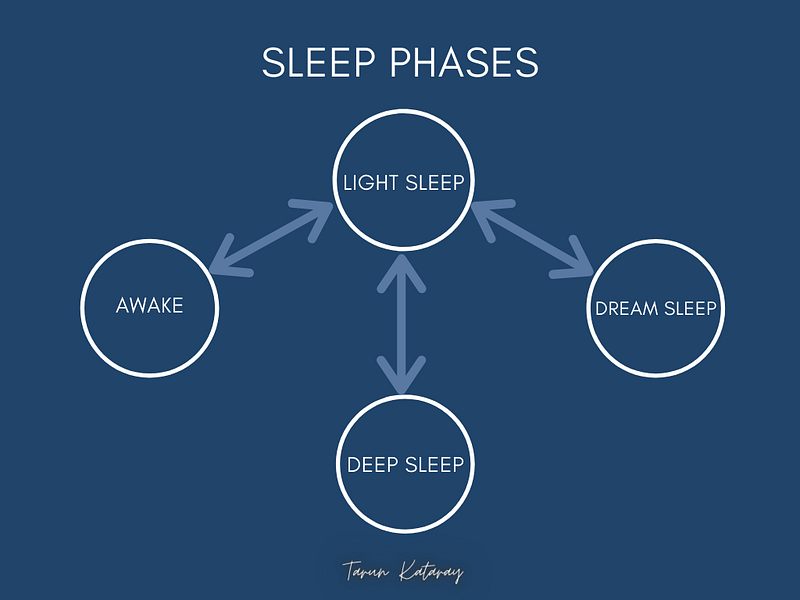
Sleep Phases (Photo by Tarun Kataray)

Light Sleep(Stage-1)

Light Sleep acts as a solid foundation for our dynamic sleep. It is a state between fully conscious and Deep sleep/ REM sleep.

In this stage, brain waves begin to drop down, muscle activity tends to decline. Almost, half of the individual’s night is spent in this phase.

Deep Sleep(Stage-2,3)

Deep Sleep is a phase where the body restores itself. This sleep makes individuals feel rested and not sleepy the next day. Typically, Adults spend 25% of their sleep in Deep Sleep.

Studies have also shown that Deep Sleep is restorative because this is the phase where there is maximum production of the Growth Hormone. These growth hormones strengthen our muscle tissues and reinforce our bones.

Dream Sleep/ REM Sleep

REM Sleep generally begins approximately ninety minutes after an individual falls asleep. REM Sleep comes in twenty to forty-minute cycles, for about 4–5 times in the night.

Every individual, during sleep, transits between these phases in cycles throughout their sleep time. Light sleep acts as a passage between the Awake phase, Deep Sleep phase, and REM Sleep phase.
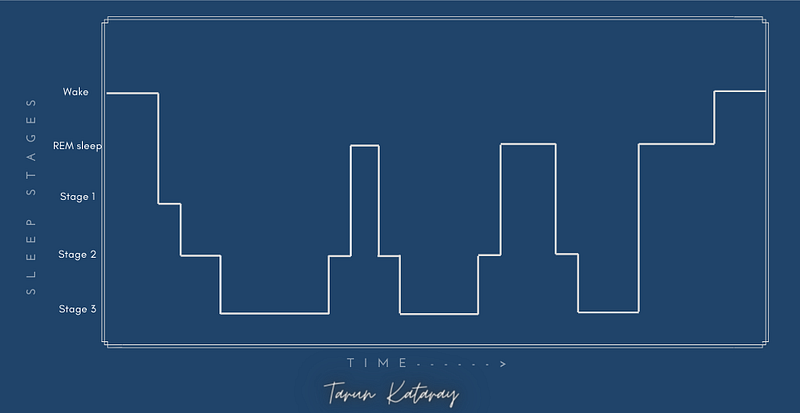
Hypnogram of an Ideal Sleep (Photo by Tarun Kataray)

The Challenge/ My Self Experiment:

This procedure was developed at the Stanford Healthcare Organization. If you have problems with sleeping, then this is the challenge that will help you!

Steps to follow

  1. Determine your wake-up time and set multiple alarms around that time.
  2. Ask your spouse/Roommate/friend to wake you up if you don’t wake up with the alarms dispersed in the room. Take any necessary measures to wake up.
  3. Work backward by 6 hours. This is your new bedtime. In other words, if your alarm is set for 6:30 AM, your bedtime is now midnight.
  4. Rules are simple, as you can go to bed anytime on or after your bedtime. if you aren't sleepy at midnight, feel free to stay awake as late as you like.
  5. You must be awake earlier or on the wake-up time.
  6. Napping is not allowed. Neither is sleeping at your desks, falling asleep before dinner time, nor napping on the couch before evening. Sleep is not allowed at any time except for your sleeping period. In this case 1 AM — 6:30 AM

The technique applied in this challenge is called Sleep Restriction. In this method, we initially restrict the amount of time spent in bed.

The results of this challenge will be visible within the first week. But you will realize that you are not getting enough sleep. Don’t worry that’s normal.

The next step is to increase the time spent in bed by 15 to 30 minutes as long as you are not again losing the quality of your sleep at night which, can be measured by sleep efficiency. Follow the extended time for at least a week before extending again.

The decision on when to extend your bedtime should be based on sleep efficiency. Sleep efficiency is the percent of the time slept relative to the time spent in bed.
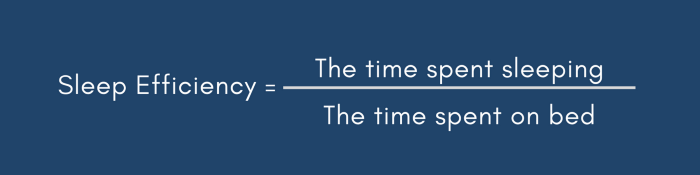
Sleep Efficiency (Photo by Tarun Kataray)

If Sleep Efficiency is more than 85% yet, you feel sleep deprived then increase your bedtime by 15 to 30 minutes.

If Sleep Efficiency is less than 80% then its time to further restrict your bedtime.

Once you aren’t feeling tired the next day along with having a sleep efficiency of more than 85% then Congratulations! You have found an optimal sleep requirement.

This article by the Centers for Disease Control and Prevention will give you a brief idea of how much sleep is required by an individual in general.

My Overwhelming Results:

These are the statistics, measured by the smartwatch app before I took this challenge to improve my sleep pattern.

BEFORE

  1. Average Deep Sleep per night: 1hour 32minutes 21.24%
  2. Average (Light Sleep+REM Sleep) per night: 5hours 41minutes 78.75%
  3. Average time to fall asleep per night: 27 minutes

These are the statistics when I found the optimal sleep needed by me to feel rested the next day. It took me 4 weeks to find my optimal bedtime.

AFTER

  1. Average Deep Sleep per night: 1hour 52minutes 26.6%
  2. Average (Light Sleep+REM Sleep) per night: 5hours 13 minutes 74.5%
  3. Average Time Taken to fall asleep: 9 minutes

Though my total time spent on the bed has decreased, The amount of deep sleep has dynamically increased from 21% to 26%. Now, I doze off into the slumberland rather instantaneously, upon hitting the bed. Also, an interesting fact is that I am not dreaming anymore.

Due to a good night’s sleep, I am feeling rested the next day. My productivity levels got a huge boost. I can now focus for longer periods on a single task.

I can lift more weights in the gym as my muscles are getting enough rest. Due to this, hitting the gym turns out to be more enjoyable than before. I am having a continuous flow of energy throughout the day in me. As a result, I feel my health improved dramatically.

Conclusion

Sleep Restriction is a scientifically proven method to revamp your sleep pattern. This, not only helps you in finding your optimal bedtime but also helps to increase the time spent in the deep phase.

On having a good night’s rest, there are a lot of side benefits like an immunity boost, increased productivity, growth, memory retention, and increased physical performance.

Visit my personal blog here.

,

Sleep
Productivity
Life
Health
Self Improvement
Recommended from ReadMedium