
How To Use Story To Keep People Around
Star Wars. Hunger Games. Karate Kid.
What made those movies highly popular? (If you’d like to debate whether or not they SHOULD be popular meet me in the comments ;)
But that’s not the question I’m asking here. What made these movies so intriguing? Why did people stay glued to the screen and talk about them for years after?
Why is Star Wars such a worldwide pop culture phenomenon?
If you’re endeavoring to write anything powerful, or create marketing messaging that will last past your time, or produce a movie that will be more than just “eh it was alright”, if you’re trying to create anything that involves words in any way (what, like anything and everything?) the answer to that question is: The Story Brand Framework.
Story Brand Framework
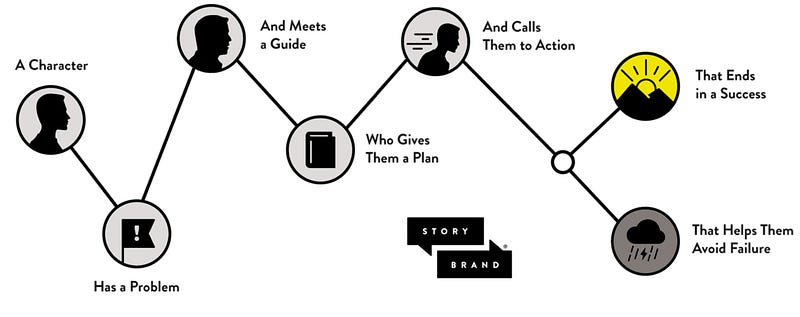
Star Wars used this framework, and that’s the main reason why it’s popular.
Star Wars Story Plot Example
A character: Luke Skywalker
Has a problem: wants to become a Jedi and fight the evil empire.
He then meets a guide: Obi-Wan Kenobi and Yoda.
Who gives Him a Plan: Training through the marshes
And calls him to action: Use the FORCE!
This gives him the courage to reach an ending: (comedy and tragedy are mixed into this ending) Luke destroys the Death Star, converts his evil dad Darth Vader to return to the light, and preserves the Rebellion to fight another day.
That helps him avoid failure: Should Luke fail in his quest, the Rebel Alliance would be crushed to a pulp.
So there you have it. The story framework. Why does it work?
Story Brings Clarity
Pretty websites don’t sell things. Words sell things. If you haven’t clarified your message your customers won’t stick around to read or listen.
Clarifying your message can feel like you’re inside a bottle trying to read the label. But the human brain is drawn to clarity and away from confusion.
Is your message simple, relevant, and repeatable?
There’s a reason most marketing copy doesn’t work: the message is too complicated.
The more simple and predictable the communication, the easier it is for the brain to digest. Storytelling helps because it is a sense-making mechanism.
Story formulas put everything in order so the brain doesn’t have to work to understand what’s going on.
Story Helps The Reader Gauge If Your Content Helps Them Survive
If you ever studied Maslow’s Hierarchy of Needs in school, you’ll remember that human beings have five basic needs:
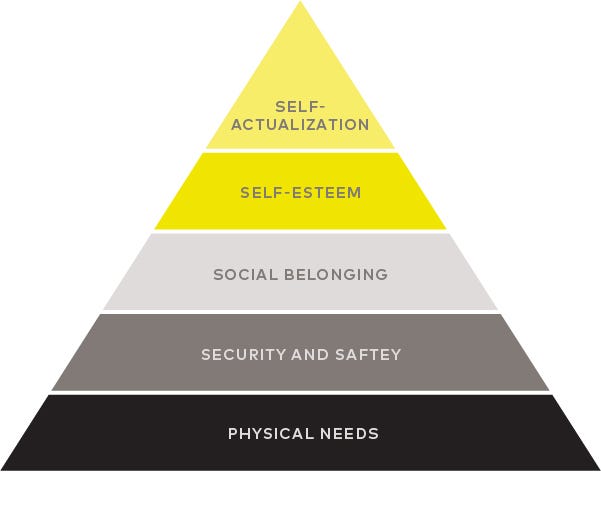
- Physical — food, air, water
- Security — shelter, safety
- Social — belonging, love, inclusion
- Self-esteem — power, prestige
- Self-actualization — creativity, development
We are constantly scanning our environment for the things that will help us meet these needs, + survive and thrive.
If your brand messaging or writing doesn’t immediately tell the reader how you help them “survive”, they will move on to the next thing.
Not because your product or writing isn’t amazing but because you asked them to burn WAY too many calories to figure out how you help them survive.
The human brain is constantly scanning the environment for info that is going to help them meet their primitive need to survive.
When we go on about how we’re the BEST and you SHOULD read our writing people immediately quit caring because that info isn’t helping them eat, cultivate relationships, find power, experience deeper meaning, or protect themselves.
Mistake one: Fail to focus on the aspects that will help people survive and thrive.All great stories are about survival.
- Is what you write helping people reach one of their five basic needs?
- Is it helping them develop creativity?
- Is it sharing a story about love that will help them further relationships in their lives?
- Is it helping to build their self-esteem?
Mistake Two: Your message is too complicated and people are burning too many calories trying to understand it.There’s a survival mechanism in our brains that will tune anyone out as soon as you start confusing someone. I’m sure you can recall a time that you clicked onto a website and immediately bounced off because everything was a jumbled mess, there were too many ads, and your eyes were assaulted by one of those popups.
The key is to make your message about something that promotes survival and to do so in such a way that it’s understandable without burning too many calories.
Solution one: DeleteIf you confuse you lose.
Your enemy is noise.
You hear all kinds of noises every day but when you hear the screech of brakes you don’t think, “OOO music.”
Your brain doesn’t automatically remember that exact noise and file it away as memorable.
You hear Fur Elise and your brain immediately recognizes those sounds as music. Why?
Music is noise that is submitted to certain rules. The brain remembers music and forgets noise.
Are you writing forgettable noise or creating remarkable music?
When storytellers bombard people with too much info the audience is forced to burn too many calories organizing the data. Stop creating noise — Cut out the info your customer doesn’t need.
If your marketing or writing is cluttered and confused you will lose people.
The more we cut out the better the screenplay or book, the better the article, the better the marketing message.
Cutting out words is hard.
Blaise Pascal is often credited for sending a long letter stating he simply didn’t have time to send a short one.
Those words are your sweat and tears. You spent time writing a long article. And perhaps it’s programmed into us in high school (HEY. Write a 1200 word paper on BLAH and have it on my desk by tomorrow.) Forget that training. If you can get your point across concisely in 200 words, then only write 200 words. At every chance look for a point to cut, chop, snip, slash and scratch out words.
Too many words?
Too many calories burned. Too many people lost.
The most powerful tool we can use to organize info for our readers is story — the ultimate formula for communication.
In a story, audiences must always know who the hero is, what the hero wants, who the hero has to defeat to get what they want, what tragic thing will happen if the hero doesn’t win, and what wonderful thing will happen if they do.
Truly creative marketers know how to use this formula while avoiding cliche.
A good story is life with the dull parts taken out. — Hitchock
When writing stories think about the points you can make that are relevant to the human's desires to survive.
The human desire is to transform. Writers that realize people are human, filled with emotion, driven to transform, and in need of help truly do more than sell products or promote an idea; they change people.
Want more tips like this? Subscribe to support my writing :) 


