
How to use Natural Language Processing (NLP) to analyse Earnings Calls?
Earnings calls are a vital source of information for anyone keeping track of a company’s performance.
However, going through these often lengthy and complex discussions to extract meaningful insights can be a daunting task.
This is where Natural Language Processing (NLP) comes into play.
NLP, a field that combines computer science, artificial intelligence, and linguistics, offers a powerful way to analyze and interpret the vast amounts of unstructured data in earnings calls.
In this article, we’ll explore the basics of NLP and how it can be applied to understand and analyze the content of earnings calls more effectively.
But let’s start with, what are Earning Calls?
What are Earning Calls?
In a nutshell, earnings calls are critical events where publicly traded companies discuss their financial results, business strategies, and market performance with investors, analysts, and the media.
These calls offer valuable insights into a company’s operations and future outlook.

During these calls, senior executives, typically including the CEO, CFO, and occasionally other top management, present their company’s financial results for a specific period, usually a quarter or a fiscal year.

The content of these calls is diverse and comprehensive. It includes detailed discussions of revenue, profits, expenses, and other key financial metrics.
More than just numbers, these calls also delve into the qualitative aspects of the business. Executives often elaborate on the company’s strategies, operational challenges, market trends, competitive landscape, and future projections.
This might involve discussing new product launches, market expansion plans, mergers and acquisitions, and any significant changes in the company’s leadership or operational structure.
Moreover, these calls are not just one-way communication. They include a Q&A session, where analysts and investors pose questions, seeking clarifications and additional insights.

This interaction provides a deeper understanding of the company’s performance and strategies. The tone, language, and confidence of the executives during these sessions can also be very telling and are often scrutinized for subtle cues about the company’s health and outlook.
The information divulged in these calls is invaluable for stakeholders. It helps them assess the company’s financial health, understand its strategic direction, and make informed decisions.
For analysts, this is a crucial source of information for their research reports and investment recommendations. For investors, both current and prospective, these calls can significantly impact their investment decisions.
Understanding NLP
Natural Language Processing (NLP) is a technology that sits at the crossroads of computer science and linguistics.
It’s part of the broader field of artificial intelligence (AI) and is all about teaching computers how to understand and work with human language.
This is more than just recognizing words; it’s about grasping the nuances, context, and even the sentiment behind those words.
For finance professionals and investors, NLP can be an invaluable tool.
The world of finance is filled with vast amounts of text data — from earnings call transcripts and financial reports to news articles and analyst reports. Traditionally, going through this information requires significant time and effort, and it’s easy to miss out on subtle yet critical insights.
With NLP, computers can rapidly analyze this text data. They can extract key pieces of information, like financial metrics or market trends, from large documents in seconds.
This isn’t just about finding specific words or numbers; NLP enables computers to understand the context. For instance, it can differentiate between a company announcing a “profit” and a “loss,” even if both are mentioned in the same document.
Moreover, NLP can identify trends and patterns in language that might indicate changes in market sentiment or business performance.
For example, by analyzing the language of several earnings calls, NLP can help pinpoint shifts in a company’s strategy or confidence level that might not be immediately apparent through traditional analysis.
In simple terms, NLP acts like a highly efficient, incredibly fast assistant, one that can read through mountains of text, understand it, and highlight the most important and relevant information for finance professionals and investors. This can significantly enhance decision-making processes, allowing for more informed and timely investment choices.
One of the key steps in order to be able to perform this analysis is obtaining reliable and clean data.
So how to do this?
Data Acquisition on Earning Calls
To analyze earnings calls using NLP, the first step is to gather the relevant data. One effective method is to download each transcript directly from company websites or financial information platforms.
Alternatively, you can use APIs like the one provided by Financial Modeling Prep:
This API allows for automated, structured data collection, facilitating easy access to numerous transcripts.
Data Analysis Process
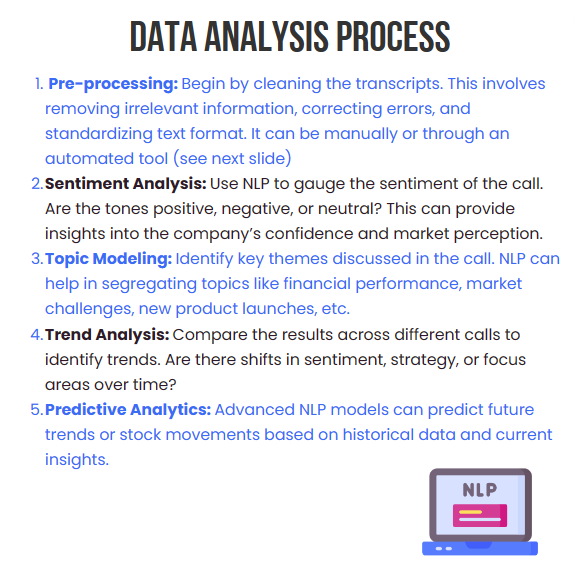
This process has 5 key steps:
- Pre-processing: Begin by cleaning the transcripts. This involves removing irrelevant information, correcting errors, and standardizing text format.
- Sentiment Analysis: Use NLP to gauge the sentiment of the call. Are the tones positive, negative, or neutral? This can provide insights into the company’s confidence and market perception.
- Topic Modeling: Identify key themes discussed in the call. NLP can help in segregating topics like financial performance, market challenges, new product launches, etc.
- Trend Analysis: Compare the results across different calls to identify trends. Are there shifts in sentiment, strategy, or focus areas over time?
- Predictive Analytics: Advanced NLP models can predict future trends or stock movements based on historical data and current insights.
More detailed below:
When using Natural Language Processing (NLP) to analyze earnings calls, the data analysis process can be broken down into five distinct but interconnected steps.
Each step plays a crucial role in transforming raw transcripts into meaningful insights:
Pre-processing: This is the foundational step where the raw transcripts of earnings calls are cleaned and prepared for analysis.
It involves removing unnecessary or irrelevant information such as filler words, correcting grammatical errors, and standardizing the text format.
This step is essential because clean and standardized data ensures that the NLP algorithms can process the text more efficiently and accurately.
Sentiment Analysis: Here, NLP is used to determine the underlying sentiment of the text. This involves analyzing the language used in the earnings call to gauge whether the tone is positive, negative, or neutral.
This step is crucial for understanding the company’s confidence level and overall market perception.
For example, a predominantly positive tone might indicate optimism about future prospects, while a negative tone might reflect challenges or uncertainties.

Topic Modeling: This involves identifying and categorizing the main themes or topics discussed during the earnings call. NLP algorithms can sift through the text to pick out recurring subjects such as financial performance, market challenges, regulatory impacts, or new product launches.
This step is particularly useful for understanding the focal points of the company’s discussion, allowing analysts and investors to grasp the key areas of emphasis or concern.
Trend Analysis: By comparing the results of sentiment analysis and topic modeling across multiple earnings calls, one can identify trends and patterns.
This might include shifts in the company’s strategic focus, changes in market sentiment, or evolving challenges and opportunities. Such trend analysis can provide valuable context for the company’s performance and strategy over time, offering insights that go beyond the scope of a single earnings call.

Predictive Analytics: The final step involves using advanced NLP models to make predictions about future trends or stock movements. This is done by analyzing historical data in conjunction with the insights gained from the current earnings call.
Predictive analytics can provide forecasts about a company’s future performance, helping investors make more informed decisions. For example, consistent positive sentiment and a focus on growth strategies in earnings calls might predict a rise in stock prices.