
How To Use HIIT To Increase Your Fitness Level — From a Personal Trainer
High-intensity interval training is a simple way to get fit with short workouts and minimal equipment. Here are 3 workouts to try.
I hate the gym. It’s ironic considering I’m a personal trainer, but I’m telling the truth. I truly hate going to the gym. I get frustrated by the lack of available weights, and overwhelmed by the large number of people in a small area, and I hate the 20-minute drive. When I became a personal trainer, I noticed the clients I worked with had a similar feeling. Finding a mutual time to do an hour-long training session or waiting for equipment we needed were constant battles we struggled with.
After a particularly frustrating training session, I began to look for a new way to train my clients, thinking there had to be a better way. It was here I stumbled upon the answer: HIIT (high-intensity interval training).
Let me ask you this: Does a 15 to 30 minute workout designed to increase your fitness level with the freedom to workout wherever you want with minimal equipment sound amazing to you? This is HIIT.
I’m going to share with you what I’ve learned about HIIT, provide my experience from doing HIIT training myself and with clients, and, most importantly, provide you with HIIT workouts you can do right now!
The Basics of HIIT
HIIT is one of the best methods of exercise to get a high-quality workout in a short period of time. HIIT is the practice of exercising at a high level of intensity followed by short amounts of rest. This type of workout stresses your body at a very high level and leads to strong adaptations from your body. Benefits — such as decreasing body fat percentage, increasing your VO2 max (the maximum rate of oxygen consumption your body can sustain), and decreasing your resting heart rate — are all achievable with HIIT training.
There are several key principles for making a workout a HIIT workout, and the following principles should be followed — as they allow you to effectively stress your body and increase your fitness level.
Intensity
HIIT workouts are designed to be intense. When you do a HIIT workout, your expectation should be to exercise at 85% to 95% of your max intensity (or max heart rate). When your intensity is up this high, your heart, which is just a muscle, has to adapt much more than if you were on a slow, long run. This translates to your heart growing stronger and can lead to increases in your VO2 max.
Time
HIIT workouts are designed to be short periods of intense exercise followed by longer periods of rest. Since you’re exercising at such high levels of intensity, you naturally can only keep it up for a very short period of time. On the rest side, you need to allow your body a chance to recover so your body is able to once again hit the 85% to 95% intensity needed. HIIT routines have very specific work-to-rest ratios to reap the benefits. 1:2 or 1:3 should be the ratios used in a workout. Common examples are as follows:
- 30 seconds of work/60 seconds of rest
- 30 seconds of work/90 seconds of rest
- 45 seconds of work/90 seconds of rest
The whole HIIT workout should not last longer than 15 to 30 minutes. Remember these workouts will be very hard, so if you’re able to exercise longer than 30 minutes in a HIIT format, you’re not at a high enough intensity.
Note: Lowering the amount of rest from a ratio of 1:2 or 1:3 turns the HIIT workout into an interval workout. Interval workouts typically lower the amount of rest allowed, changing the ratio to 1:1 or 2:1 (30 seconds on/30 seconds rest or 30 seconds on/15 seconds rest). These types of workouts are still beneficial but are different than HIIT workouts.
HIIT movements
I’ve found HIIT training to be more effective the more muscle groups involved. When you use multiple muscle groups, your heart is working harder to pump oxygen to all areas of your body, leading to a growth of your heart’s VO2 max.
The beauty of HIIT is in the endless combinations of movements that can be done. If you love burpees but hate squats, you can do an amazing workout incorporating a ton of burpees.
HIIT workouts aren’t just bodyweight-focused. They can also have a cardio focus. Running, biking, rowing, and climbing the stairs are all great modalities for HIIT, as they are full-body movements.
Single movements like bicep curls should not be used in HIIT workouts. This type of movement doesn’t significantly elevate your heart rate — thus, fitness level — when compared to a compound movement like burpees. With this in mind, HIIT training should focus on movements involving multiple muscle groups or full-body cardio.
HIIT workout frequency
HIIT workouts shouldn’t be done every day; in fact, the American Council of Exercise advises doing HIIT twice a week when beginning this style of training. After several weeks of committing to this style of workouts, you can add a third day and keep a careful eye out for overtraining. You’re stressing your body at a very high level, and your muscles need time to recover. The American Council of Exercise recommends a 48- to 72-hour recovery period in between HIIT workouts. This time allows your muscles to recover from the microtrauma you put upon them and to be able to once again reach the 85% to 95% intensity level you need.
Physiological Benefits
There are many benefits of HIIT, but I want to highlight the two with the most scientific proof and practicality for your personal life.
Increased VO2 max
Based on a recent study, HIIT training is proven to increase your VO2 max. VO2 max sounds super fancy, but it’s just the amount of oxygen the body can deliver to working muscles as you exercise. This is important, as the faster your body can process oxygen, the harder and faster you can potentially train. As you increase your VO2 max, you’ll find yourself pushing past the distance or reps completed from previous weeks with ease.
Increasing your VO2 does not guarantee better performance — rather, it provides the potential for better performance. That being said, an increased VO2 max does indicate an increase in physical fitness along with a stronger, more efficient heart.
Effectiveness in reducing body fat
HIIT has been shown to reduce abdominal and subcutaneous (just under the skin) fat more effectively than cardio training. A study was performed showing the comparison of body fat percentage of subjects completing steady-state cycling compared to doing HIIT workouts. At the end of the 15-week study, the HIIT group reduced their body fat by 5.73 pounds when compared to the group just doing steady-state cardio.
This is the beauty and effectiveness of HIIT. The ability to combine a shorter period of exercise with high body-fat loss is one of the main reasons I use HIIT workouts as one of my tools with clients looking to lose weight.
HIIT Workouts to Use Right Now
There are infinite combos when creating a HIIT workout. The main qualification for the movements is they need to significantly raise your heart rate and engage as many muscle groups in the body as possible — for example, cycling, running, stair climbers, burpees, squats, pushups, etc.
Remember, the key factor in a HIIT workout is the intensity. These workouts are at a very high intensity, so they need to be shorter. The following workouts should be completed at 85% to 95% of your max intensity. While a lesser intensity will still have positive effects on your body, they won’t increase your fitness level as effectively as a true HIIT workout.
Listed below are tested and proven workouts I’ve created to let you jump right into HIIT training with confidence.
To time my workouts, I use the app Tabata Stopwatch Pro. It allows you to customize the times and will audibly tell you the times to work and times to recover. I’ve tried at least 32 different workout timers, and this one is by far my favorite.
Total body HIIT workout
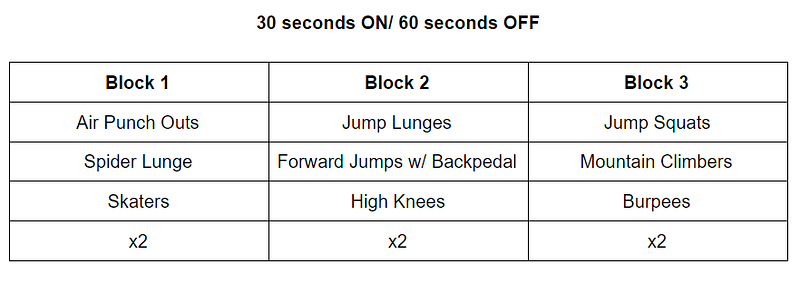
This is a great standard HIIT workout, with movements designed to target your shoulders, chest, legs, and core. It’s one I’ve personally been doing for the past month, and it kills me when the burpees come around! You will exercise for 30 seconds with 60 seconds rest after each movement. Feel free to try this workout with different work-to-rest ratios. If 30 seconds on/60 seconds off is too much, raise the rest to 90 seconds.
Cardio HIIT workout
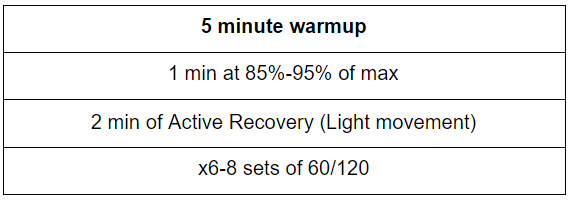
Cardio is one of the best pairings with HIIT, and this workout will greatly develop your VO2 max when compared to any steady-state cardio. The workout can be done running, rowing, climbing stairs, or on a bike. Your focus is making those 60 seconds at a high intensity. At the end of the work period, you should very strongly feel like you need to rest but still be able to maintain an active rest during the recovery time. Remember, intensity is based on what’s difficult for you, not how fast someone else can go.
Low-impact HIIT workout
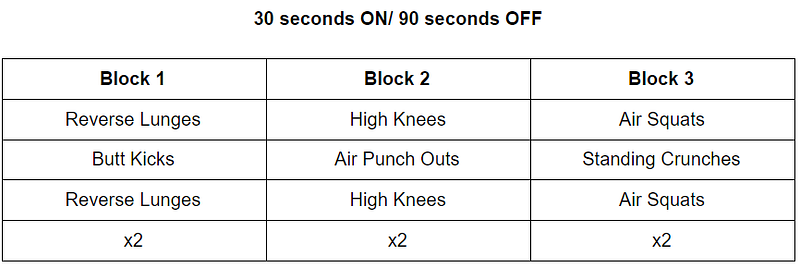
This HIIT workout keeps you off the floor, limits jumping movements, and allows the use of support, if needed. With any of the squat or lunge movements, feel free to use a wall or chair for assistance in balance and support.
I am so excited for you to implement HIIT into your fitness journey. I hope these workouts provide a new sense of excitement and sustainability when it comes to your fitness journey.
HIIT workouts can have unlimited flexibility as long as you keep the intensity and work-to-rest ratios within the guidelines. You’re going to kill it!