
How to Use Grammarly Without Sounding Like a Robot
Knowing what to ignore is key to keeping your authentic voice
Many writers use Grammarly to eliminate grammatical errors. Publications on Medium recommend using it before submitting articles because it saves them time editing and publishing so many articles. However, if you follow all of Grammarly’s suggestions, your writing will be monotonous, inhuman, and will lack personality and taste.
Publications Require Grammarly
For instance, Mind Cafe, one of the most popular publications, states in its submissions guidelines they want writers to proofread with Grammarly.
…we highly recommend that all of our writers run their work through Grammarly. when we receive a draft, we don’t want to see more than a couple of critical errors, and Grammarly will help you fix these easily (and for free).
The editors of Mind Cafe also state that they’ve become affiliates for Grammarly because they’re so passionate about the application.
the free version of grammarly will help you with:
spellchecking: grammarly detects correctly spelled words used in the wrong context. you can stop worrying about misusing homophones like lose/loose, affect/effect, lie/lay, there/their/they’re, and many other commonly confused words.
grammar checking: grammarly can fix hundreds of complex grammatical errors, including subject-verb agreement, article use, and modifier placement, to name just a few.
Grammarly and Me
I won’t deny the value of Grammarly. I’m dependent on it when I write because English is my second language. In fact, I relied on it so much that I even paid for the premium fee for a while. I know it’s crazy, but I desperately wanted to be a better writer, and it seemed pretty affordable compared to the exorbitant price of online writing courses that influencers offer.
Still, I have mixed feelings toward Grammarly. It’s easy to use and convenient, especially for non-native English writers. However, you shouldn’t forget the fundamental fact that Grammarly is a supplemental tool and can’t detect everything you need to know. If you edit just as Grammarly suggests without thinking, you won’t improve your language skills that are key to becoming a better writer.
As a non-native English writer and a heavy user of Grammarly, I’d like to review what suggestions we should follow, what we should be aware of, and ultimately, what to ignore.
Advice Worth Following
Spellchecking
Yes, that’s why we need Grammarly. I call myself a typo queen because I make so many spelling mistakes. But be aware that Grammarly can’t tell the difference between words that are close together, such as loyalty and royalty, pallet and palette. Its AI can’t tell whether those nouns are used in the right context, so only people can find these types of mistakes.
Grammatical errors
As Mind Cafe editors say, it’s suitable to find basic grammatical errors such as subject-verb agreement, article use, and modifier placement. However, we should be careful when it claims other grammar errors because the errors programmed into Grammarly aren’t always actual mistakes.
No-Go Advice
Passive voice
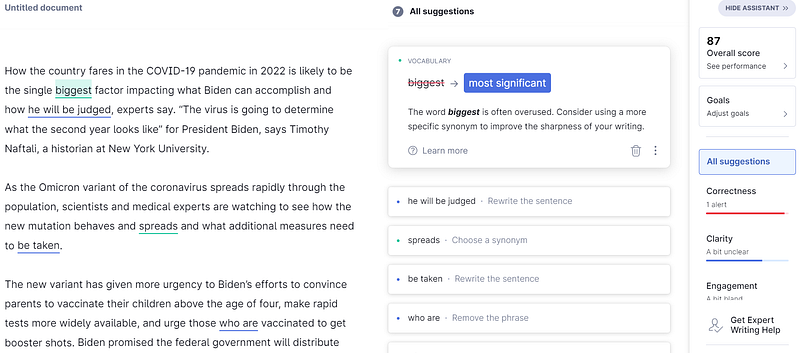
Grammarly doesn’t like passive voice. When you write in passive voice, you’ll always get the suggestion to rewrite it in active voice. Although non-native English writers may overuse passive voice, there are times it is necessary, such as “measures need to be taken.” Unless there is a way to come up with a subject to recompose the sentence, you can stick to the original sentence.
Prepositions
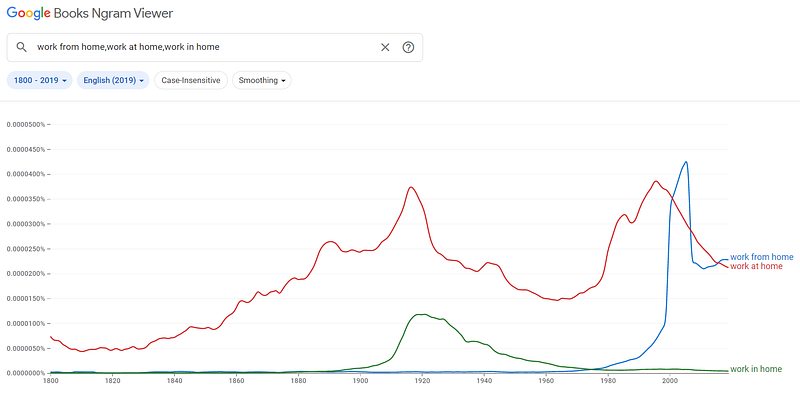
One day, when I was checking my student’s essay, Grammarly tried correcting “work at their homes” to “work in their homes.” I suspected “work from” or “work at” must be common, so I confirmed their frequencies using Google Books Ngram Viewer.

Google showed the below result. My mild surprise turned mounting suspicion based on this chart. Now I don’t trust Grammarly blindly and always make sure to double-check with other search engines.
Wording suggestions
- Conciseness: Grammarly will often highlight things as “wordy,” but of course, you can ignore it if you like the original tone. If you really want to use “absolutely,” you can definitely go with it even if Grammarly suggests removing these adverbs. Also, when it marks a sentence as “hard to read” because of the length, stick to your writing if it’s readable.
- Vocabulary: Grammarly tells us when we use overused, archaic, or overly complicated words. For example, Grammarly will always suggest changing “important” to “essential” or “necessary” because it’s overused. That’s not a perfect solution because important things are not necessarily necessary. Wording is critical for writers because it defines the tone of the piece. I recommend not following all the advice Grammarly gives you.
- Variety: When specific words are used repeatedly in a document, Grammarly reminds us to change them. It’s helpful if you find appropriate alternatives, but often, its recommended synonyms are not the right ones. For instance, when I wrote a piece about origami, it encouraged me to change “papers” to “reports”, “articles”, or “documents.” Unfortunately, origami papers are none of these, so I shut down the pop-up.
Articles
When you use non-English names for things, it doesn’t always suggest the use of an indefinite or definite article before the word. Because it could be a name or a place, and Grammarly can’t tell the difference.
Conclusion
Running Grammarly after composing my essay is still my routine. But for me, it can feel like a battle. Sometimes, I quickly delete its suggestions saying, “no way,” and other times, I grumble but follow its advice anyway.
After running Grammarly, I usually have another round of peer-review with human beings I trust and respect as a writer because they’re the best reviewers, even if they make typos on rare occasions.
Grammarly is helpful for non-native English writers to make sure the piece is error-free. However, we should take its advice with a grain of salt. Its AI can find minor errors, but only educated people can refine the writing to make it stronger.
Follow me for more stories about Japanese culture & society, travel, and parenting. You can also subscribe with the referral link that supports me directly.