How to Use Design Thinking for Your Personal Goals and Development
What’s good for business can also be good for our personal lives

„You cannot solve problems with the same mindset that they were created with” — Albert Einstein
I have been fixated on the idea of developing myself as a person, setting goals, and reaching them for a few years now. During this time I have read hundreds of articles, studied books, and watched a large amount of YouTube videos that all advised me on some areas of personal development and on how to reach my goals. Some had a business focus others were about health and many just about life in general. I have discovered a ton of information on how to develop myself as a person and on how to set and reach my goals. However I always kind of struggled to pull through with these when my circumstances changed or I found new information on the way. What I haven’t really discovered is a flexible but organized approach to personal development that provides me with actions to take but also adapts to the changing conditions in life.
At the same time, I have been working as a business and IT consultant in the area of digital innovation and software development. In short, we focus on optimizing and solving companies’ problems with new ideas and technology. We heavily use a methodology called design thinking. It’s valuable for solving problems in a structured yet flexible and creative manner. Generally, separating my work from my personal life, I have never considered using techniques from my profession to optimize my personal development or to reach my personal goals.
Recently, this changed. I participated in a meet up hosted by agile coach Tobias Göppel who did just that. It was an organized workshop on how to use the design thinking framework for your personal development. Brilliant! Why have I never thought of this? It makes total sense. Why should we use these great techniques with proven effectiveness only to help our companies? Why not adopt them for our personal lives, too?
So, I did. I want to share with you how I did this and inspire you to do the same.
Firstly, I will give you a quick overview of the design thinking framework. Secondly, will dive into the how’s and what’s of using design thinking in self-development.

Design Thinking: A short introduction
Design thinking is a combination of process, methods, and mindset for solving problems creatively focused on the customer. As such, it is an extension of the human-centered mindset. Though there is no one correct design thinking process, a rough outline of the workflow looks as follows:
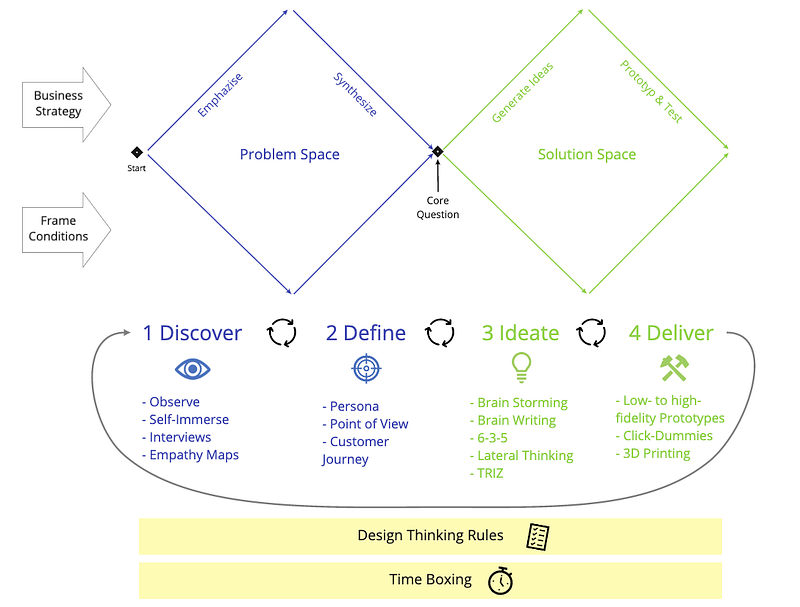
Based on the high level business strategy and the frame conditions provided, 4 steps are conducted iteratively.
- Discover: In this phase, we open the so-called problem space. We observe and emphasize with the customer to understand their situation and problem better.
- Define: Now, we close the problem space by synthesizing our observations into a core question that we want to answer.
- Ideate: Then, the more creative part begins. We open the solution space. Here we use creative techniques to accumulate as many possible solutions as possible.
- Deliver: From all the ideas gathered before, we select a few good ones for which we build prototypes. We repeatedly test these prototypes with the customer and iteratively develop them further into complete products.
At any time in the process we are ready to go back to an earlier stage if we feel like we’re not on the right track.
During the whole process we use strict time boxing for each activity and follow our predefined design thinking rules. These may include guidelines such as Leave titles at the door, Don’t criticize, Build on the ideas of others, or simply Have fun.
In literature, different process outlines can be found, but the underlying concepts remain the same: The uncompromising focus on the customer and the iterative approach through the problem- and the solution space to resolve the problem.
Applying Design Thinking for Our Personal Development
It’s time to put the theory to work for ourselves. For the following steps, it is useful to ask friends or family members for help, as external perspectives and ideas can help us see things clearer and spark our creativity. However, you can also do by yourself without a problem.
Phase 1: Discover
We start by getting an in-depth understanding of the customer i.e. ourselves. The topic of understanding ourselves and our motives has without a doubt the potential to fill entire books. And, it does. For the sake of the length of this article, we’ll skip the psychoanalysis part. In practice, here are the two easy steps that I recommend you do:
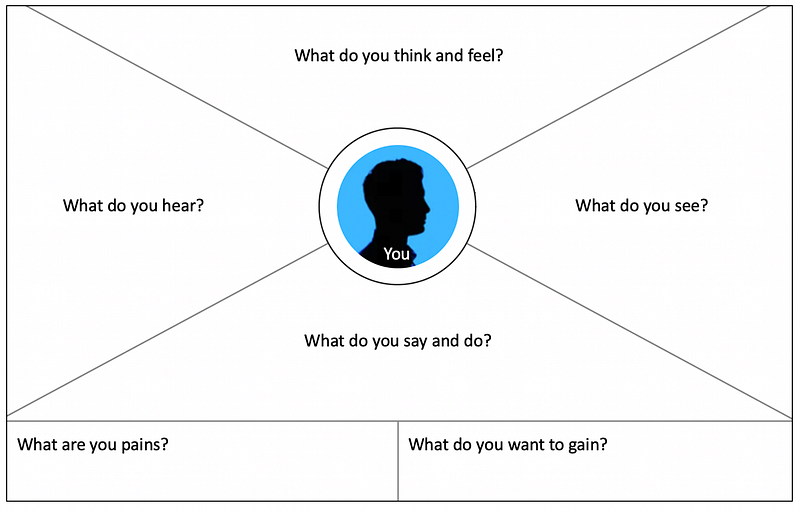
Firstly, take an empathy map as shown in the picture below and describe yourself:
- What do you hear and see in the world around you, e.g. other people and media? Focus on the influences that you might be open to. For example: People traveling to amazing places or Gossip, or How I met you mother, or Articles on personal development on Medium, or simply Clouds and Rain. You get the idea.
- What do you think and feel? Why do you think and feel these things? E.g. I have to make a fortune to be happy, or I feel stuck in my job, or I would love to have more impact on other people’s lives.
- What do you say and do? For example: I started reading articles on happiness, or I started a blog, or I would love to live on Bali for some time etc.
- What are your biggest pains? For example: “I don’t have enough time or energy besides my job to work towards my personal goals” or “I feel too dependent on external validation” or “I don’t have enough money to travel” etc.
- What do you want to gain? E.g. The ability to work on my personal goals besides my job, or Freedom from external validation, or A fulfilling job.
Then, in the second step of this phase, meditate. Really? Yes. Bear with me. It helps you to dig deeper inside yourself and understand yourself better. So what do you have to lose? Try it. Start by sitting down, closing your eyes, and relaxing. Then only pay attention to your breath and let go of anything around you, especially your thoughts. Do this for at least 15 Minutes. Then meditate on your situation. Think again of the 6 different dimensions of the empathy map. One after another. Notice the feelings that come up when thinking about the different details. Dare to ask why. Maybe you’ll realize that you missed some important points. Or that you have to change the map fundamentally.
At any time during this exercise: Stay true to yourself. Go where it hurts. That’s the way.
Truth — more precisely, an accurate understanding of reality — is the essential foundation for producing good outcomes — Ray Dalio
Keep working on this until you feel that you understand your current situation, with your pains and gains well. Then move on to the next step.
Phase 2: Define
Now it’s time to synthesize your findings into the core question towards your ultimate goal that you want to reach. You should deduce that question from your personal Gains that you identified. The core question should be SMART. That means that it should satisfy the following requirements:
- Specific: The goal of the question should be precise.
- Measurable: You should be able to know when you reached your goal.
- Achievable: It’s good to think big but it should be realistic.
- Relevant: Is it the right question to ask towards your goal?
- Time-bound: When are you going to achieve it?
A core question could look like this:
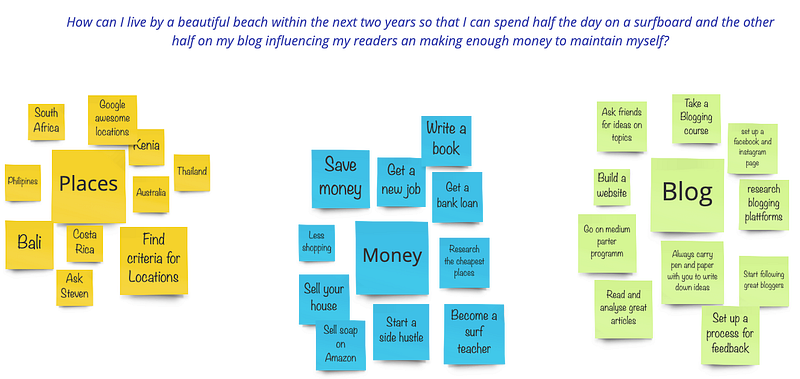
How can I move to live by a beautiful beach within the next two years so that I can spend half the day on a surfboard and the other half on my blog influencing my readers and making enough money to maintain myself?
or in a more generic fashion like this:
How can I double my resilience in the next 10 months so that I can feel more independent of the external factors that are out of my control?
The latter is a tough one, as you’ll have to break down resilience into all the factors that influence it and then ask a core question on each one of those. Anyway, it is possible, it might just take longer.
After this phase, being aware of your goals and what to strive for should already give you some comfort.
And now the fun part can begin. Align your energy towards your goal. Answer the question. Solve your problem:
Phase 3: Ideate
Start by gathering ideas on how to reach your goal. Here you must be open-minded. Stimulate your mind. Be creative. Think outside the box. Be wild. Don’t think about execution. You’ll have plenty of time to worry about feasibility later. For now, just free yourself from any concerns and mental barriers. Use brainstorming or other creative techniques to do this. Ideally, partner up with other people as building on each other’s’ ideas is a basic concept in design thinking and usually results in better results. Here are a few creative methods that I enjoy applying:
- Brainwriting
- 6–3–5
- Lateral Thinking
- Morphological box
- TRIZ: The 40 principles of innovation or substance-field-analysis
Collect all the ideas that you come up with on sticky notes, ideally on a blank wall. When you have your creative mind exhausted, take a short rest.
Next look at the wall of ideas. Go over each one of them and group similar ideas. Drop ideas that seem too far-fetched.
Then, when you have assembled a couple of groups, study them in detail. Saturate these ideas with additional inputs, again using sticky notes.
Phase 4: Deliver
Elaborate on the ideas that seem most promising. Do research. Analyze options. Formulate hypotheses. Create decision criteria. Put your findings together like a puzzle. Eventually, you will have to discard one idea after another until you have worked out the most promising solution to your core question.
Document your solution. This could take any form. It could, for example, be a detailed roadmap, a flip chart with drawings, a booklet, a website…anything. Whatever fits your solution best.
Finalize your solution. Work towards you goal step by step always gathering as much feedback from friends, family, or other people that could be helpful as possible. Also take enough time to align with your pains and gains. If necessary, adapt.
Final Note
At any point if new information emerges or generally your circumstances change, don’t be afraid to go back one or more steps. This is normal and helps you to find your direction. With design thinking, you have a great framework to guide you, to help you to adapt and to continue towards your goals. Always imagine that you deliver the solution to your core question in the form of a product to a customer. You would want to sell a well-thought-out and completed product that perfectly addresses the customer’s need, right? In this case, the customer is you. The product is your goal and your plan to reach it. And the price is your life. So the stakes are high. Take responsibility and act accordingly. Do the necessary work. Do it for yourself. You deserve this. And remember to enjoy the process itself because life happens in the present moment.
You’ll find more on why taking responsibility is the first step to freedom here:
I hope this helps you and I would love to hear about your experiences.