
How to Use Culture to Create the Best Employee Experience
Using the Tool of Social Construction

In the beginning, it is important to understand that culture is what the organisation “is”, and not something that the organisation “has”.
The best employee experience is the result of an organisational culture that engages and aligns their emotional commitment to the organization and its goals because they are emboldened and empowered to use exceptional discretionary effort.
Organisations evolve as they make sense of themselves and their environment. As a social organism, the organizational survival instinct seeks to reduce uncertainty through information flows, and the organization is enacted through the interpreted meaning of individual actions.
Culture is the fusion of beliefs, values, norms, and behaviors that provide the organisational cultural character. The degree of cohesiveness of organisational culture is the extent to which its members have internalised the beliefs, attitudes, and values within the organisation, as manifested in their individual and collective behaviors.
Organisational culture is therefore both an adaptive regulatory mechanism, uniting individuals into the organizational social structures, as well as a necessary means to create adaptive organisms operating within their environment.
The implications of such a perspective are that organisations would behave and act as a consequence of how it interprets their world. It is this enactment and interpretation process that constitutes the essential dynamics of organisational culture.
CREATING A CULTURE OF EMPLOYEE ENGAGEMENT
Open system perspectives in organisation theories see organizations both as hierarchical systems and as loosely coupled systems. In open systems, there is some semblance of clustering and levels where multiple subsystems exist to specialize in certain system activities. Interdependencies and connections within a subsystem also appear to be tighter than between subsystems. And these “stable sub-assemblies” give a distinct survival advantage to the entire system.
Organizations however do not function as mechanistic cybernetic systems. The normative structures are often loosely connected to actual behavior at both the individual and collective levels. The organization is, in effect, a coalition of groups and interests, with each attempting to obtain something from the collectivity by interacting with others, and each with its own preferences and objectives. The resulting culture, as the constructed organizational reality, is dependent on the degree to which a group of people shares many beliefs, values, and assumptions that encourage them to make mutually-reinforcing interpretations of their own acts and the acts of others. This loose coupling nature of organisation is a key ingredient in enhancing the quality of adaptability in the organisational culture.
Adaptability presumes learning. In this respect, culture refers to what is learnt. Therefore, if culture is learned, its ultimate locus must be in individuals rather than in groups. A satisfactory cultural theory must therefore explain the sense in which one can speak of culture as being shared or as the collective property of a group of individuals, and it would have to identify and describe the processes by which “sharing” emerges.
To become the organisational culture, employee engagement is therefore learnt and not taught. The desired exceptional employee experience is the outcome of a learning organisation that transforms the employee engagement idea into its organisational culture.
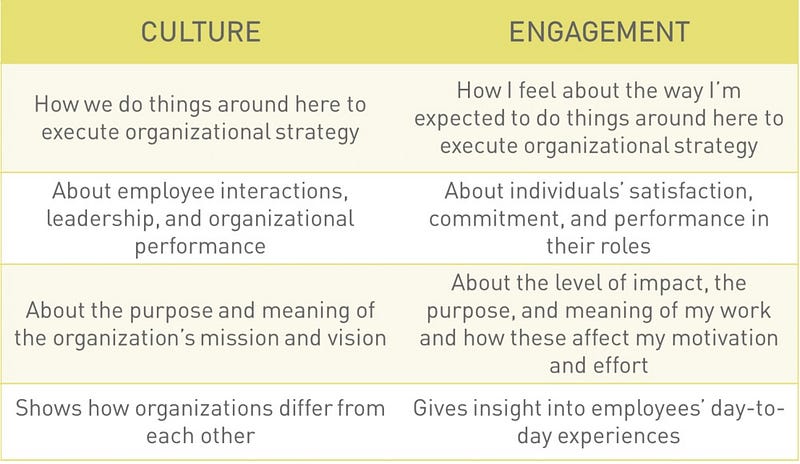
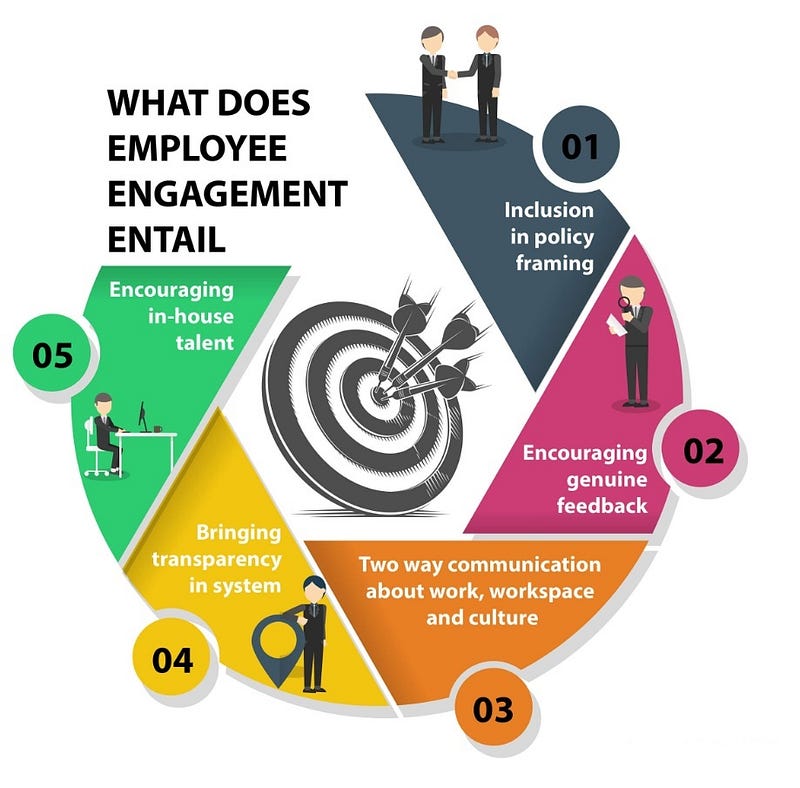
There is no clear single definition of employee engagement. The different expectations of each organisation have spawned various indicators and quasi-measures purportedly measuring their respective culture of employee engagement.
USING SENSEMAKING AS THE SOCIAL CONSTRUCTION TOOL
An important concept in understanding culture is the idea of “social construction.” That is, there is no absolute version of the world — rather one makes interpretations according to his perception systems. This operates at both the individual and collective levels. The meanings that we attach to our interpretations are our “social constructions.” The concept of social construction leads to the notion of organisations being essentially socially constructed realities that rest as much in the hearts and minds of their members as they do in concrete symbols, artifacts, and sets of rules and relationships. Shared meaning, shared understanding, and shared sense-making are all different ways of describing cultural formation. Culture, therefore, refers to the process of reality construction that allows people to see and understand particular events, actions, objects, or situations in distinctive ways.
The notion of culture as a value concept is not new. The empirical reality becomes “culture” to us because and insofar as we relate it to value ideas. It includes those segments and only those segments of reality that have become significant to us because of this value relevance. However, only a small portion of the existing concrete reality is colored by our value-conditioned interest and this alone is significant to us. It is significant because it contains relationships that are important to us due to their connection with our values. Cultural patterns have an intrinsic double aspect: they give meaning, that is, objective conceptual form, to social and psychological reality both by shaping themselves to it and by shaping it to themselves.
“Sense-making” describes the meaning-sharing development process. Sense-making is the process of clarifying and appreciating the potential of relationships, in the evaluation of the external environment. These processes of sense-making are essentially learning processes.
Sense-making is an overall “meaning-giving” activity that is grounded in identity construction, retrospective, enactive, social, ongoing, focused in relation to extracted cues, and driven by plausibility, not by accuracy. This activity consists of the processes of enactment, selection, and retention, which are located on the aggregation level of the organization, not of the individual. In the end, sense-making in organizations creates a structure of shared meanings and understandings based on which concerted action can take place. A network of shared meanings and interpretations provides social order, temporal continuity, and contextual clarity for members to coordinate and relate their actions.
Sense-making is a never-ending attempt to reduce multiple meanings (equivocality) and handle complex informational data confronted by people in an organisation.
“Enactment” describes the way an organisation as a social organism adapts and adjusts to its environment by acting upon it to change it. Enactment involves defining the beginning of information management, followed by selection which is narrowing down the equivocality, and then deciding what to deal with and what to leave alone, ignore, or disregard. And finally, retention refers to the decision as to what information, and its meaning, employees will choose to retain.
Sense-making, when seen as a uniquely different organisational learning process, demands a more radical approach than normal individual learning which occurs when people give a different response to the same stimulus. Cultural organizational learning occurs only when groups of people give the same response to different stimuli. Organisations are patterns of means-ends relations deliberately designed to make the same routine response to different stimuli, a pattern that is antithetical to learning in the traditional individual-focused sense.
Organisational transformation involving cultural change must therefore aim at organisational cultural learning in order to obtain a sustainable and enduring change.
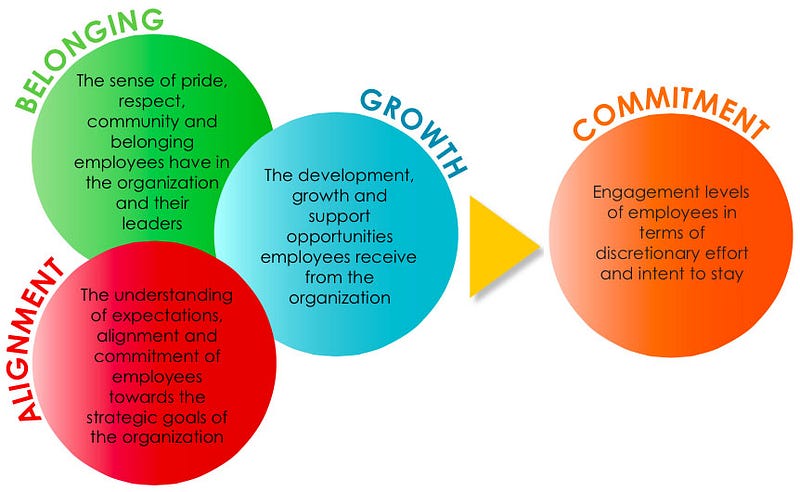
A social psychological transformation of organizational citizenship blossoms as the desired employee experience emerges through the sense-making activities to fuse meaning-sharing for a psychological contract which has empowering emotional and cognitive elements. The end state is emotional and intellectual involvement and commitment that leads people to do their best work, and exhibit behaviours associated with the radical employee engagement ideology, now culture, such as:
· employees consistently speak positively about their organisation to co-workers, potential employees, and customers;
· employees have an intense desire to be part of the organisation; and
· employees exert extra discretionary effort to actively contribute to the business success.
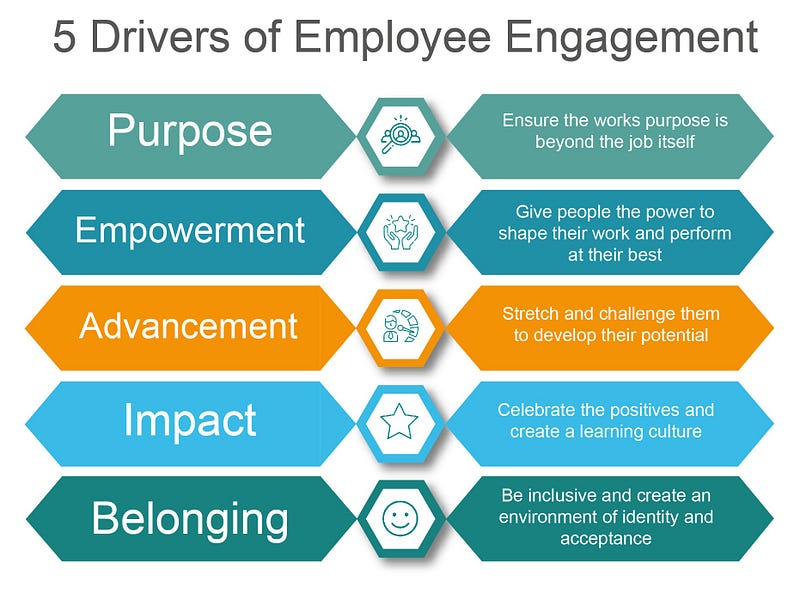
Within a high employee engagement culture, engaged employees internalise a sense of emotive attachment towards their organisation, which empowers investing themselves in both their work role and in the organisation as a whole. These employees use their talents to the fullest in support of the organisation’s vision and mission goals through dedication and commitment, voluntary discretionary efforts, and advocacy.
Please enjoy my recent Articles.
You can also subscribe to my stories and social media posts via your email. Enjoy more interesting Articles by signing up for Medium here: