
Writing
How to Use Block and Pull Quotes
Being consistent in your writing style can add to your credibility.
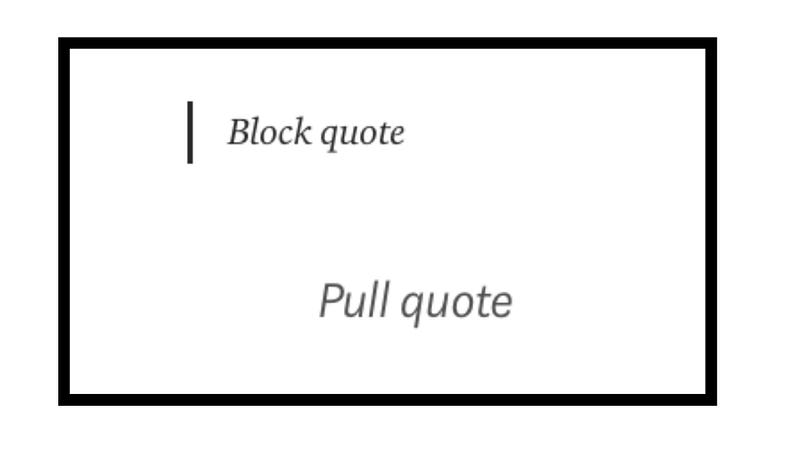
When blogging became mainstream almost 20 years ago, it allowed writers to engage in the online medium without the constraints of writing conventions typically reserved for the print medium. Writers could color their text, poets could reset margins for their words, and visual storytellers could add photos to their stories. Writing online would open up new expressions of the creative process.
On the other hand, we have to ask ourselves the purpose of our message. Is it to inspire? Is it to move people emotionally? Is it to engage? Or is it to inform? As a communication professor and a writing instructor, I always look at how the medium can enhance the message, and how it can interfere with the message to be conveyed.
In nonfiction works, we might draw a quote from the works of others. It might be a passage that inspired us or a quote that reinforces our line of reasoning. In employing quotes on the online medium, we can borrow from the writing conventions of the Associated Press so that our writing style doesn’t confuse the reader. These conventions also create consistency across all the works on a particular website or blog. You’ll also see some similarities across other writing conventions in nonfiction writing, such as MLA Style or Chicago Style.
A typical quote
For typical quotes of a sentence or two, you can use the quote in a typical paragraph. “You’ll need to use the double quotation marks around the quote, and then attribute it to the writer or speaker if it’s not apparent in the surrounding sentences,” she said. Also check the punctuation, noting that if the attribution comes within the sentence, the end of the quote has a comma, not a period.
“If the attribution comes in the middle of the sentence,” she said, “then you can put the period at the end of the quote, inside the quotation marks.” Notice that this quote is only a few lines. For longer quotes or passages of text, you’ll use a block quote.
Block quotes
Although different writing guides will have different rules for how many lines or words will require a block quote, a good rule of thumb is about 3–4 lines of text. You don’t attribute the writer or speaker within the block quote. Instead, you can introduce the speaker in the preceding text. Some will use a colon, which will look something like this:
For block quotes, you don’t need to insert quotation marks. Because the quote is already set apart from the main text, it is unnecessary. The only reason you would need quotation marks within a block quote is if the passage of text has a quote within it. “If this is the case, you’ll use the double quotation marks,” she said.
Pull quotes
Pull quotes aren’t necessarily quotes, although they can be. Pull quotes are sentences “pulled” from the main text for emphasis. They also provide the reader with a visual break, which is necessary when reading longer texts.
A pull quote should be short and used sparingly. I like to use them to separate my work into sections. The pull quote should appear somewhat near the main text from which it pulls. In other words, you can put them a paragraph or two before or after the original line of text. You don’t want to put the pull quote directly before or after the original line of text.
You don’t want to put the pull quote directly before or after the original line of text.
Notice how awkward that is. Avoid using pull quotes as an echo effect.
Don’t put your own text into pull or block quotes
Notice that my examples of quotes above, I used my explanations as part of quotes. It was mostly to explain what I was doing within the text itself. If you put your own words into quotes, it should be while relaying your own story or recalling words that you’ve written elsewhere.
In other words, you don’t want to use your own words pull quote or block quote just to make your text more interesting to read. If anything, it confuses the reader, who is wondering who is being quoted.
You can add to your own writing credibility not only by using quotes, but also by using them appropriately. By adopting some writing style conventions, the reader can focus on what you say rather than how the words appear on the screen.


