
How to Use a Christmas Carol to Drive Your Personal Change
Use this classic tale to affect lasting change.
Personal development is hard. That’s because personal development requires us to change. And people resist change for many reasons. It’s scary. It’s a lot of work. It may require you to be different. You might need to sweat in public. Or hug people who smell.
If you’d summarize all these reasons in a single word, it’d be pain.
Here’s the problem: most people won’t change until the pain of not changing becomes too great. A classic story illustrates this:
A farmer was on his way home when he passed his neighbor who was sitting on the porch of his home. Beside him lay a dog, curled up and whimpering in pain. The farmer approached his neighbor. “Hiya neighbor, I noticed your dog seems in pain. What is the matter?”
His neighbor looked at the dog. “You’re right, he is in pain. He’s sitting on a nail.”
The farmer was perplexed. “But why doesn’t he just get up?! Clearly, it hurts a lot!”
His neighbor shrugged. “I guess because it’s not hurting enough yet.”
People won’t change until the pain of not changing becomes too great.
Like the dog in the story, people will suffer for a long time before they’re motivated enough to make a change. This could mean spending months, sometimes even years, experiencing the pain of not changing.
This is no way to live.
What if we could speed up the process? What if we could change before the pain becomes too much to bear?
What if we could change even before we experience any pain at all??
Fortunately, we can. To know how, we turn to another classic story: A Christmas Carol by Charles Dickens.
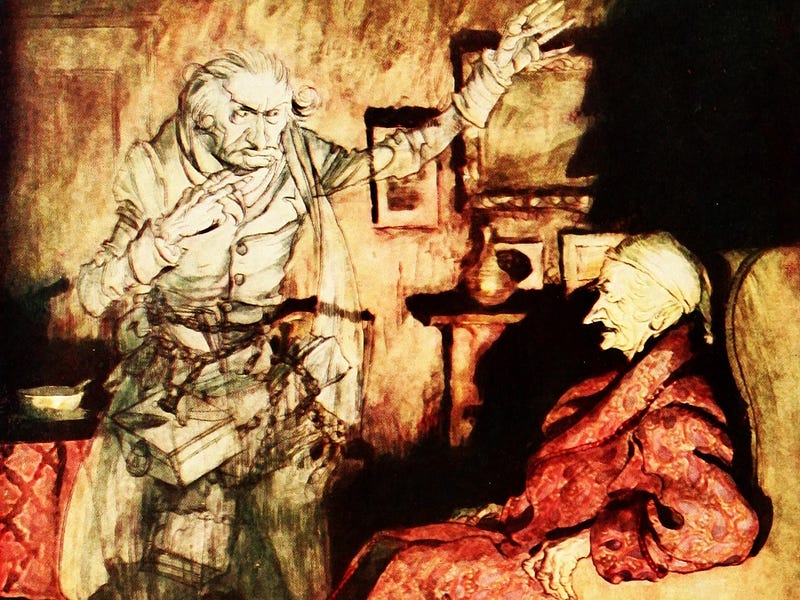
In A Christmas Carol, we meet Scrooge, a mean-spirited and selfish man who hates Christmas. One particularly cold Christmas eve, Scrooge is visited at home by the ghost of his old business partner, Marley. Cursed, Markey wanders the Earth entwined by heavy chains and money boxes forged during a lifetime of greed and selfishness. Marley tells Scrooge that he has a single chance to avoid the same fate: three ghosts will visit him. He must listen or be cursed to carry much heavier chains of his own. Later that night, Scrooge is indeed visited by three ghosts: the ghost of Christmas Past, the ghost of Christmas Present, and lastly the ghost of Christmas Future.
The ghost of Christmas Past takes Scrooge to Christmas scenes of Scrooge’s boyhood, reminding him of a time when he was more innocent. The scenes reveal Scrooge’s lonely childhood at boarding school, his relationship with his beloved sister Fan, and a Christmas party hosted by his first employer, Mr. Fezziwig, who treated him like a son. He shows Scrooge’s neglected fiancée Belle ending their relationship, as she realizes he will never love her as much as he loves money. Finally, they visit a now-married Belle with her large, happy family on the Christmas Eve that Marley died. Scrooge, upset by hearing Belle’s description of the man that he has become, demands that the ghost remove him from the house.
Then the ghost of Christmas Present takes Scrooge to a joyous market with people buying the makings of Christmas dinner and to various celebrations of Christmas. Scrooge and the ghost also visit Scrooge’s clerk, Bob Cratchit’s family feast. Here Scrooge meets Tiny Tim, a boy who is seriously ill. The spirit informs Scrooge that Tiny Tim will die unless the course of events changes.
Finally, the ghost of Christmas Future shows Scrooge a Christmas Day in the future. The silent ghost reveals scenes involving the death of a disliked man whose funeral is attended by local businessmen only on condition that they provide lunch. When he asks the spirit to show a single person who feels emotion over his death, the ghost shows him the pleasure of a poor couple who rejoice that his death gives them more time to put their finances in order.
When Scrooge asks to see tenderness connected with any death, the ghost shows him Bob Cratchit and his family mourning the death of Tiny Tim. The ghost then shows Scrooge a neglected grave, with a tombstone bearing Scrooge’s name. Sobbing, Scrooge pledges to change his ways.
The next morning, Scrooge awakens to the realization that none of what he has seen of his future has happened. Overcome by emotion, he indeed changes his ways, becomes a kind, generous and compassionate man who is, above all, loved by those around him.
A Christmas Carol is a wonderful story that shows us how even the most stubborn people can change. It also shows us a hint on *how* they change. And perhaps most important, stay changed.
I was first introduced to this technique when I was pursuing my certificate as an NLP Trainer. Since then, I have used the Dickens Technique on myself and with various clients and always with great (albeit sometimes unexpected) results.
Before I take you step by step through the technique, I must point out that there are actually two versions of the Dickens Technique, a shorter version, and a longer version. I have found the shorter version just as powerful as the longer, however, sometimes the longer version may be necessary. I’ll briefly explain the longer version after I explain the shorter version.
Also, a word of warning. While pretty simple, The Dickens Technique is a powerful technique and can be very painful (that’s kind of the idea). I’d therefore strongly suggest you only use this technique in a safe environment and when you have time afterward to go through, whatever emotions may have surfaced. Having a notebook handy to write your thoughts is a good idea, too.
So how does it work?
The Dickens Technique is a technique that combines the power of visualization with the concepts of pain and pleasure. The easiest way to explain is to go through the steps together. I will take the role of the coach talking to you as one of my clients. I’ll add explanations of the distinct steps in between.
You can work through the steps by yourself, in your head, or by writing stuff down. Or you can use a partner to talk you through the steps. In the latter case, it can be easier for you to get “into” the technique which will make it even more powerful.
Before we begin, make sure you know what you’d like to change. This could be a habit of action like overeating, a habit of thought like thinking the worst of yourself in some situation, a personal circumstance like where you work, or basically anything you’d like to change.
First, I would like you to imagine (if you are doing this by yourself you can also write it down) the present. I would like you to close your eyes and take a few deep breaths while you really associate with the habit you’d like to change. How do you feel when you perform the habit? What do you say to yourself when you perform the habit? What do your surroundings look like? Are there any sounds or smells you would associate with the habit?
What we are applying here is yet another powerful concept called association. Have you ever noticed how when people talk about their problems they often talk in the 3rd person? This is often a subconscious way of distancing themselves (aka disassociating) from the problem, making it less painful and somehow not theirs. By asking our client to associate with their issue, we make it more real to them.
Are you feeling it? Good.
Now I would like you to think about, see and feel and hear, what this habit is costing you in the present. What might you miss out on because of this habit? How does the habit affect you negatively? How does it affect your health? How does it affect your work, perhaps your chances of getting promoted? How does it affect people around you? Your spouse? Your kids? Your parents? How does it affect how they look at you? How does it affect how your friends see you?
Again, we’re associating but this time, we’re adding another layer by focusing on the negative impact of the issue, the pain our client is suffering (either consciously or subconsciously) by maintaining the habit.
How does that make you feel?
This is a good moment to pause, whether you get an answer to the question. It doesn’t matter. What matters is that our client gets some time to, for want of a better phrase, wallow in their misery. But we’re not done.
I would like you now to imagine 1 year from now, knowing you have done nothing to change, knowing that you bring everything you are feeling with you, day after day, month after month. Nothing has changed because you have done nothing to change.
Again, pausing can be powerful here. We’re increasing the pain by compounding the effects of not changing over a longer period. Notice how there is no need to get into specific details or to help our client by making suggestions. Trust me on this one. Whatever you can come up with, our brain can come up with something worse. Give it time to do that.
How does that make you feel?
We’re repeating this phrase because it serves to focus the mind of our clients even more on how they’re feeling, which, by this time, isn’t very good. Let’s take it one step further.
Now let’s travel forward in time, to a moment 3 years from now. Imagine how you feel now, having lived with this habit for years, with the pain of not changing for 3 whole years. If you would look into a mirror now, who would you see? How would your body display all the effects that not changing have had on the way you look?
It’s really important to pay close attention at this stage. I remember an instance during my certification that my client suddenly panicked because they could not see themselves anymore! Their habit was overeating and in their future, they have literally died because of not changing. At this point, we broke off the session by skipping ahead to the conclusion. The pain at that point was more than enough.
And what about your family? Your friends? How do they feel about you, knowing you could have changed all these years ago? That you had the strength, the capability, to change, but didn’t? Are they around you? Or have they, perhaps, distanced themselves from you? What effect has this had on your work, on your career?
Pause briefly.
How does that make you feel?
Now, you could continue on like this to include 5 years into the future, or even 10 years. But I’ve found this is often unnecessary. Use your own judgment.
When you feel that you’ve dialed up the pain enough, guide your client gently back to the present.
Now, I want you to imagine that this was all just a bad dream. Take a deep breath. And another. Realize that you are still in the present, and none of this has happened. Yet. Whatever you do now, in the present moment, will determine your future. Imagine now everything you could do to make things better, to make sure that your future is better. Imagine how you will feel if you make these changes, now.
This is the end of the short version of the technique. Let your client open their eyes (if they were closed), stand up, wave their arms, or jump about. Anything to shake off the feelings they’ve just experienced. Then sit down with them and write exactly what they’ll do (and when) to make sure the future they imagined will never come to pass.
In the long version of the technique, you basically repeat the technique of time-traveling, but this time, you take the pleasure of changing as a starting point.
Phew! If you have made it this far, you’ve just learned of the most powerful change techniques I have ever come across. Use it and use it wisely. I’d be delighted to hear about your experience with it. And if you have questions, please let me know.