
How to Understand Your Grief

Grief. A human experience, from which no one is immune. No one. Everybody on this earth will experience some form of loss at some point in their lives. Most people will experience several.
Grief will knock you down a few pegs and steal your breath. Grief will hit you when you least expect it, and also when you think you are prepared. Either way, the ache cuts just as deep.
But if we allow grief to consume us, we cannot move forward, not even an inch. And frankly, that is no way to live.
By the end of this article, You will better understand your own experience of grief, and how you can learn from it, keep living, and grow.
Understanding Grief
To understand grief, we must know what the word itself means. Most people are familiar with the idea that grief is a deep sorrow, and that the term is often associated with the loss of someone close. While not exclusive to human loss, grief is still generally reserved for things of significance, like the death of a pet or the loss of a home to a fire.
As often as we say or hear phrases like “I’m so hungry, I could eat a horse” or “I was so mad, I thought I was going to explode,” we tend to show a bit more respect for grief. Rarely would you hear someone say something so exaggerated or trite about grief. We collectively understand that this isn’t the time for jokes.
Grief is deep and unyielding, especially at first. And if we let this grief consume us, we will remain stuck in that can’t-breathe, can’t-eat, can’t-even-see-straight daze that follows loss. Many of us feel what we think is grief, only to truly understand that it wasn’t that at all, when the real-deal shows up. Not all that different from being in love.
I lost my father in January of 2020, after he battled cancer for a year, and kidney disease for a lifetime. At the end, we knew his days were few, as did he. Mentally, we did all we could to prepare for the inevitable. And then the moment came, and none of my preparation mattered anymore. This was Grief, with a capital G.
The Ball in the Box Theory
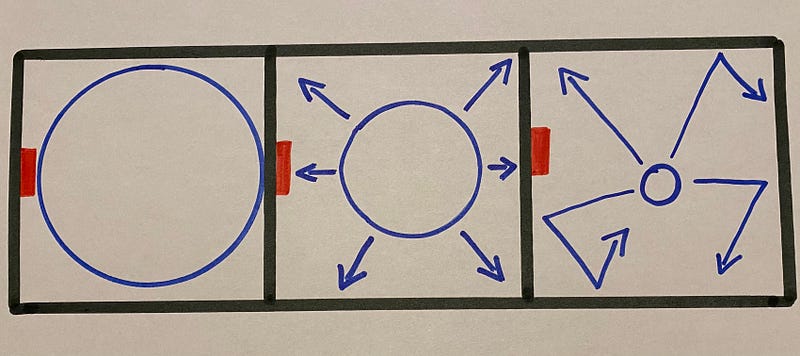
The Ball in the Box Theory has been praised as being one of the most accurate representations of how people experience grief. There is no official attribution for this theory, as its origins are anecdotal. A woman, named Lauren Herschel, brought it to public light through a tweet, in 2017.
https://twitter.com/LaurenHerschel/status/946888282444460033
Imagine life as a box, and on one wall of this box is a button. And every time that button is pressed, we experience pain.
Now, in that box is a ball. This ball is grief, and it gets progressively smaller, as time rolls on from the initial loss.
The First Phase
When we experience great loss, the ball is huge. It practically touches all 6 walls of that box at the same time, meaning, there is no avoiding that ball hitting the button. Imagine an exercise ball inside a moving box. The button is always being pressed and we are experiencing a constant grief that does not let up.
This can be the first few days or even weeks after a loss. We struggle with basic self-care, like brushing our hair or eating properly. We likely don’t sleep well, or we sleep too much. The overbearing, ever-present grief button does not let us. We are raw, and it feels like it will hurt this much forever, because there is absolutely no reprieve.
The Second Phase
After a period of time (how long is dependent on the depth of the grief, how resilient a person you are, and various other personal factors), the ball gets a little bit smaller and has room to move around the box. But it’s still pretty big, like a beach ball. Therefore, that grief button is still being hit frequently and may often be pressed in for fairly extended periods of time. Just a little less constant than before.
On these days, we may be able to eat a little more, choose to take a shower — instead of being told we need one, we may even find brief distraction in a conversation. We know the ball is there, we know the button is there. We anticipate that we will be deeply sad, and we can prepare for the triggers. But once that button is hit, the wound feels as fresh as ever. For me, this meant that I could talk about my dad, and cry. But this was a step forward from not being able to talk about him at all. It had hurt too much.
The Third Phase
After a little more time passes, the ball has gotten even smaller. Now it’s a basketball. It moves much more freely around the box, bouncing from one wall to the next. Frequently, but not constantly hitting the button.
This is when we can start going about our day again, and getting to all the basics. We are showered and dressed, we have tried to eat something, and we may even have somewhere to go or something to do. Knowing that the ball is smaller, it becomes safer to try to return to a degree of normalcy. We can choose to avoid places or things that trigger our grief. In fact, now we are likely seeking activities to keep us distracted, like returning to work or seeing friends. However, that button will still get pushed and knock us down. But it doesn’t stay pressed in like it did before, and we can stand back up, brush ourselves off, and try to get back to what we were doing.
We didn’t sell my dad’s car right away. In fact, we lent it to family members who travelled to be with us after my dad passed. That car was my trigger, so I did everything I could to not have to see it. A conscious choice I was able to make. But the route to my mom’s house takes me right past a cemetery, and I had forgotten that. Button pressed.
The Fourth Phase
More time passes and the ball is smaller still. Now the size of a baseball, only occasionally hitting that button. The difference is, with a small ball and so much room to move around that box, when it hits that button is completely random and unpredictable.
In this phase, we typically are able to go about our day without significant episodes of sadness. But we can still get knocked on our asses by walking past a place you used to go together, or seeing something they would have really enjoyed. My brother happened across a man that was my father’s near-doppelganger. He sent me a picture he secretly snapped of this man, and every wound opened. The old-man hat, the too-big puffy coat, the crook of his nose and the expression on his face. But, as jarring as it felt, we could almost laugh at how uncanny it was. Almost.
The Fifth (and final) Phase
And then we reach the final phase. The ball has undergone it’s final metamorphosis and is about the size of a ping pong ball. There will always be random moments that trigger memories that elicit sadness and even tears. But we wake up each day, confident that we can handle what’s coming our way, because the button is so rarely pressed now, and even when it is, we have spent enough time being sad, that we allow ourselves to recall these memories with a smile.
It’s wise to not become too complacent at any one of these stages, as there will be minor setbacks…times when the ball will grow in size, albeit temporarily. For me, the obvious and predictable ones were my dad’s birthday, which was less than four weeks after he died, father’s day, holidays (where we would be together, were it not for Covid), and the one-year anniversary of his passing.
The less predictable one was when Alex Trebek died. Jeopardy was a family institution, and bragging rights were up for grabs every weekday at 7:30pm. The death of someone he respected so much felt like losing my dad all over again. And on that day, the ball was huge.
Takeaway
Most people know that grief is a process. But having an awareness of how it will change over time can help us predict our reactions, grow from the challenges, and prepare for the setbacks.
The ball in the box theory is the outline for navigating your grief; the checkpoints along your journey. It would be irresponsible to suggest that we all have the same path. Rather, the roads in between these checkpoints are incredibly individual and depend on a multitude of personal factors. Only you can tell when that ball is getting smaller, or when that button is being pressed. But the awareness that each phase we enter is temporary can provide the strength we need to keep pressing forward.
Wishing you all courage on your journeys.


