
How to turn complicated things into playful things
13 things I learned at Dorkbot London, 15th October 2015
1. Play is simple.
You know how cats chase the red spot from a laser pointer? Humans are exactly the same. Tine Bech’s installation ‘Catch Me now’ is a spotlight projected onto the floor, controlled by a webcam and a computer. If you step into the spot, it expands for a few moments, then moves. Simple code = complicated play and lots of laughing.
2. Adults don’t like to play when there are children around
When Tine set up her ‘Catch me now’ at the Science Museum, during the day, it was dominated by children. But at night — during a science museum late opening — the adults felt they had permission and played with it in exactly the same way as the kids. Children are the apex players, at the top of the hierarchy. Only when they’re absent will adults play.
3. Cameras encourage more exuberant, open behaviour.
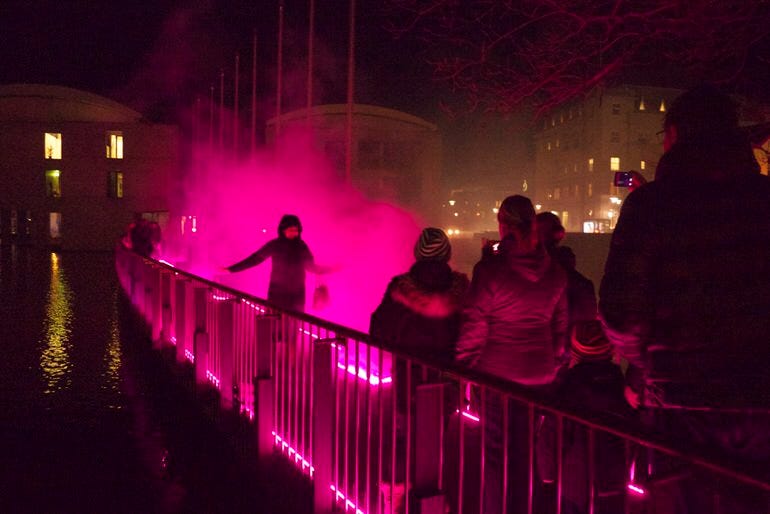
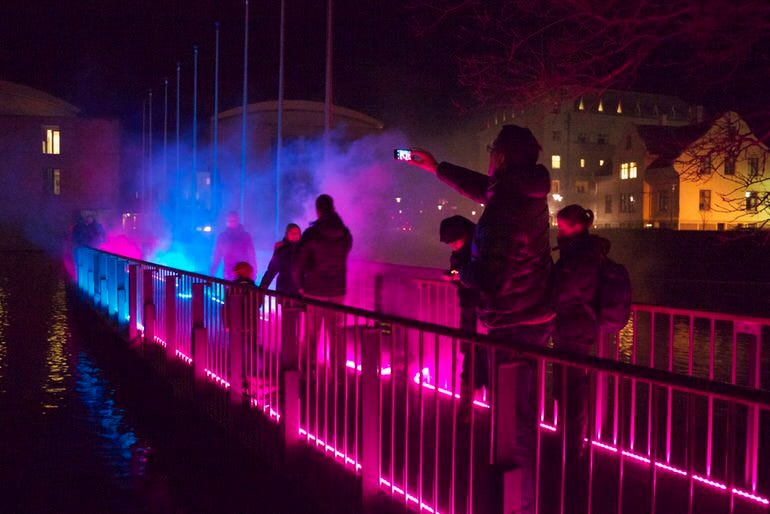
Tine’s installation ‘On the Bridge’ Reykjavik parliament building was a long, narrow bridge. She added motion sensors, red and blue lights and smoke machines — as you walk across, the red light and smoke follows you. People realised it was a great place to take selfies or group shots, and the presence of the camera made them do more — releasing their natural inhibition.

4. Humans are incredibly good at reading body language
For ‘Surface Tension’, Nicola Plant motion captured people explaining pain and discomfort, showing what it was like to have a headache. She isolated specific movements, then built a simple 3D robot arm (three arduino-controlled servos and wooden sticks) to replay those movements. Visitors were able to understand these very simple robot movements as painful or uncomfortable. Nicola is developing her work to help make robots appear more empathetic.
5. Humans can learn complicated interactions quickly through play.
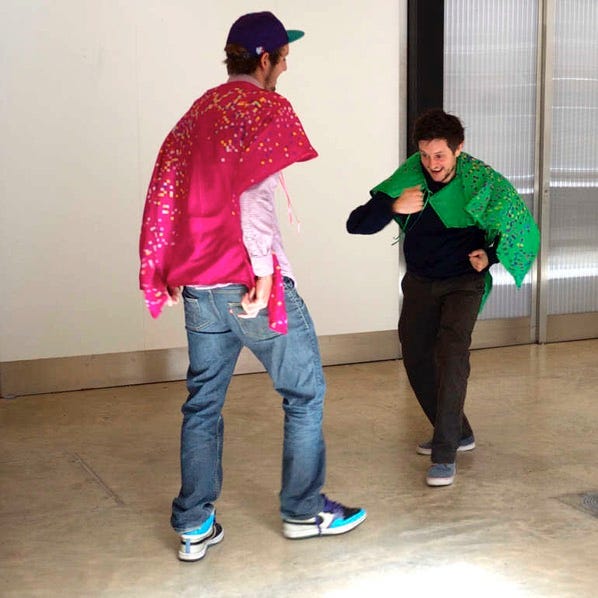
In ‘Tracking You’, Tine Bech gave people coloured capes with RFID Tags on the shoulders. Movements are tracked by a system in the ceiling and used to trigger sounds. Each cape creates very different sounds (big and monstery, or tiny and tinkly) as they move, and nothing when they’re still. When players get close to each other a laser ‘shooting’ sound is triggered. Within seconds of putting on the capes, players ‘got’ the game — adopting characters and body language based on the sounds, shaking their shoulders (that’s where the tags are, so you can create more sound that way) and devising ‘zap zap’ fighting games.
6. Clifton Suspension Bridge has a musical scale
Di Maidstone talked about her hugely successful Human Harp project, using various digital systems to ‘play’ bridges. By bonging all the support cables on Clifton Suspension Bridge, she found that it has a natural scale — a key — but ‘not a very musical one’. And yes, the amazing last shot in her promo video for the Bristol Human Harp project was filmed by ‘a drone piloted by two teenage boys’
7. Trafo Pop = Bikes + LEDs in Berlin
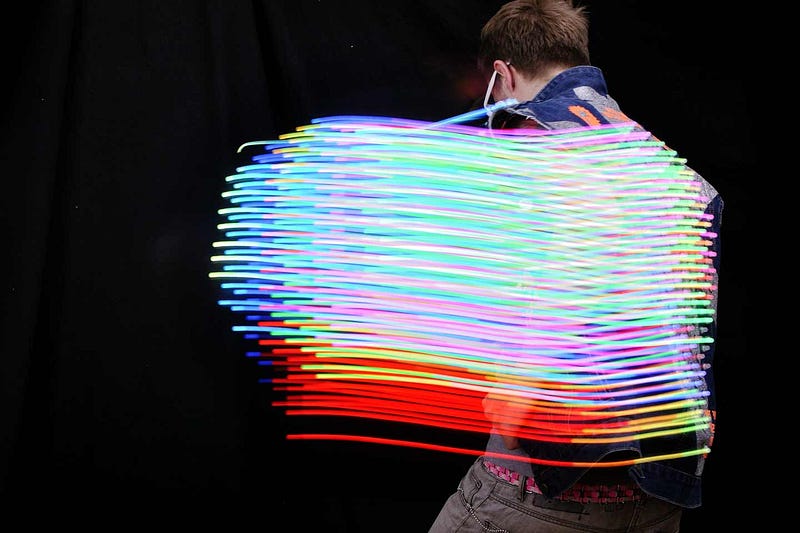
Becky Stewart (from the awesome art/tech training company Codasign) talked about the Trafo Pop movement in Berlin, where people customise denim jackets with RGB LEDs and ride around like a kitsch psychedelic hipster motorcycle gang. It’s a way to get into wearable electronics, coding and making. Becky is looking for a venue and participants to set up a London chapter of Trafo Pop — join her mailing list to get more information.
8. The Berlin Wear-It Festival looked great.
9. Soldering is just another kind of craft
While Becky was talking, one person asked if it was possible to make a Trafo Pop jacket without soldering — Becky’s response was that if you’re using a needle and thread, or an iron, you shouldn’t be afraid of learning to use a soldering iron.
10. Oculus Rift will create lots of new ways to play
Nicola Plant’s new project ‘Sentient Flux’ was inspired by swimming with phosphorescent plankton in Cambodia. The player wears an Oculus Rift VR headset and headphones. Their body movements are tracked by a Microsoft Kinect camera. The whole thing is programmed in Unity. The player’s body is visible to them as a kind of translucent ghost — but when they move, glowing sparks and particles appear streaming from their hands. It’s a relatively simple interaction, but has a dramatic effect on the behaviour of the players. Nicola showed a series of videos — some players start dancing, some wiggle their fingers — and they’re clearly all in a very different world, totally uninhibited.
11. You know when play is working, because the room gets noisy
Tine Bech said she found this the easiest way to judge success. A quiet room isn’t playful. Lots of her videos were healthily noisy.
12. Teaching London Computing looks like an interesting project
They’re funded by the mayor, and offer courses like Computational Thinking, Intelligent Paper, and The Magic of Computing. Nicola Plant is one of the teachers.
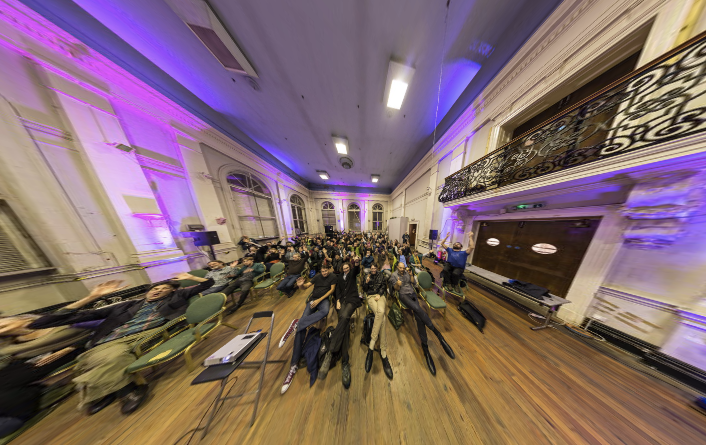
13. 360 photos are amazing, but still quite fiddly
Douglas from z360 bought his 3D photography rig, and took this megapixel photo of the event.
Thanks to Dorkbot London for a great event, find out about future events here.