
How to TRUMP any conflict
“When somebody challenges you, fight back. Be brutal, be tough.”
-Donald Trump
On August 6th, 2015, Megyn Kelly, reporter for Fox News, did what many fear to do- challenge Trump. With a coy smile, Kelly ventured into unthreaded territory, asking, “You have called women you don’t like fat pigs, dogs, slobs and disgusting animals…” The crowd erupted in a roar of laughter and Trump interjected, “Only Rosie O’Donnell.” Kelly discounted Trump’s statement and gave other instances of Trump uttering derogatory statements about women. “Does that sound to you, like the temperament of the man that we should elect as president?”[1] Kelly asked. This question resonated with me and spiked my curiosity on how Trump’s popularity increases despite his unorthodox statements. Other questions like how interpersonal conflicts between adults escalate to the point of name-calling and the role of the media in celebrity conflicts, ran through my mind.
In replying Kelly’s question, Trump turned a simple conflict with Kelly, resulting from her position as a journalist, to an egotistical one. “I’ve been very nice to you, although I could probably, maybe not be, based on the way you’ve treated me,[2]” Trump said. The debate progressed and eventually came to an end but for Trump, it only marked the beginning of the feud with Kelly.
Following the debate, Trump retreated to his twitter fortress to lambast Kelly, retweeting malicious comments about her. This is known as Flaming (Beebe 211). On a follow-up interview with CNN’s Don Lemon, Trump results to personal attacks on Kelly, saying, “She’s not very tough, she’s not very sharp. I don’t think she’s very good.[3]” He continues, “You could see there was blood coming out of her eyes, blood coming out of her… wherever.”[4] Many have drawn the conclusion that Trump was implying that Kelly was on her menstrual cycle, and hormone imbalances caused her attack on him[5]. Trump, however, denied these claims, saying that only a “deviant” would interpret it as such[6]. Notwithstanding Trump’s defense, the blood comment was the last straw for the conservative leaders and much of the public. As a result of the comment, Trump was disinvited to the Presidential candidates’ forum hosted by Eric Erickson, a Red State leader. This feud with Kelly also caused Trump to lose his longest serving employee, campaign strategist, Roger Stone, who resigned because of Trump’s “diversion to food fight” with Megyn Kelly.[7]
The conflict came to a standoff as both Trump and Kelly refused to apologize. Kelly claimed she was “doing good journalism” and Trump believed the question directed at him was “ridiculous and off-base.”[8] I shall intervene at this point, to resolve the conflict as a “communication consultant.”
Analysis of the Kelly-Trump Conflict using Learned Theories.
- The question Kelly posed to Trump began as a simple conflict and progressed to an ego conflict.

A simple conflict stems from parties having different stands on an issue. Kelly believes that Trump is misogynistic and insulting towards women, while Trump believes that he generally confronts people who challenge him. Unfortunately, most of these challengers are women. Rather than discussing the facts of the issue and addressing Kelly’s question regarding Trump’s attitude of name-calling, Trump escalates the conflict to a personal level. His ego manifests as he begins to defend his position and he states that he would reconsider being nice to Kelly. Rather than bury the hatchet, Trump migrated to twitter to further attack Kelly’s physical appearance
What to do next time:
Instead of being defensive and taking the question personally, Trump should have taken a second to breathe and cool off, and then addressed the issue at hand- his improper remarks to women. He should have found an element of truth in Kelly’s statement and admitted his fault rather than taking a defensive position. Yes, Rosie O’Donnell attacked him first, but Trump went overboard is his response to O’Donnell. He used every opportunity to make known his dislike for O’Donnell, to the extent that she says it “was the most bullying I ever experienced in my life, including as a child,”[9]. He, instead of answering the posed question, goes on a tangent about “political correctness.”
2. Self-serving bias plays a role in Kelly’s refusal to apologize to Trump because she views her behavior as more positive than Trumps’. Many people have thin-sliced Trump to be a loud egomaniac and this has contributed to people turning a blind eye to Kelly’s faults. At face value, I thought Kelly was only doing her job in bringing up Trump’s controversies. After analyzing Kelly’s non-verbal, body cues in the video, I came to the conclusion that Kelly posing the question to Trump at the debate, was a vindictive move spurred by the need for increased ratings. Her coy smile before posing the question, and the contraction in her eyes when the audience begins cheering for Trump, signifies that the event probably did not play out as she hoped.
When I first heard Kelly read the statements by Trump, I was infuriated that Trump had the audacity to call women such things. During my research, however, I discovered that O’Donnell had actually began the conflict by calling Trump a “snake-oil salesman[10]” for choosing not to fire the 2006 Miss USA for inappropriate behavior. If Kelly was actually engaging in unbiased and “good journalism[11]” as she claims, she would have presented the background story instead of painting the picture of Trump being a misogynist that actively seeks ways to deride women.
What to do next time:
If Kelly sought to genuinely discuss the issue of Trumps bluntness, she would have asked an open-ended question requiring Trump to explain why he acts in the way that he does, rather than a question challenging his capabilities.
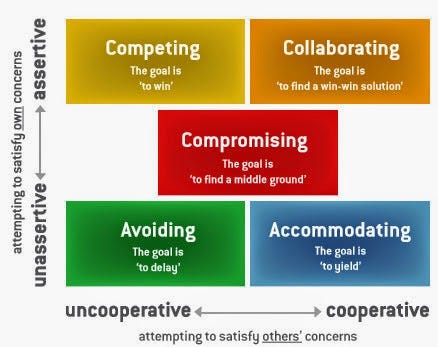
Source: Conflict Coaching, Jones and Brinkert (191)
3. Conflict Styles
Jones and Brinket, writers of the “Conflict Coaching” handbook, advise that confrontation should be avoided when there is a power imbalance and there is no protection from retaliation (166), as is the case in the Trump-Kelly conflict. I think Kelly did a good job in managing the conflict, rather than escalating it as with the Trump and O’Donnell conflict. While avoidance might not be the best strategy in resolving some conflicts, I think Kelly was wise to not engage with Trumps’ taunting. She showed maturity by refraining from personally attacking Trump. Trump on the other hand, refused to back down. He adopted a competitive conflict management style, where a winner has to emerge.
Some have attributed Kelly’s silence to timidity and low self-esteem but I beg to differ. I am of the opinion that it is Trump who has low self-esteem. This is evidenced in how fast he is to state his high rankings, many billions and business acumen. Others might interpret this as pride but I am certain some element of low self-esteem exists. Even at the debate when the question of O’Donnell was brought up, Trump seemed aware of the extent of his statements until the audience began clapping and his confidence was restored.
Intervention Plan
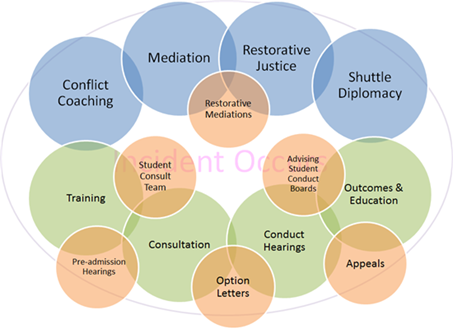
Source: Bing images
I have decided to implement the “Comprehensive Conflict Coaching model” which was consolidated by Ross Brinket. It is comprised of four stages- Discovering the Story, Exploring three Perspectives, Crafting the Best Story and Enacting the Best Story (Jones, Brinkert 33). In order to avoid the eruption of emotions, I would run one-hour coaching sessions for three days, one day for each step, with Trump and Kelly separately. Between these sessions, I would give periodic assessments and reflection assignments to test that the participants are actually learning skills to help them become other-oriented communicators. At the end of the three days, I would bring Trump and Kelly into a room so that they can put their newly gained knowledge into practice. I would act as a moderator in this case, and let Trump and Kelly direct the conversations.
Stage 1: Discovering the Story
The people engaged in the conflict, in this case, Kelly and Trump, would give their account of the conflict and engage in perspective taking to discuss possible narratives of the other party. This would help me, the conflict coach, gain deeper understanding into the conflict and the parties involved in the conflict.
I would begin the session by asking the individual to tell me about the conflict with the other party. At this stage, I would expect to find a lot of assumptions in the story, influenced by the standpoint theory. Kelly and Trump are from different social backgrounds and this would play a role in how they interpret the other’s behaviour (Beebe 69).
After the initial story, I will then ask questions to challenge assumptions and the make the speaker aware of the consequences of their actions on the other person.
2. Exploring the 3 Perspectives of Identity, Emotion and Power
According to Brinkert and Jones, most conflicts are hinged on identity, emotion or power. Here, I would work with both parties to identify the underlying causes of the conflict and we would identify what actions can be taken to avoid the conflict next time. The clients would be made to take responsibility for their actions rather than deflecting to excuses or justifications.
The identity perspective: In the Trump-Kelly case, Kelly tries to taint Trump’s image by revealing his other conflicts with women on national TV. Trump is aware that Kelly’s question would heavily dent his ambition to be president of the United States of America and he is not pleased.
The emotion perspective would help both parties become other oriented and emphatic. I would ask Trump to discuss his feelings about the poll rankings and whether that played a role in how he reacted to Kelly. I would ask Kelly to discuss her feelings on how the audience reacted to her question and how she has been dealing with Trump’s campaign against her.
The power perspective: Trump and Kelly would be made to realize the role of power in their conflict. Perhaps Kelly felt “power-drunk” at having the opportunity to question Trump, a prominent business man. Similarly, Trump might have felt too proud to subject himself to questioning by Kelly, a journalist.
3. Crafting the Best Story
Here, the client imagines and voices what an ideal resolution to the conflict would be. Each person would present objective criteria for what a fair resolution would be. I would ask them to choose a symbol, for example, a dove or olive branch, to represent this new beginning of the way forward.
4. Enacting the Best Story
I would work with the clients, Trump and Kelly, to determine the best approach to resolve the conflict. I would merge results from Trump and Kelly and utilize this when both parties meet to settle the dispute. We would collaborate and brainstorm together to generate fair means to settle the conflict.
In addition to the above intervention, I would provide Trump with communication skills training in confronting people. I believe that one of the many things that hinders Trump from sustaining healthy relationships is his low emotional intelligence. This communication training would equip him to handle situations better and to be less aggressive and competitive. The highlight of this additional training would be “Think before you talk,” where I would encourage Trump to deliberate on the consequences of his words before uttering them. I would expect that Trump and Kelly’s relationship would be restored to a cordial one at the end of the four day training.
[1] http://www.bing.com/videos/search?q=kelly+trump+video+at+debate&FORM=VIRE1#view=detail&mid=29B98F85D490D814B61729B98F85D490D814B617
[2] http://www.bing.com/videos/search?q=kelly+trump+video+at+debate&FORM=VIRE1#view=detail&mid=29B98F85D490D814B61729B98F85D490D814B617
[3] http://www.cnn.com/2015/08/08/politics/donald-trump-cnn-megyn-kelly-comment/
[4] http://www.thedailybeast.com/articles/2015/08/08/donald-trump-s-gross-history-of-misogyny-from-rosie-o-donnell-to-megyn-kelly.html
[5] https://www.opposingviews.com/i/politics/trumps-attack-megyn-kelly-gets-him-disinvited-redstate-event
[6] http://fortune.com/2015/08/09/trump-insult-women-history/
[7] https://ca.movies.yahoo.com/post/126200476646/trump-kelly-feuds-first-casualty-trump-campaign
[8] http://www.cnn.com/2015/08/08/politics/donald-trump-cnn-megyn-kelly-comment/
[10] http://www.cnn.com/2015/08/07/politics/donald-trump-rosie-odonnell-feud/index.html
[11] http://www.hollywoodreporter.com/news/megyn-kelly-donald-trump-feud-814381