
Artificial Intelligence Unravels the Mystery of Hieroglyphs
Play, learn and work with Google Fabricius
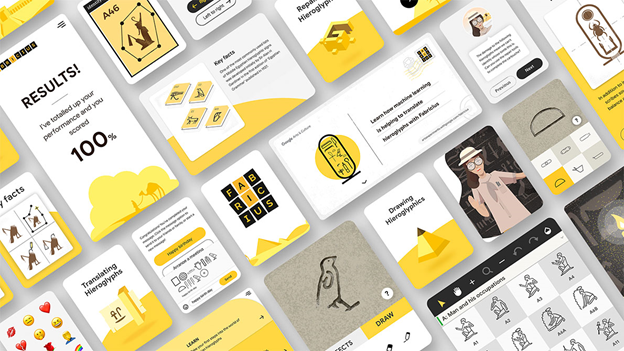
Have you ever imagined how people at the time of ancient Egypt used to communicate with each other? They simply used drawings, signs and symbols as the form of written communication famously known as “Egyptian Hieroglyphs” one of the oldest forms of writing! Not everyone could write these hieroglyphs only scribes (writers, sons of wealthy Egyptians) were trained to do so. Even after 5000 years, these languages remains a mystery for those who haven’t studied it. To solve this conundrum Google has launched an AI-based tool Fabricius, that will not only help decipher ancient hieroglyphs but it will also help people to make sense and learn about ancient Egypt’s language. To celebrate 221st anniversary (July 15th, 2020) of Rosetta stone(a slab of stone from 196BC, has message carved into it in three different types of script that helped scholars to crack the code of hieroglyphs) Google has launched its latest AI-powered tool Fabricius, here you can “learn”, “play” and “work” around with hieroglyphs. This is the first digital tool for translating and deciphering hieroglyphs.
Features of Fabricius:
Learn:
With the short six easy steps and interactive tools, Fabricius virtual assistant teaches you about the basics of hieroglyph script. The tour begins with taking you back to 1922 to discover who was buried in a mysterious tomb!
· In the first stage, with the hands-on activity the let you trace the hieroglyphs (for easier study) as accurately as you can.
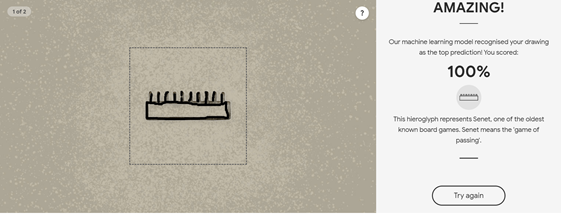
· With the introduction of the second stage, the tool teaches about the creation of facsimiles (i.e. creation of an exact copy of hieroglyphs) to prevent damage.
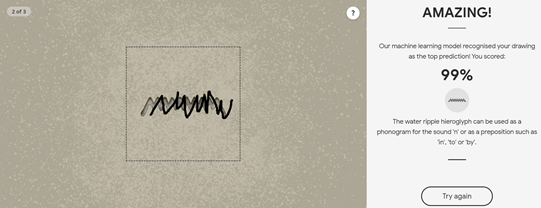
· At stage 3, we have to identify the hieroglyph from a given list of symbols.
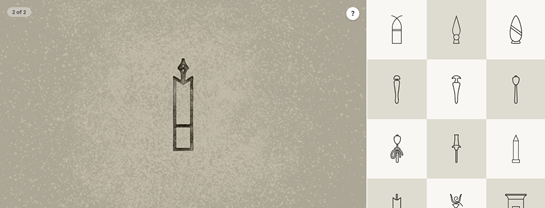
· Now in the 4th stage, we have to reconstruct the damaged hieroglyphic sign to reconstruct the name of Pharaoh.
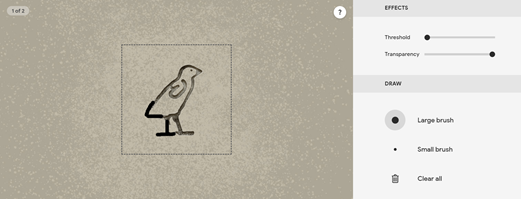
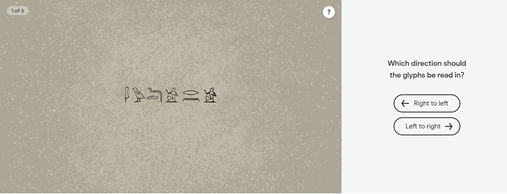
· Stage 5 teaches about the order in which they are meant to be read.
· With the final stage 6, this tool enables us to translate a cartouche (the series of hieroglyphic symbols inside an oval frame). And you will discover Tutankhamen’s tomb!
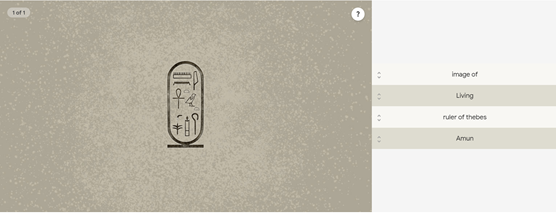
This tool also provides several interesting facts about hieroglyphs and ancient Egypt between different steps of learning.
Play:
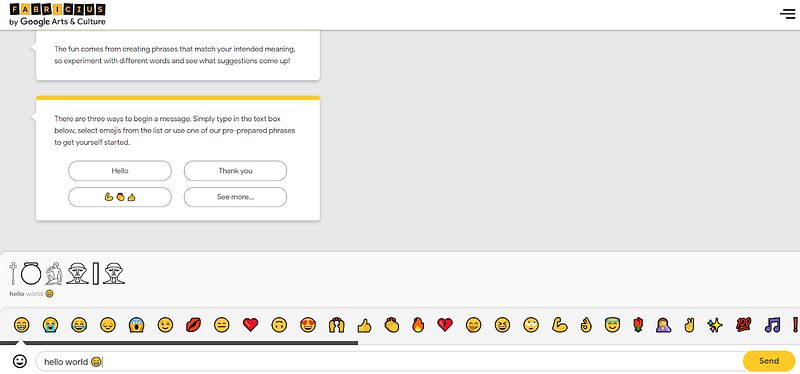
Here, you can translate your messages and emoji’s into hieroglyphs and see how they would have looked in like in the ancient Egyptians language. Casual consumers can here write unique words in hieroglyphs and can share them with their friends over social media. This way user can imagine how Egyptian hieroglyphs are equivalent to emoji. However, Google has stated that this is just for fun purpose and the results might not be academically correct.
Work:
With the help of various academics around the world, Google has developed a set of tools powered by Google’s Machine Learning technology to support academic research, increase accuracy in translation and translation of middle Egyptian hieroglyphs. This artificially intelligent tool will ease the research process, for which,” experts had to dig manually through books upon books to translate and decipher the ancient language — a process that has remained virtually unchanged for over a century.” According to Chance Coughenour, Google Arts and Culture program manager.
According to BBC report , “here in this application users can upload the real life images from artefacts and walls where hieroglyphs are available. These images then can be digitally enhanced to better analyse the symbols. Users can trace the outlines of hieroglyphs, which the software then tries to match up with similar symbols in its database — allowing them to search for different meanings and attempt to decipher findings.”
This software also provides a solution for broken text where researchers can annotate and edit faded symbols that are available in Workbench.
However, this workbench is only developed for desktop and it is currently not available for mobile devices. This tool is released as an open-source to support the better understanding and future development in the field of study of ancient languages.
What is the technology behind Fabricius?
The main underlying technology behind this software is machine learning and artificial intelligence. To be more precise Google’s AutoML technology and AutoML vision were used to develop a machine learning technology to decode the scripts of hieroglyphs.
The translation process of hieroglyphs works on three phases-
- Extraction- extracting the hieroglyphs from the uploaded images of artefacts and walls and creating workable facsimiles.
- Classification: now comes the training part of the neural network for the development of a machine learning model to correctly identify over 1000 hieroglyphics.
- Translation- the final step involves matching workable facsimiles sequences and blocks of text to available dictionaries and published translations to achieve the final result.
This software is being released as an open-source platform to improve and increase both the data available and the functionality of the tools.
This experiment aims to increase the awareness and preserve the history and culture of ancient Egypt civilisation along to increase the efficiency of translation with the help of machine learning. This project began with the Ubisoft’s research project “The Hieroglyphics Initiative” (developed by Google) to understand the written language of Pharaohs.
Fabricius is named after the father of epigraphy, the study of ancient inscriptions.
Available in English and Arabic, this software can be accessed free on Google’s Art & Culture app for mobile devices and desktop as well. However, workbench feature for research is only available for desktop. The company believes that Egyptian hieroglyphs are just a starting step for Fabricius, soon this technique will be applied to other ancient languages also!
Find more about the latest happenings in the tech world at: https://patataeater.blogspot.com/
Originally published at https://patataeater.blogspot.com on July 18, 2020.