
How to Train Your Mind to be More Proactive in Life
It starts with a simple change like — Instead of saying I can’t do this, say I chose not to do this

What am I doing with my life ?
Should I take this decision?
Why did I take that decision ?
Should I stand up to the bully ?
We all have stood in front of the mirror and talked to ourselves. We all have mentally argued the pros and cons before making a decision. This ability is very unique to humans. This is one distinctive quality that differentiates us from animals. This is one of the reasons why humans are so advanced.
This virtue I just explained is called Self Awareness. We can think before making a decision. We can think about our thoughts. This helps us stand apart and examine ourselves. This is why we can learn from other's experiences and our own failures. We can judge whether the decision we made was the right one. Self Awareness is also why we can change our habits. We have the capability to work on new habits or break an existing one.
We can train our minds to be more Proactive.
Sometimes (or maybe most times) our decisions and responses are influenced by external factors that we may seem to not have any control over. Genetics plays an important role in shaping your personality. It is no surprise that identical twins Paula Bernstein and Elyse Schein turned out to be very similar even though they had been raised separately. The environment and surroundings also play a critical role in personality development. How your parents brought you up, how good your friends are can all impact your personality.
But you still have the awareness to make a better decision. Your friends can influence you, but you still can make a decision based on your personality, based on your principles. You can be proactive. The environment around you can be a stimulus, but you still can choose a response you want.
The Stimulus and Response
Jono, from Leeds, England, was born with a rare genetic disorder called Treacher Collins Syndrome. He had no cheekbones which cause his eye to dip down and had very little ears thus needing hearing aids. Jono was not even 2 days old when his parents put him for adoption after realizing this disorder.
As Jono grew, he realized that he looked different. Teens his age didn’t want to play with him and he got lots of stares. He was considered ugly and infectious. He was consistently bullied for his looks. He tried making friends by sharing candies and other sweets, but could not get much love from others.
As he grew older, he realized it was not his face that is holding him back, it was his attitude. He realized there are people fighting a tougher battle than him. He embraced what made him different and eventually fell in love with himself and his face. He adopted a positive attitude and outlook on life.
In his own words,
Instead of hiding away I’m choosing to show my face to the world and the amazing smile and blue eyes that go with it. I’m choosing to live!
There’s nothing more disabling than a bad attitude!!!!! Believe in yourself, be positive and love all that you are and your world will become a better place too!
Jono is now an inspiration to millions of people with Treacher Collins Syndrome. He travels around the world making friends and sharing his positive outlook on life. He is doing what he can to create awareness about TCS. He is inspiring kids around the world and adults who have this genetic disorder to be comfortable and content with being different.
We have to respond to every stimulus. That is how it works. But how we respond is up to us. We have the self-awareness to respond based on our principles and ideologies. Everyone faces tough times in their lives, some less and some more, but how we react is what differentiates us. Jono responded to the stimulus by accepting how he is and spreading the knowledge so that others can benefit from it. He chose to be proactive.
Highly proactive people do not blame circumstances or the conditions for their behavior. They realize that their behavior is an output of their conscious choices. Another way of looking at proactivity is by understanding what we can control and what we cannot — And what we can influence and what we cannot
Circle of Concern And Influence
A very important part of being proactive is understanding what we can control and what we cannot. In Stephen Cohen’s book, 7 Habits of Highly Effective People, he calls this the Circle of Concern and the Circle of Influence.
I have been working in the tech industry for more than a decade. I have seen a lot of different folks and have a lot of diverse experiences. But this one experience was very distinct and special. I was friends with 4 folks who worked on the same project at a point in time. The manager leading the project was known for being mean, very mean.
So, the five of us frequently used to have lunch together. Most of the time, they spent time discussing their manager — James. They used to discuss how the manager was not fit for the project and how he used to demean their work. One of them said, “In our weekly sync-up, James frequently finds faults in my work. I really do not know how to work under him”. The other agrees and said “Yeah, I know. I really want to work on a different project. This project is killing my personal life”
Now there was this guy in our group Phil, with whom I was acquainted recently. He was a friend of my friend. He used to remain calm in these discussions. Whenever someone asked for this opinion, he usually used to say “I know he is inconsiderate, but I like to focus on the good side of him. After all, he is a very technical guy. You can learn a lot from him”. As usual, the rest of the folks did not like him much. They now argued against him and called him the manager’s puppet.
Phil is now very successful in his career. He now is a senior director and manages very critical projects. And strangely we all knew he had the qualities in him. Phil always looked at the bright side. He looked at every opportunity to learn something. He tried to reduce his circle of concern and increase his circle of influence. Even in stressful times, he tried to focus on the positives, he tried to work on what he can control.
He maybe could not have controlled how that manager treated him, but he could surely work on his own growth. While the reactive minds were blaming the manager’s meanness for all of their problems, the proactive ones saw the same manager’s technical side and learned from him. By just having a positive outlook and working on his own personal growth, he was able to increase his circle of influence.
Change the Language
We discussed how self-awareness plays a vital role in shaping your principles and attitude. This is why listening to our language could be a true indicator of the degree to which we are proactive. Before we learn to be proactive, we need to understand where we are going wrong.
My friend is driving me crazy
There is nothing I can do
My wife makes me go mad
I did this because of the situation
A reactive language absolves self from responsibility. Reactive people feel highly victimized and out of control. We need to remove this reactive language from our dictionary.
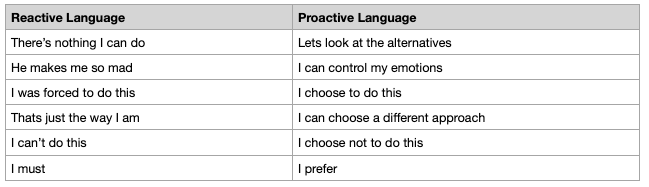
We have a belief that proactive means being pushy and aggressive. It is quite the opposite. A proactive language is not about being aggressive but is about knowing what needs to be done for personal growth. It is based on the values and principles we believe in. Mahatma Gandhi was proactive, but his language was not at all aggressive. He broadened his circle of influence by his action, by his principles.
So, What Needs to be Done to be More Proactive?
In Stephen’s book, The 7 Habits of Highly Effective People, he suggests taking a Thirty-Day Test of Proactivity. Let me explain how this works. For thirty days, we will only work on the Circle of Influence. Our language will be of proactivity and not reactive. Try it in every problem — In relationships, at the office, with friends, etc. If you make a mistake admit it, correct it and learn from it. Work on this you have control on, work on YOU.
I also started this as a thirty-day test a year back, and it has been helping me ever since. I have not perfected it, but I can see how it is improving me. I work as an engineer, and there is a lot of negativity associated with it. I earlier used to crib about my work, my manager, and everyone. Now I just embrace it and work on improving myself. In my marriage life, I try to listen more, I try to understand my wife’s point of view before jumping to conclusions. And our relationship is so much better — proactivity is infectious. Even in my writing, I am more proactive. I am responsible for writing a shit article, not the medium publishers and the readers.
Closing thoughts
Try out the thirty-day challenge and see how it feels. Try to change your language. Try to increase your circle of influence and reduce the circle of concern. Do not think of the problem, spend time on the solution.
Recast your current problems into proactive goals — Suze Orman


