
How To Track Crypto Whales Trading Activity In 3 Simple Steps

Whales are crypto traders that hold large amounts of capital in their crypto portfolio.
Following and copying the trading activity of successful crypto whales can be a very profitable trading strategy.
Since all transactions on the blockchain are publicly visible, you can trace the activities of any wallet.
The theory is that these traders know things that you don’t and place their capital accordingly. By following them, you can position yourself early for pumps and get out in time before dumps.
Let’s look at a simple method on how to find wallet addresses and track the so-called “smart money” activity.
1. Find whale wallets
The first thing you need to do is find some whale addresses that you will analyze.
Use the following apps to find tokens that have recently pumped and copy their contract address:
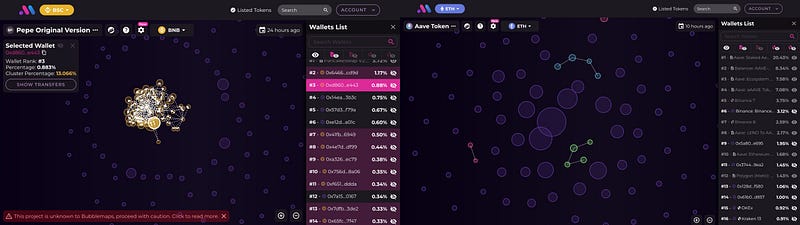
Next, head over to Bubblemaps and copy the address in the search bar. On the right, you will see all the addresses that hold the token as well as their percentage.
It’s important to analyze the token distribution.
If interconnected wallets that have interacted with each other hold a large number of tokens, this means that the token is controlled by a small group of people and is likely a scam.
Let’s compare a fishy vs. a healthy token distribution:
2. Analyse whale activity
Once you’ve identified a few whale addresses, you’ll use DeBank or Zerion to analyze them.
Simply copy and paste any wallet address into these two apps and voilà! You will have complete insight into their entire transaction activity.
Here you can see which tokens these wallets are buying, selling, or transferring on-chain, and when the activity took place.
First, analyze the wallet activity to find wallets that have been profitable in their recent buys. This will require finding which tokens they bought and when, and then analyzing the price of these tokens on charts to see how the price evolved.
Once you have a list of profitable whales, follow their activity every day to see which new tokens they’re accumulating.
Don’t ape into a token just because a whale is buying it, always do your research!
3. Avoid scams
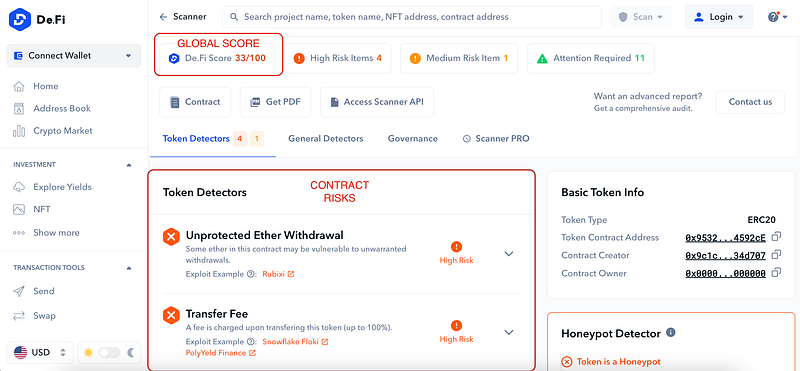
One of the best tools to detect scams on newly listed tokens is De.fi scanner. Paste in the search bar the contract address of any token found on DEXScreener, DEXTools, etc.
De.fi scanner will automatically analyze the contract, give a global score and warn you about any potential risks that the contract contains.
Tokens that have a score of 90 or higher can be considered “safe” from the contract point of view.
Avoid investing in any token with a score below 90 unless you really know what you’re doing.
BONUS TIP: Use Whale Alerts on Telegram Bots
You can use a Telegram bot such as Maestro Whale bot to receive an alert directly on your phone when a whale you’re following makes a transaction.
Simply open the channel in Telegram and add the wallet addresses you wish to track. You can add up to 3 addresses. Then you’ll receive notifications when they move their funds.
To Sum Up
In this story, I presented a simple 3-step method for finding and tracking whale activity:
- Use DEXTools, GeckoTerminal, or DEXScreener to find interesting tokens and copy their contract addresses. Paste the addresses into Bubblemaps to find whale wallets and analyze token distribution.
- Use DeBank and Zerion to analyze the transactions and trading activity of the whale addresses.
- Use the De.fi scanner to make sure you’re not dealing with scams.
- As a bonus tip, you can use Telegram bots to get whale activity alerts directly on your phone.
You can tell me in the comments what methods you use to find, track and copy crypto whales!
If you want to learn how to make a consistent profit from the Metaverse in 2023 and beyond, check out my free guide How To Make Your First $1000 In The Metaverse.

Join Medium using my referral link and get exclusive access to more stories like this one and to a wide range of quality content from thousands of writers for just $5/month.
Never miss a story and updates:
You might also enjoy these stories:
Disclaimer: This content is for educational purposes only and should not be considered as financial or any other advice. Always do your own due diligence before investing your hard-earned money.


