Free AI web copilot to create summaries, insights and extended knowledge, download it at here
4580
Abstract
ff painful feelings, which if you sat with long enough, might just push you to take a risk.</p><h2 id="d03c">2. The friends you see most regularly are heavy drinkers too.</h2><p id="85ab">For most of my life, I tended to gravitate towards the drinkers. I liked the looseness and camaraderie, the off-key jokes and the feeling of rebellion.</p><p id="7e51">In my twenties, I was actively put off by people who didn’t drink. They made me feel uncomfortable. I hated the way they left so early, how they always stayed the same. Where was their sense of fun?</p><figure id="0213"><img src="https://cdn-images-1.readmedium.com/v2/resize:fit:800/0*LVh8fK5ozk6kc2f2"><figcaption>Photo by <a href="https://unsplash.com/@parktroopers?utm_source=medium&utm_medium=referral">Park Troopers</a> on <a href="https://unsplash.com?utm_source=medium&utm_medium=referral">Unsplash</a></figcaption></figure><p id="b4ba">Around this time, I made a friend who didn’t drink much, and we started to have sweet wholesome evenings together, eating elaborate salads and watching romcoms.</p><p id="6537">Her sober ways provided respite from my increasingly alarming habit, but I didn’t see her as often as I saw the friends who loved to drink.</p><p id="4c7f">Nor as often as I drank alone.</p><p id="4666">We didn’t want to spend our time in the same way. And though I liked her best, I couldn’t resist the pull of booze.</p><h2 id="8d81">3. You drink fast compared to your non-drinker friends.</h2><p id="904e">I’m not talking about your heavy drinking friends, those lovely maniacs shouldn’t be used as measuring sticks. I’m talking about the friends you see less often. The acquaintances.</p><p id="91d9">It was during a writing residency in a Scottish Castle that I finally realized I drank faster than ‘normal people’. Until then, I was still operating under the illusion that everyone drank the way I did.</p><p id="7700">But during our first trip to the pub on Friday night, everyone except for me had half a lager. And after they had finished, they put their empty glasses down. They looked at each other expectantly.</p><p id="92f8">They were ready to head home.</p><p id="617e">It was the strangest experience of my life.</p><figure id="e8f6"><img src="https://cdn-images-1.readmedium.com/v2/resize:fit:800/0*WQbPLvW6Qd6mksxS"><figcaption>Photo by <a href="https://unsplash.com/@alexandroskarantges?utm_source=medium&utm_medium=referral">Alexandros Karantges</a> on <a href="https://unsplash.com?utm_source=medium&utm_medium=referral">Unsplash</a></figcaption></figure><h2 id="9745">4. You jokily refer to yourself as an alcoholic.</h2><p id="ea53">On a wilder night at the pub — two drinks a pop — I was the only one still thirsty at last orders.</p><p id="bf8b">“I’ll have one more,” I said, self-consciously, trying not to sprint as I made my way to the bar. “Because I’m an alcoholic.”</p><p id="6529">The three lovely writers sat politely, while I finished an extra pint, which suddenly seemed very large. Which brings me to my crucial point.</p><h2 id="49ec">5. You are more than happy to drink alone.</h2><p id="bd40">For years, opening a bottle of cold white, and pouring a glass to cook dinner, was my idea of heaven. How luxurious and civilized and <i>grown-up</i>.</p><p id="458d">Writing that sentence, I feel the old longing. What sweet pleasure drinking alone was!</p><p id="eab3">But it kept me isolated too. It helped me to believe that I didn’t need anyone.</p><p id="07a5" type="7">Alcohol works. If the aim is to turn us into numbed out fast-paced doing robots.</p><p id="c38a">For years, I mourned the total absence of community in my life, at the same time as I adored drinking wine by myself.</p><p id="b0c8">It didn’t occur to me until after I quit drinking that my love of solo drinking and my growing feeling of isolation were connected. This is the scary thing about drinking. It hampers your ability to think.</p><p id="3686">As I became self-sustaining as a writer, I rarely had to work in a team or go to a meeting. Gradually, I became more isolated. I wished to be a part of something, but it just seemed harder and harder to connect.</p><p id="b487">I’d switch from sad and lonely in the day, hating modern life for making islands of us, to happily drinking wine by myself at night.</p><p id="1d12">And I suspect I could have continued doing it forever.</p><h2 id="a0c3">6. In the early hours of the morning, you worry about your drinking.</h2><p id="9e72">The early hours of the morning are a strange, haunted sort of time for the heavy
Options
drinker. You wake up, desperately dehydrated, with no understanding of why you drank enough to make yourself ill again.</p><p id="be8c" type="7">Society and modern life isn’t designed to suit humans. We need a little something extra to get us through.</p><p id="4914">Buying and pouring the wine, it’s easy to convince yourself that this is a treat. You want to relax. You deserve something nice.</p><p id="1646">But lying in bed, feeling nauseous and headachey or just incredibly flat it’s hard to understand why you drank the way you did.</p><p id="5fd1">Why didn’t you stop after one glass or two, the way you’d promised that you would? Tonight it will be different, you think. But there’s a hollowness to the thought because you have had it so much recently, and yet here you are again...</p><figure id="5060"><img src="https://cdn-images-1.readmedium.com/v2/resize:fit:800/0*XxtUC8yWhIngwoQm"><figcaption>Photo by <a href="https://unsplash.com/@twinsfisch?utm_source=medium&utm_medium=referral">twinsfisch</a> on <a href="https://unsplash.com?utm_source=medium&utm_medium=referral">Unsplash</a></figcaption></figure><h2 id="b9ff">If you need help to stop drinking, you’re not alone.</h2><p id="7568">And there’s no shame in getting addicted to something deeply addictive. The fact is, it’s likely not going to get any easier to stop than it is this very moment.</p><p id="3fbf">If you’re ready to try something different, try my <a href="https://www.chelseyflood.com/post/how-to-get-sober-by-mistake">alcohol experiment</a>. Do whatever it takes to stay sober for 30 days: go to your doctor, try <a href="https://smartrecovery.org.uk/">Smart</a> or <a href="https://www.alcoholics-anonymous.org.uk/">AA</a> or <a href="https://www.hipsobriety.com/">Hip Sobriety</a> or <a href="https://soberistas.com/">Soberistas</a>. Read <a href="https://www.chelseyflood.com/beautiful-hangover">beautiful hangover</a>. Listen to <a href="https://www.recoveryelevator.com/podcasts/">Recovery Elevator</a> and <a href="https://theshairpodcast.com/">SHAIR</a> podcasts. Read <a href="https://thisnakedmind.com/">This Naked Mind</a>. Try <a href="https://www.moderation.org/">Moderation Management</a>.</p><p id="ef6a">There is a whole community of people just waiting to help you. Reach out. Something better is waiting for you.</p><p id="9f7a"><b>Sign up for more from me at <a href="https://beautifulhangover.substack.com/">beautifulhangover</a> <3</b></p><p id="623a">*I write as a person now sober, who used to drink too much. Please seek medical advice before you quit, especially if you are a daily drinker.</p><p id="939f"><i>Chelsey Flood is the author of <a href="https://www.amazon.co.uk/Infinite-Sky-C-J-Flood/dp/1481406590">Infinite Sky</a> and <a href="https://www.amazon.co.uk/Nightwanderers-C-J-Flood/dp/0857078054/ref=pd_sbs_14_img_0/259-7613096-1827151?_encoding=UTF8&pd_rd_i=0857078054&pd_rd_r=2019a085-6721-4963-b4df-2089e1ac4706&pd_rd_w=5eQcR&pd_rd_wg=3drKq&pf_rd_p=e44592b5-e56d-44c2-a4f9-dbdc09b29395&pf_rd_r=ZFDC540YB7C0WH4H87BZ&psc=1&refRID=ZFDC540YB7C0WH4H87BZ">Nightwanderers</a>, a lecturer in creative writing and a dedicated truth-seeker. She writes about freedom, addiction, nature and love.</i></p><div id="7b55" class="link-block"> <a href="https://readmedium.com/what-hbos-the-flight-attendant-gets-right-and-wrong-about-alcohol-use-disorder-1d9675a58e53"> <div> <div> <h2>What HBO’s The Flight Attendant Gets Right (and Wrong) About Alcohol Use Disorder</h2> <div><h3>Drinkers create drama, which is why TV is full of them.</h3></div> <div><p>medium.com</p></div> </div> <div> <div style="background-image: url(https://miro.readmedium.com/v2/resize:fit:320/0*GwgoeyWI7sGUM2NV)"></div> </div> </div> </a> </div><div id="2330" class="link-block"> <a href="https://readmedium.com/what-does-it-mean-to-be-almost-alcoholic-357d0d0776e6"> <div> <div> <h2>How to Tell If You Are Almost Alcoholic</h2> <div><h3>If drinking problems exist on a continuum where does yours sit?</h3></div> <div><p>medium.com</p></div> </div> <div> <div style="background-image: url(https://miro.readmedium.com/v2/resize:fit:320/0*aBRseZu1fghLoVWT)"></div> </div> </div> </a> </div></article></body>
Sarah Allen Benton’s book, Understanding the High-Functioning Alcoholic explodes old stereotypes of alcoholism. She explains that these ideas are not only wrong but dangerous.
It’s something I’ve written about before, the lesser understood fact that there are many different types of alcoholics or people with Alcohol Use Disorders (AUDs)and a great many of them are functional.
Many people with an AUD hold positions of power, raise families and do excellent work.
We usually drink too much to cope with the fact that our life doesn’t suit us.
These sorts of drinkers are ‘high-functioning alcoholics’ (HFAs). An oxymoron if ever there was one, but this is the society we live in; one with a very high tolerance for booze.
HFAs drink hard and function at a high level. They drink much more than the government guidelines for alcohol consumption, which places a lot of stress on their bodies and psyches, and they do whatever it takes not to let anyone notice.
Many people with an Alcohol Use Disorder hold positions of power, raise families and do excellent work.
HFAs’ ability to function in spite of their habit saves them from the consequences that normally signal that a person’s drinking is out of control.
They don’t lose a job. They don’t lose their partner. They don’t lose their driving license.
In other words, they keep getting away with it.
So how can you tell if you’re a high-functioning alcoholic?
Here are six signs to look for.
The busy, competent mum who has everyone’s schedule down to a tee. She cooks amazing dinners, smashes it at work, and shows up on time for every activity. And she cannot wait to get home to drink wine.
The talented musician who drinks before playing, but the performance is so good nobody minds.
These drinkers know that they consume more than is healthy, but they are so productive that they don’t worry about it.
We usually drink too much to cope with the fact that our life doesn’t suit us. Or because we are doing too much.
All too often, society and modern life isn’t designed to suit humans. We need a little something extra to get us through. Maybe we have been given more than a fair share (women, especially mums, I’m looking at you, and not in a judgy way.)
Women, especially, are drinking more than ever.
And alcohol works. If the aim is to turn us into numbed out fast-paced doing robots.
But drinking too much can stop you from ever creating a life that does suit you.
It takes the edge off painful feelings, which if you sat with long enough, might just push you to take a risk.
For most of my life, I tended to gravitate towards the drinkers. I liked the looseness and camaraderie, the off-key jokes and the feeling of rebellion.
In my twenties, I was actively put off by people who didn’t drink. They made me feel uncomfortable. I hated the way they left so early, how they always stayed the same. Where was their sense of fun?
Around this time, I made a friend who didn’t drink much, and we started to have sweet wholesome evenings together, eating elaborate salads and watching romcoms.
Her sober ways provided respite from my increasingly alarming habit, but I didn’t see her as often as I saw the friends who loved to drink.
Nor as often as I drank alone.
We didn’t want to spend our time in the same way. And though I liked her best, I couldn’t resist the pull of booze.
I’m not talking about your heavy drinking friends, those lovely maniacs shouldn’t be used as measuring sticks. I’m talking about the friends you see less often. The acquaintances.
It was during a writing residency in a Scottish Castle that I finally realized I drank faster than ‘normal people’. Until then, I was still operating under the illusion that everyone drank the way I did.
But during our first trip to the pub on Friday night, everyone except for me had half a lager. And after they had finished, they put their empty glasses down. They looked at each other expectantly.
They were ready to head home.
It was the strangest experience of my life.
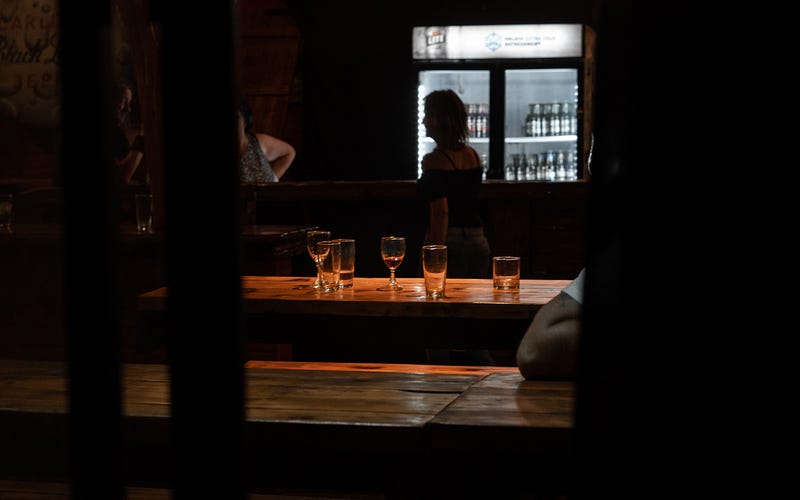
On a wilder night at the pub — two drinks a pop — I was the only one still thirsty at last orders.
“I’ll have one more,” I said, self-consciously, trying not to sprint as I made my way to the bar. “Because I’m an alcoholic.”
The three lovely writers sat politely, while I finished an extra pint, which suddenly seemed very large. Which brings me to my crucial point.
For years, opening a bottle of cold white, and pouring a glass to cook dinner, was my idea of heaven. How luxurious and civilized and grown-up.
Writing that sentence, I feel the old longing. What sweet pleasure drinking alone was!
But it kept me isolated too. It helped me to believe that I didn’t need anyone.
Alcohol works. If the aim is to turn us into numbed out fast-paced doing robots.
For years, I mourned the total absence of community in my life, at the same time as I adored drinking wine by myself.
It didn’t occur to me until after I quit drinking that my love of solo drinking and my growing feeling of isolation were connected. This is the scary thing about drinking. It hampers your ability to think.
As I became self-sustaining as a writer, I rarely had to work in a team or go to a meeting. Gradually, I became more isolated. I wished to be a part of something, but it just seemed harder and harder to connect.
I’d switch from sad and lonely in the day, hating modern life for making islands of us, to happily drinking wine by myself at night.
And I suspect I could have continued doing it forever.
The early hours of the morning are a strange, haunted sort of time for the heavy drinker. You wake up, desperately dehydrated, with no understanding of why you drank enough to make yourself ill again.
Society and modern life isn’t designed to suit humans. We need a little something extra to get us through.
Buying and pouring the wine, it’s easy to convince yourself that this is a treat. You want to relax. You deserve something nice.
But lying in bed, feeling nauseous and headachey or just incredibly flat it’s hard to understand why you drank the way you did.
Why didn’t you stop after one glass or two, the way you’d promised that you would? Tonight it will be different, you think. But there’s a hollowness to the thought because you have had it so much recently, and yet here you are again...

And there’s no shame in getting addicted to something deeply addictive. The fact is, it’s likely not going to get any easier to stop than it is this very moment.
If you’re ready to try something different, try my alcohol experiment. Do whatever it takes to stay sober for 30 days: go to your doctor, try Smart or AA or Hip Sobriety or Soberistas. Read beautiful hangover. Listen to Recovery Elevator and SHAIR podcasts. Read This Naked Mind. Try Moderation Management.
There is a whole community of people just waiting to help you. Reach out. Something better is waiting for you.
Sign up for more from me at beautifulhangover <3
*I write as a person now sober, who used to drink too much. Please seek medical advice before you quit, especially if you are a daily drinker.
Chelsey Flood is the author of Infinite Sky and Nightwanderers, a lecturer in creative writing and a dedicated truth-seeker. She writes about freedom, addiction, nature and love.