
How to Take Notes like a Prolific Content Writer
And never run out of ideas again.
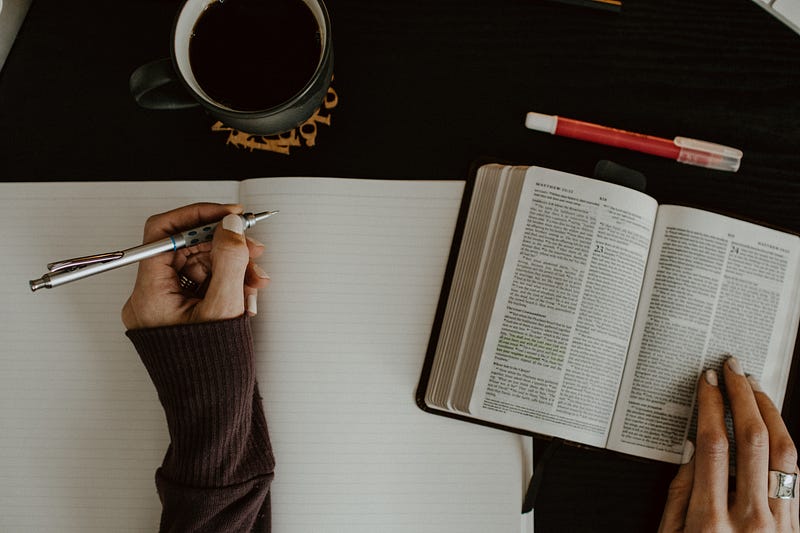
I take notes like a teenager takes TikTok videos.
I have a compulsion for it. I’m both an autodidact and possess a behavioral condition characterized as hypergraphia. Not really, but you get the gist. As Tim Ferriss once quipped,
“I trust the weakest pen more than the strongest memory.”
Thus, my note-taking has made me a proficient writer.
Recently, a reader made a funny remark on an article I wrote titled, Seven Books That Will Change Your Life, she commented, “I hope you read for fun.”
Her comment made me laugh because, for me, reading the books on that list was for fun. Even more enjoyable? Taking notes on books that speak to me.
Note-taking is how I remember the essential ideas I want to recall for later use. If I don’t take notes on what I read — things that light a spark in me — I forget them. Thus, making reading a waste of time.
I don’t read frivolously, I read to produce and lead a better life.
Simple reasons to take notes when reading
- Review books I highlight in a few minutes without having to reread the entire book.
- Connect similar ideas from different books into one category using a simple number and letter system.
- Retain relevant ideas embedded within the text, take it out, and use it as my own, in my own words.
- Extract the good stuff, those nuggets of knowledge that resonates.
- When you write something on a piece of paper or an index card, it frees up space in your brain for other things.
- The number of new ideas is a measure of productivity for writers, especially nonfiction writers.
- Writer’s block is a thing of the past.
- A sentence or paragraph that speaks to me I won’t be able to recall if I don’t make a note. If something only enters your short-term memory, it will most likely be forgotten. However, if you take notes, you have a record to recall what was important to you when you read it.
Humans are drawn to self-improvement. We like to learn. And for those of us who write, the more notes on hand, the more you have to draw from.
Coming up with a system to organize notes is another thing entirely.
Each writer will have her own preference. You should use a system that is easy for you to follow, that you stick with it. It doesn’t have to be complicated.
My system is simplicity in action
I transfer notes from margins of books and scraps of paper around my house onto index cards.
What works best for me is writing ideas, notes, great sentences, structures I wish to emulate, from the books I read onto numbered index cards. I write the date in the upper right-hand corner and a number and letter in the upper left-hand corner. The letter references the category in which the note is to fit, and the number references the order.
I write down anything that speaks to me — a great sentence, an idea, a killer headline, or something I want to add to a story in progress.
Ideas come to me at the most inconvenient time, like in the shower or when I’m trying to sleep. I’ll wake at 2:00 am thinking about a story I’m working on and how I could rearrange it more effectively. I write a note.
Notes are everywhere — in notebooks, in my notes app, on Post-its, on scraps of paper, on the back of receipts, in the margins of books I read. I transfer all these notes to index cards and keep them in a simple box to reference when I need them.
I don’t know what this writer’s block is, which other writers speak of, and you’ll never hear me ask, “What should I write about today?” I have at least ten headlines ideas and 20 story ideas I could write today if I had more time.
Proficient writers are note-takers. They are also readers. And when they get an idea or inspiration strikes, they write it down, so they don’t forget.
Whether you are a blogger or are working on The Great American Novel, knowing how to take notes is essential and will save you a lot of time in the long run.
One way to streamline your note-taking is to go digital
I have started on this digital reading journey in baby steps.
I can’t read a screen before I go to sleep, it affects my sleep negatively, and I can’t function without sleep.
Sleep is the number one priority in my life; not getting enough sleep affects every aspect of my life negativity, so I make it a priority. You may be different.
I’ve gone digital for my daytime reading, but I love holding a physical book in my hand at night.
It lulls me to sleep.
A step by step way to take notes digitally
- Download a book to read in electronic format, I use Kindle.
- Reading and highlighting text in Kindle format is a great way to absorb key takeaways and next actions.
- Go to Kindle notes, which you can access when you are logged into Amazon.
- Next, use Evernote to scrap the entire page of your highlights for that book.
- Look at the Evernote document and do a third pass of key material.
- Add three asterisks at the beginning of key material, I sometimes use the bold format also.
This process allows me to review the key takeaways from a book, which could be fiction — it’s not limited to nonfiction. Even for fiction (which I do read for pleasure), I highlight beautiful paragraphs, turns of phrases, and the structure of which I want to look at repeatedly.
Adding the three asterisks before crucial parts in my Evernote document allows me to do a quick ‘Control F’ to search for the key takeaways from a book. The three asterisks enable me to quickly find what resonated, finding what I’m searching for in a matter of minutes.
Learning to take notes well gives you material. The number of new ideas one has on hand — whether in your Evernote app or on a piece of paper — is an important measure of productivity for a nonfiction writer.
Having a myriad of notes from which to draw eliminates the need to think too much about what to write next.
Jessica is a writer, an online entrepreneur, and a recovering Type A personality. She lives in Los Angeles with her extrovert daughter, two dogs, and two cats.


