
How to Survive as a Freelance Content Writer — Part 4
Managing your writing isn’t always easy. Finding ways to balance, writing, marketing and home life are essential to success.

Part 4 — Managing Your Writing
When starting out on your freelance writing career it can be easy to lose sight of the key ingredient — the actual writing. Organising your finances, finding work and promoting yourself can take up so much time that actually writing begins to feel like an inconvenience.
When this happens, it is easy to lose focus, become disillusioned and give up on your dream.
And this is something you want to avoid. Yes, I know that’s obvious, but it’s so obvious that the ease with which it can happen is often overlooked.
With that in mind, here are some tips on managing your writing and keeping the dream alive.
Find a place to write
Having the perfect place to write can make all the difference to your approach. There is no one right place, each author needs to find their own. My first space was a room at the back of the house that I share with my iguana. She was great for bouncing ideas off, but not so good at constructive feedback.
Where you choose to write is affected by the type of writing you do, the noise level you are comfortable with, and whether you prefer a desktop, laptop or tablet for your writing. Some people work best sat cross-legged on the floor on a tablet, others prefer their favourite comfy chair in the local coffee shop.
Most of my writing requires online research, so a stable connection is a must. Another must is a decent chair because of my physical difficulties. It’s the same reason I prefer to work at a desk on a desktop computer. I have learnt over the years to filter out most noise, which is essential when you work from home. Other people need near-silence, music, or even the TV to get their brain working.
Organise your time
When are you at your most productive?
When are the conditions around you at their best for you to focus on work?
Aim to get the bulk of your work done at this time. If you are most alert first thing in the morning, then get your tea, coffee, or whatever gets the juices flowing and head straight to work. Don’t open Facebook, check emails or otherwise become engrossed in distractions, just get to work.
I try to always leave my latest project open on my desktop, this means as soon as I wake up the computer it is staring me in the face.
You may of course need to find other appropriate times to work, depending on where you work and your general life situation. If I only worked at my optimal time, I would get an hour a day between me getting up and the hungry hoards waking up. If your preferred working time just isn’t feasible for whatever reason, you need to adjust your commitments and practices to get the best balance for you.
One way to achieve this is through time blocking — this is what I call it, but it probably has an official name as well.
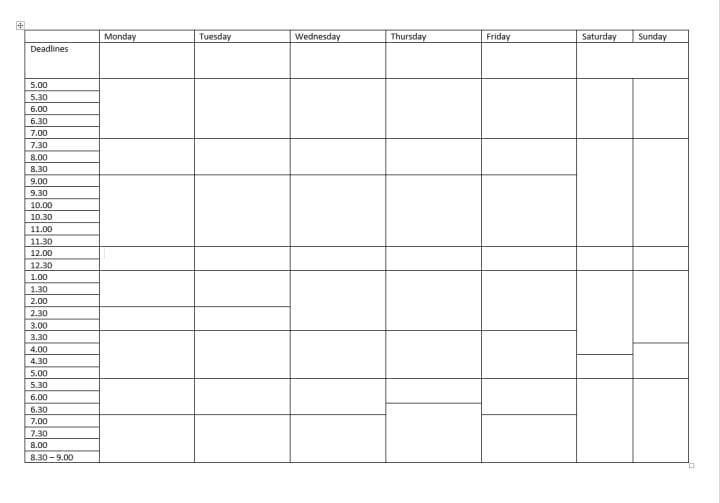
Think back to your old school style timetable where the day was separated into blocks, each block was filled with a specific lesson. The main difference between the school timetable and your adult version is that your new one is going to be longer. It needs to begin at the time you generally wake up and end at the latest you want to generally be working. I work in blocks of half an hour, mainly because it works well for me.
Once you have the blank timetable, block out the times when you have things you must do, the things that cannot be moved, removed or otherwise changed. This might include school runs, medical appointments, volunteering work or meetings. Now block out time to eat, rest, and exercise, yes exercise is important.
The time that is left is what you have left to work and carry out social and other activities. Now you need to create the perfect work/life balance with the time that is left and meet all your deadlines.
Time Blocking Timetable
Meeting Your Deadlines
When you are a freelance writer it is very rare that you work with just one client, meaning you are regularly juggling competing deadlines for different people who all have their own priorities and worries.
Planning is the key; you need medium and short-term planning sheets.
A wall planner, calendar or monthly planning app helps you to see an overview of your upcoming deadlines. Doing this means you can see potential clashes, as well as times when you have limited or no work.
The work needed to meet your deadlines can then be transferred to your time blocking timetable. So, if you have two deadlines due the same day, you can allow the required number of time slots needed to complete both on time and to the required standard.
Staying Flexible
While planning, time blocking, and thinking ahead are all essential, so too is being flexible. You could have the best-laid plans in the world, but one snow day and everything is suddenly turned upside down. One pandemic and a school shutdown later and you are tearing your hair out and wondering if you are ever going to get back on track again. All you can do is contact clients, let them know what is happening and do your best.


