
How to Stop Procrastinating in 15 Minutes
What my high-school physics lessons can teach you about getting started.

Procrastination. The word alone is enough to strike fear into your heart, remind you of all your unfinished work, and make your sweat glands work like a galley slave.
You, me, and everybody procrastinates. We push off what’s important but unpleasant in favor of what’s less significant but more amusing. We trade long-term benefits for short-term gratification.
It’s easy to fall into this trap. One moment you’re focused on your work and the next you’re watching fail compilations on YouTube. Or you don’t even get to the point where you start work but clean your apartment, sort out your clothes, and call your mum instead. You forego what you have to do in favor of what you want to do.
This procrastination makes you miserable. While it feels good to avoid the hard word and kick back with some ice cream and Netflix, remorse will knock on your door sooner or later. If you don’t open, it gets louder — and you can only turn up your TV so much to drown it out. At one point, it kicks in your brain’s front door. You panic in light of the approaching deadline and rush to the coffee machine so you’ll get through the upcoming all-nighter. When you wake up the next morning dreary-eyed and with keyboard-imprints on your face, you ask yourself why it always ends up like this.
As a former master level procrastinator, I’ve been through this cycle often enough to know it isn’t worth it. It’s hard to relax while you procrastinate and when you finally get to work, it’s like you’ve warp traveled into Apocalypse Now. Everything’s on fire, you can hear sirens, and feel the creeping fear of not making it.
Imagine how relaxed everything would be if you started on time — no remorse and no frantic last-minute sessions. No more bad conscience and stress caused by deadlines.
If you use a little psychological trick, beating procrastination isn’t that hard. But first, you have to understand why you procrastinate in the first place.
Here’s What Doesn’t Work
My roommate has been putting off the final work on his PhD thesis for a bit — a little over 1.5 years, in fact. Now he has decided to finish a first within the next eight weeks, which is quite an ambitious goal. Remorse knocked on his door loud enough for him to finally hear it.
To make sure he stays on track, he asked me to be his accountability partner. I couldn’t refuse — after all, I get to kick his ass if he doesn’t follow through. Sounds like the perfect job for me.
At first, he committed to doing it on the weekend — a few hours at a time to move things forward. This didn’t work out at all since nobody wakes up on a Saturday looking forward to spending four hours neck-deep in spreadsheets and statistics. The only people who do so are mathematicians and while I deeply admire them, I’m firmly convinced they’re from another planet.
Like my roommate, you can’t just schedule a block of time and expect you’ll magically find the motivation to do the work you’ve been putting off for so long. Do what you always do, get the result you always get. Instead, you have to take a different approach.
The Everlasting Battle of Motivation vs. Resistance
Whenever you decide if you’re going to do something or not, there’s a tug-o-war inside your brain between two opposing forces — motivation and resistance.
Motivation is everything that pushes you towards action. Your bad conscience, the good feeling afterward, and the promise you’ve given your accountability partner.
Resistance is everything that holds you back. Your warm bed, your desire to relax, all the other fun things you could do, and the horror you experience when you think about the huge mountain of work that seems impossible to dig through.
If motivation is greater than resistance, you act. If resistance is greater than motivation, you don’t.
In my roommate’s case, his resistance was bigger than his motivation. He knew he needed to get things done, but the thought of spending the next four hours glued to a laptop screen instead of enjoying his weekend made him resign. You can’t blame him.
Motivation is a finite resource. You can boost it by watching an inspirational video on YouTube, but on some days even the “Motivational Speech Megamix Vol. 15” won’t do the trick. Plus, you’re stuck on YouTube again, a prime source of distraction. Instead, you have to lower the resistance.
When you’re stuck with a task you dislike or dread, even the tiniest bit of resistance can make the difference between action and avoidance.
How can you lower the resistance? By drastically reducing the amount of work you set out to do.
Commit to only 15 minutes.
You greatly reduce the resistance and turn the towering mountain of work into a molehill you can easily take care of. Even the most dreadful task will seem doable when you know it’s only for 15 minutes. I could even talk to my future mother-in-law for that time.
Now you’re of course wondering how you’ll get all of your work done since your two-hour tasks can’t just be cut down to 15 minutes. This is where the power of default options comes into play.
What physics has to say about procrastination
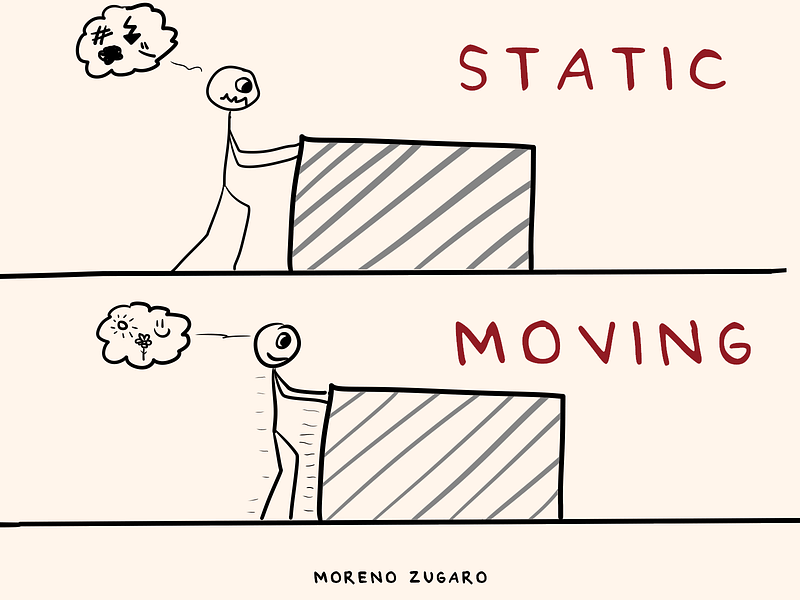
In physics, the resistance you have to overcome to drag an object over a surface is calculated using friction coefficients. The coefficient of static friction is always bigger than the sliding one, which means that giving an object the initial push is much harder than keeping it moving. If you ever pushed a dead car down the road you know what I mean.
Procrastination is much like physics — getting started is the hard part, staying in motion not so much.
Once you’re immersed in an activity, your default option is to keep going. When you watch YouTube or Netflix and have autoplay enabled, you’re much more likely to stay for “just one more video.” When you’re already in your PJs, you’ll go to bed instead of hitting the bars. And when you’re already working, you’re much more likely to go on even after the 15 minutes have passed.
My roommate took this to the extreme. He committed to doing just two minutes every evening — almost zero resistance. But on average, he ends up working for about 45 minutes and accumulates three solid hours of work on his thesis before the weekend even comes around. Good for him, bad for me — kicking his ass was fun.
Commit to small efforts and then keep going. It’s much easier than facing everything at once.
The Most Important 15 Minutes of Your Life
“Yesterday, you said tomorrow.”
Procrastination is often labeled as the silent killer. I’ll do it tomorrow here, just five more minutes there. Over time, all your tomorrows and five minutes accumulate, slowly robbing you of your life without you noticing it.
How many dreams have you given up on because you never took action?
How many times have you said tomorrow only to never do it at all?
How much could you have accomplished and what could your life look like if you just got started?
Time is your most valuable resource. Stop wasting it. Stop procrastinating. Take action, even if it’s only for 15 minutes. They will be the most important 15 minutes of your life.
I help men find direction and meaning and create their dream life by being more authentic. Sign up for my free 5-minute newsletter and become part of the Authentic Men Tribe!
I’m a huge fan of small changes that lead to large results, like this piece shows: