
How To Stay on Top of the Latest AI Research
Strategies on how to keep up with a rapidly advancing field

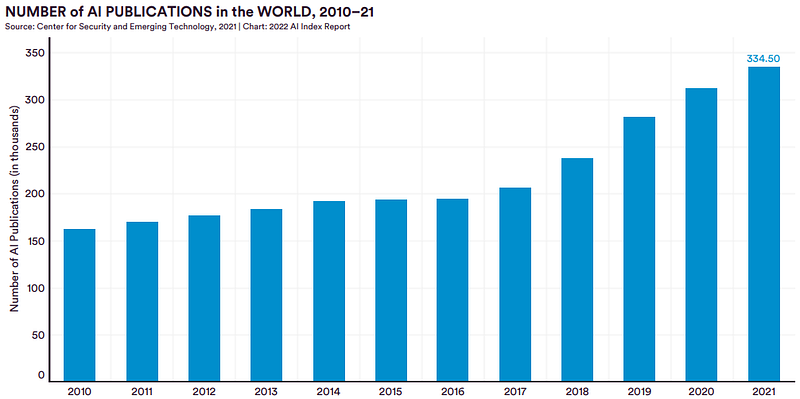
Artificial Intelligence (AI) is a disruptive and fast-moving field whose developmental trajectory is accelerating rapidly. In fact, the number of publications in this space has been rising dramatically in recent years. Stanford’s annual Artificial Intelligence Index Report shows that the number of AI publications has increased from 162,444 in 2010 to 334,497 in 2021 [1].
If you are working in the field of AI, you have probably also noticed the shortening intervals between major industry advances such as OpenAI’s DALL·E 2, GPT-3 and ChatGPT, or DeepMind’s AlphaFold. Those are just some examples that captured the attention of both the general public and the tech industry as they were extensively reported on and widely circulated on social media. However, advancements are also becoming more frequent in other disciplines, ranging from robotics to drug discovery, self-driving cars, and space exploration.
Surely, this ever-increasing, perpetual stream of new methodologies and publications makes it increasingly difficult for AI practitioners and developers to stay up-to-date with the latest research. This article will outline some strategies on how to navigate this landscape without suffering from information overload. Specifically, we will divide this article into sections based on the frequency with which the suggested activities can be done: daily, weekly, monthly, and yearly.
While this article is specifically geared toward AI research, the following strategies are applicable to most fields characterized by rapid advancement.
Daily
For AI practitioners with a full-time job and a continuously packed agenda, daily learning slots may seem hard to squeeze in. However, there are a few things that can be done on a daily basis without having to carve out significant chunks of time.
Subscribing to a daily newsletter is a great way of staying on top of things and it typically only takes a few minutes to read them. Examples include The Download by MIT Technology Review, or TLDR. These are not necessarily AI-centric, but rather technology-focused newsletters containing the latest developments in the tech sector, including plenty of AI-related content.
Regarding scientific literature, arXiv offers a daily email-alerting service that sends out daily listings of new submissions based on custom-specified topics. These topics can be selected from their category taxonomy. For instance, AI is present under the category Computer Science, and denoted as cs.AI. Similarly, Google Scholar also provides an alerting service based on user-specific topics of interest.
Perhaps one of the fastest ways to keep up with the latest literature is to follow their authors on social media, particularly Twitter. A lot of the big names in AI are using the platform to share their publications, thoughts, and information on their projects, including Yann LeCun, Geoffrey Hinton, Richard Sutton, Andrew Ng, and Christopher Manning.
Weekly
Whereas daily endeavors to keep up with AI research mainly include brief engagements here and there, weekly learning should be a bit more in-depth. A time investment of a few hours per week seems reasonable for the endeavors outlined below.
One of the most reliable and highest-quality sources of AI research are peer-reviewed research papers. There are a variety of sources and journals from which those can be retrieved, such as IEEE, Nature Machine Intelligence, Pattern Recognition, and many more. In addition, arXiv is a great source for open-access e-prints. The only caveat here is that, while these e-prints do go through a content moderation process, they are not peer-reviewed.
Furthermore, podcasts are a great way to stay informed and learn about where AI research is headed. By now, there is an enormous number of podcasts available throughout a variety of platforms, so one has to be selective. Here are a few suggestions of top-rated AI podcasts: The TWIML AI Podcast by Sam Charrington, Data Skeptic by Kyle Polich, Talking Machines by Katherine Gorman and Neil Lawrence, and Practical AI: Machine Learning, Data Science by Changelog Media.

Lastly, there are a number of informative newsletters that are sent out on a weekly basis. Prominent examples include The Batch by DeepLearning.AI, Alpha Signal, and The Sequence.
Monthly
There is a variety of activities one can engage in on a monthly basis. However, the planning aspect here might be a little difficult as these activities tend to occur on an ad-hoc basis. Examples include symposiums, webinars, reading groups, or lectures. While most of these events are regularly hosted by a range of educational institutions and businesses, only some of them are available to the general public.
If you are lucky enough to be affiliated with an institution that regularly hosts such events, that’s great! However, if this is not the case, being proactive in this domain can go a long way. Gather your colleagues and set up your own reading group or journal club where you keep each other in the loop and discuss the latest research findings in your area of interest.

Yearly
The AI community is vast and as a result, there are a multitude of annual conferences taking place both in-person and remotely. This is a great way to catch up with recent developments in the field, learn more about state-of-the-art methodologies, and engage in stimulating conversations with fellow researchers and engineers.
Among the most popular conferences are Neural Information Processing Systems (NeurIPS), the International Conference on Machine Learning (ICML), the International Conference on Learning Representations (ICLR), Computer Vision and Pattern Recognition (CVPR), and the Association for Computational Linguistics (ACL). These conferences cover a wide range of topics such as natural language processing, robotics, image processing, brain-computer interfaces, and much more. Again, it is important to be selective here in order to not experience information overload by attempting to attend every session at such a conference.

Conclusion
This article highlights some prominent activities — ordered by the frequency of recurrence — that can be undertaken in order to keep up with the latest research in AI. As the amount of information in this space increases every day, it is important to be selective in order to avoid information overload. Specializing in a particular subfield can also help narrowing down the scope of research within which one would like to keep up.
While many of the suggestions in this article are free, such as newsletters and podcasts, some do require subscriptions or attendance fees, especially certain journal articles or conferences, respectively.
Finally, if you think that your own team or institution does not do enough in this domain, why not take action and launch regular reading group or journal club meetings yourself? It’s a great way to stay on top of things, learn a new thing or two, and expand your network at the same time.
References
[1] Zhang et al. (2022), The AI Index 2022 Annual Report. AI Index Steering Committee, Stanford Institute for Human-Centered AI, Stanford University, March 2022.


