
How to Remain in a State of Soft Fascination, Amidst the Forest and Deep Breathing
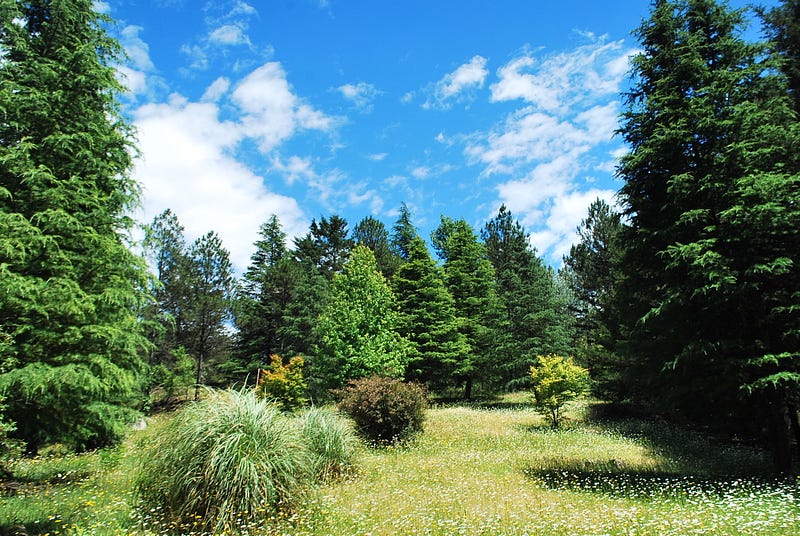
«What goes on in your mind when you see a butterfly, the sunset, or the rain?»
Karoshi, that Japanese term that signifies death by overwork. Japan is a country where competition loses against the suicide rate and seeks its solution in the tranquility of forests. Finding peace and balance is essential for surviving the job expectations.
An ancient Buddhist practice called Shinto involves taking forest baths. It’s about engaging your five senses in a natural space, away from technology. It allows you to center yourself in the present moment, surrounded by nature, free from anxiety and the constant alertness to anticipate problems.
Amidst the chaos of competitive stress, Japan endeavors to create more forests to provide its citizens with spaces for practicing Shinrin-Yoku. According to a report in the newspaper El País, every year between 2.5 and 5 million Japanese people participate in these “forest therapy” sessions.
Shinrin-Yoku is the act of walking in a natural environment.
A typical session consists of a two-hour leisurely walk through the forest and breathing exercises. To assess the changes brought about by the treatment, blood pressure and other physiological variables are measured before and after the walk. Scientific studies help us comprehend the impact that a simple outdoor walk can have on our lives.
For instance, South Korea has invested 140 million dollars in establishing a National Forest Therapy Center. However, it’s not difficult to notice that spending half an hour in the countryside leaves us more relaxed than waiting in traffic, observing how we remain stuck at a green traffic light with no shade from a tree.
Yoshifumi Miyazaki, a physiological anthropologist at Chiba University’s Center for Environment, Health, and Field Sciences in Tokyo, Japan, describes the human connection with nature as a home. In an interview with Outside Magazine, he stated, “During our evolution, we have spent 99.9% of our time in natural environments. Our physiological functions are still adapted to this environment”. This explains why natural settings induce calmness and comfort.
Studies conducted by scientists at the University of Chiba have shown that out of 600 subjects since 2004, those who frequently visit forests have a 12.4% lower cortisol hormone level. Practitioners of Shinrin-Yoku report being in a better mood, experiencing less anxiety, and unknowingly exhibiting a reduced incidence of heart attacks.
Interacting with nature decreases the activity of the prefrontal cortex, the part of the brain responsible for planning, problem-solving, and decision-making. Instead, activity shifts to other brain regions associated with emotions, pleasure, and empathy — qualities closely tied to creativity. “That’s why food tastes better in the forest,” says Miyazaki in the Outside Magazine interview.
Parks also serve as small oases of nature, and in the worst-case scenario, it is always better to admire nature photos, listen to the flow of a river, or observe a tree on the street rather than being glued to a cellphone screen. Sometimes, it is necessary to immerse ourselves in the natural world, once again experiencing the falling of a leaf, the swaying of branches, and the sensation of walking with the breeze.
#NowPlaying: The Smiths


