
How To Speed Up Article Writing
Through The Magic of Timers
The year was 1998; the month was February. I have been out of the workforce for seven years and desperate to get back to work. The only problem was there was no more work in my chosen field. Research money had dried up, and technical jobs in the field of Biochemistry didn’t exist (at least in Australia).
Flipping through the job section of the newspapers, I realized I was in the wrong field. There were plenty of jobs in Information Technology, and all I needed was get another piece of paper that said I understand the subject and can be employed.
But the only problem was the enrolment date had passed. I met the course coordinator, and she told me that I had missed the lectures, which she had conducted all through February to familiarize new students with programming. She suggested I should try next year.
But I was not prepared to wait for another year.
“Guess, this is what I will do,” she pulled out a thick C++ programming textbook, “Take this book and see if you can go through the first six chapters in the next five days. If you really understand them, on your own, I will allow you to join the course.”
Those six chapters amounted to 200 pages. I needed to finish one and quarter a chapter a day. I made a rough estimate; if I can spend five minutes per page, I could go through them. That is when I discovered that my kitchen timer had other uses too.
I discovered timers again while doing the cartooning course recently.
Speedy sketching a skill every cartoonist has to master. We were to sketch within 15 minutes, no matter what. Soon I discovered that my sketches were better when I did them with a timer and pathetic when I took as long as I wanted.
The timer gives you an arbitrary deadline.
Parkinson’s law says that “work expands to fill the time available for its completion.” No matter how much we detest deadlines, deadlines get the work done.
Clock ticks away relentlessly, getting you tired by the minute. It’s not just time that’s being drained away, but also energy.
The more time you spend, the more tired you get. The more tired you get, the more inferior the work is.
By the time you get to the editing and formatting stage, you’re so exhausted that writing seems like a chore to avoid. And eventually, you decide it’s too much misery and doesn’t want to write anymore.
This painful experience can be minimized if you learn to write with a timer.
A timer forces efficiency. And it forces you to stop. It gets your continually editing mania under control. It allows you to divide writing into small tasks and finish them one at a time. When the buzzer goes off, it’s time to finish the piece.
The timer gets the novel written.
In 1996, the Wall Street Journal reported that the Brazilian novelist Ryoki Inoue has just written his 1,039th book since he took up the craft ten years ago. He wrote his novel in less than eight hours, right in front of the reporter. Inoue started the book around 10 p.m., and by 5:30 a.m., he was putting finishing touches on a 195-page story of drug traffickers and corrupt cops.
Ryoki Inoue holds The Guinness World Records as the world’s most prolific writer, having published 1075 books.
How do you think he pulled it off?
“The important thing is to abandon inertia — even if it means walking sideways like a crab,” Mr. Inoue writes.
The timer helps beat inertia.
Time Timer inventor Jan Rogers’ youngest child struggled to make transitions from one daily routine to another. Whether it was time to get ready for school or homework, practice, or bed, her young daughter often felt frustrated and anxious because of her inability to grasp the concept of elapsed time.
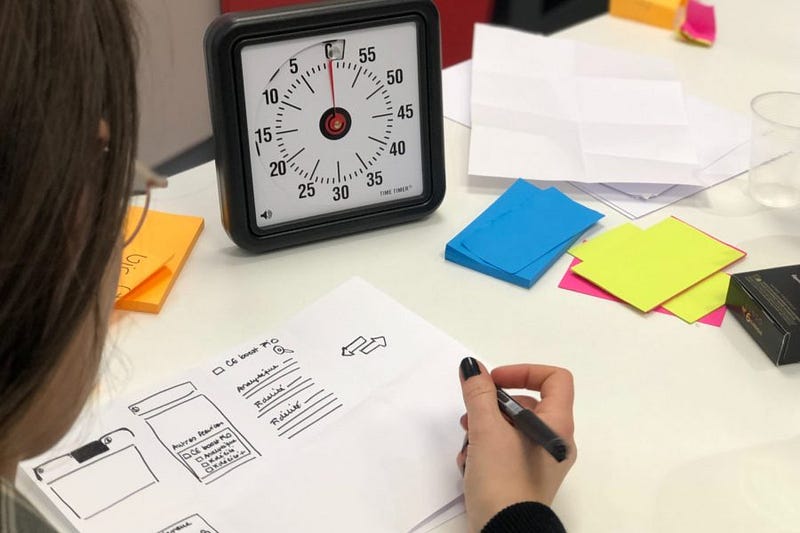
To solve this problem, Jan created the Time Timer — an innovative, simple time management timer designed to “show” the passage of time through the use of a red disk. As time elapses, the red disk disappears, explaining how much time has passed and how much is remaining.
The timer enhances the quality of your work.
Working with a timer doesn’t compromise the quality of your work. It rather enhances it. Professionals always work on tight deadlines and still produce great quality work. Here is a story to illustrate that.
“George of the Jungle” started as a Saturday-morning cartoon. One day, as the show was being developed, two professional songwriters got a call from the Walt Disney Pictures. “We need theme songs for ‘George of the Jungle’ and two other cartoons,” they were told. “And we need them fast.”
“How fast?”
“Four hours from now.”
The songwriters went to work. The clock ticked. Four hours later, they had banged out all three songs.
And guess what? The studio not only liked them and used them, but the song for “George of the Jungle” turned out to be one of the most memorable and successful things they ever wrote.
So get away from your assumptions about how long a task is supposed to take. Get it done much more quickly.
The timers help you meet deadlines.
Have you ever missed a work deadline?
Your boss asks for a report within twenty-four hours; how do you accomplish that? You might spend little extra time at work, but the thing that really gets the report done is your concentration level.
The concentration comes with the timer.
Brand new to programming, I read and understood 200 pages of a C++ programming textbook within five days. Some pages took a bit longer, but others even less than two minutes, giving me time to revise the previous pages and take notes. But timer kept me on time with finishing the task. Needless to say, I was accepted in the course and was offered three jobs even before I finished my degree.
Next time you sit down to do a task, turn on the timer.
Time flies, so can you.
This article was first published at www.neeramahajan.com.
No one will help you more in your writing journey than other writers. Subscribe to my newsletter at www.neeramahajan.com to go deep with your writing.
If you liked this article, you might also like this one too.