
How to speak confidently in front of an unfamiliar audience
An international update to my public speaking tips
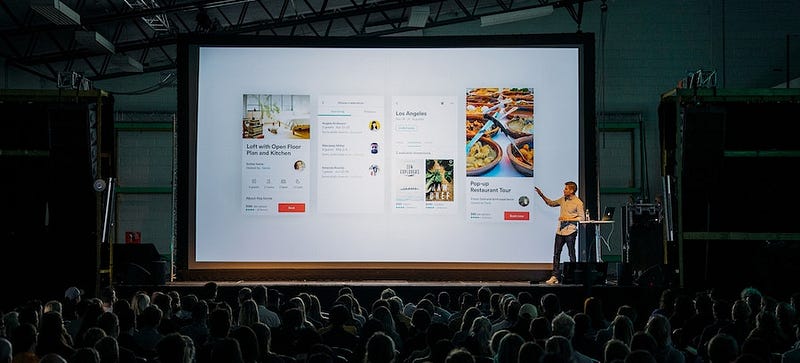
I just finished a trip to Melbourne, where I spoke at Design Leadership 2019. It’s an excellent conference, by the way. It’s run very well, and the organizers and attendees were terrific people to spend a couple of days with.
I want to share some advice for speaking at an international event while everything is still fresh in my mind. Many of my tips for public speaking are still relevant, but there are some unique points to be made here as well. Presenting is always a little bit different when you’re speaking in front of an audience in another country, or when there might be a language difference.
A good friend of mine told me about the conference and suggested that I submit a proposal. Initially, I was hesitant. I’ve been out of the corporate world for almost 10 years. I’ve been doing my own thing and stepped away from a formal design leadership role even earlier. I haven’t led a big team in a decade.
But, then I said, “Why not? What have I got to lose? They can reject it.” I knew one of the conference organizers and respected him. So, I had a hunch that it would be a great event. Plus, I had always wanted to visit Australia.

Confidently pursue speaking opportunities
So, this would be my first piece of advice. Your initial step onto the path of speaking confidently starts with being more confident about what you have to offer. You have nothing to lose and so much to gain. It’s easy to fall into the trap of thinking, “Why would anyone want to hear what I have to say?” I’ve had clients say that while I was recommending that they do more public speaking.
But, your life and work experiences, mistakes made, and lessons learned are always of value to other people who aren’t quite as far along on the same path. Unless you were born today, there is someone behind you on the path. What you know is valuable to them. Believe me.
There is probably a conference, panel, or other speaking opportunities relevant for almost anything you feel like you have enough knowledge and experience to discuss. Talk with people in your network about the events they would recommend. Keep your eyes open for local opportunities to speak at meet-ups or to be on relevant industry panels.
Don’t just limit yourself to your hometown either. If there are cities and countries you’ve always dreamed of visiting, look for an opportunity to speak at an event there. That’s what I did, and I’m so glad that I finally had the chance to visit Australia!
Some resources:
- Check out Meetup to find and attend local events. I’ve joined and spoken at a couple of meet-ups near my hometown. It’s an easy way to get started with a much smaller audience, and the events are usually way less formal. For example, one of my last talks was to a group of about 10 local businesspeople over lunch and drinks.
- Eventbrite is another useful service for finding events around the world. Attend the ones that interest you, get to know the organizers, and then you’ll be able to pitch them later. Sometimes you’ll even see a note that the rest of the panel for an event is TBA. That’s your chance to reach out to the organizer and see if you could join.
- Find a local chapter of a relevant association, attend meetings, and look for an opportunity to speak at one of the events. For example, the Association for Computing Machinery makes it easy to find a chapter near you. I’ve also talked at BayCHI a few times over the years.
- Talk with the people in your network who are often giving talks and participating on panels. We all have at least one of those friends. Ask for their recommendations and find out how to apply to speak at the events they suggest.
- If you already have quite a bit of experience with public speaking, you might be ready to create a profile on SpeakerHub to get serious about finding more opportunities, both free and paid. You can check out my profile to see an example.
Choose a topic that translates well for the intended audience
Research the people who will be attending the event. Where do they live? What do they do? Where do they work? What are their industry backgrounds? What do they care about? What are their struggles?
I spent some time on social media (e.g., Twitter) and found dozens of recent and relevant tweets that gave me some clues. This preparation is especially helpful when you will be speaking in another country. The culture and working environments are different than what you are familiar with.
Research the other speakers at the event and the conference organizers. What are their proposed talks? What are their backgrounds? What have they talked about at past conferences? Find articles they’ve written, recent tweets, interviews, etc. What has been presented at previous events by this organizer? This all gives you more clues about the general themes of interest.
Since I’m no longer neck deep in the day-to-day life of leading a Design team, I decided that my theme had to be something that is evergreen. I wanted to find something that has always been an issue and is still a problem today. It couldn’t be the latest design trends or advances in technology.
I settled on the issue of power. More precisely, the lack of power that people feel in organizations. For example, why do designers feel powerless despite contributing significantly to the success of so many companies for decades?

If you want to see the talk, you can view it here. But, that isn’t what this story is about.
It’s about how I prepared for the talk, how I presented that day, and what’s unique about presenting to an international audience.
Don’t procrastinate
Speaking at an international event is a big commitment, both for you and the organizers. The costs are higher, the planning is more extensive, and the risk is higher. It’s a long way to travel and a lot of time is required, so you want to make sure that it pays off for you and them. You don’t want your talk to bomb. You also don’t want them to regret flying you in for the event.
I started writing a draft outline immediately. I somehow avoided my usual procrastination. I initially wrote the outline in Evernote and used this to capture a bulleted list of ideas.
It was a stream of consciousness exercise. I did this for the first couple of weeks. Any time that an idea popped into my head, I jotted it down. Some of my best thoughts occurred in the shower or on a run. This is surprisingly common. Keep your phone or a notebook nearby to capture them.
I also found that it helped to put the outline document away for a day and then come back to it. I would review my previous notes and quickly decide if a point still sounded promising. Sometimes, I would review something, see it with a fresh perspective, and determine that it was off-topic or seemed kind of silly now.
Create a presentation framework
I then created an outline for the slides in Keynote. It was a 45-minute presentation, so I knew it would roughly be 40–50 slides. I usually expect to spend an average speaking time of one minute per slide. Some slides were actually 5 minutes of speaking, but others were 15–20 seconds.
I like to create all of the section title slides that follow my outline and a few placeholder content slides in each section to capture notes in bullet points. I can then walk through this framework and see if the overall flow and points that I want to make feel like a coherent story that builds and supports my overall theme.
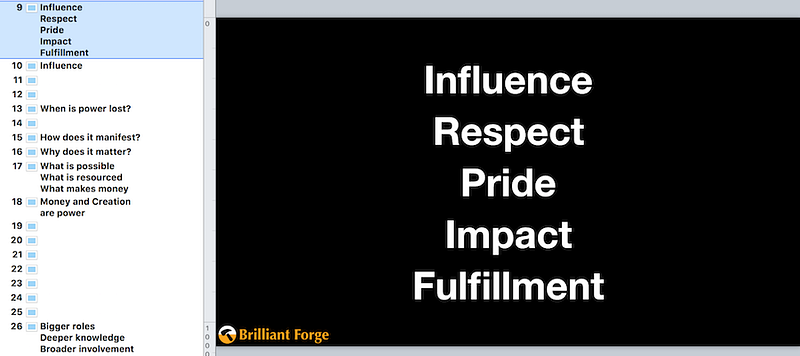
I like to create my final summary slide(s) at this point too. How do I want the presentation to end? I want to end strongly with a clear takeaway message. I want it to be emotional. The story has to build up and support this. Of course, I will tweak and change this over time as the presentation develops. But, I always have the ending in mind.
This framework is great for capturing any content that I think will help. I put in a lot of photos, graphs, quotes, etc. I would say about 70% of it will change over time (e.g., I find a better picture to support my point) and a great deal of it gets moved into the Appendix so that I don’t lose anything I might want to pull back in later.
This is also where things are unique for your international audience. Some imagery and quotes will resonate better with them than others. For example, I once made the mistake of including an image that I thought would be humorous. It had played well in the U.S. before. But, when I included it in a presentation for a French audience, they didn’t react at all. Oops.
Create a presentation script
I wrote a script separately. This document came in very handy. The speaker notes section in Keynote or PowerPoint is insufficient and tedious to use. I want to use formatting and additional notes for how I’m going to give the talk.
I indicate places where I will pause. I mark when I will stop and ask the audience a question. This is, again, a crucial place where you will interact with an unfamiliar audience differently. Do your research and decide what questions — and even jokes — will be most appropriate for them.
I highlight the words that I want to emphasize in different ways. I include notes on timing so that how I will speak is mapped to the timing of the slide animations.
I print this out to have it handy while I rehearse the presentation. This allows me to present full screen, standing with the remote in hand, and referring to the printed notes while I practice.
“You practice how you play. I still believe that.”
— Chris Harris, Jr.
I carried this script around with me for several weeks. It allowed me to become very familiar with the talk, make changes at any time, and practice it no matter where I was.
Waiting for an appointment? Read through the script.
Riding as a passenger in the car as you head to the grocery store? Read through the script.
Sitting on the plane when you have to put all electronic devices away? Read through the script.
Don’t load your slides with text
This is good advice for any presentation. But, it is especially true for an audience when there are cultural and language differences. You can adapt your vocal style and delivery in the moment as you read your audience’s reaction. You can tweak what you are going to say based on the talks that preceded yours and what you are learning about the people who are attending.
This makes your talk feel more relevant and intelligently contextual. If you cram a bunch of text on your slides, you may have missed the mark with your message. Now it’s too late. The audience is reading your slides and that’s the message they will remember.
Besides, it sucks to have your audience reading your slides and not paying attention to what you are saying. But, they can’t help it. If you pop up a slide with a bunch of words, they will feel compelled to read it.
Do not read your presentation!
Speaking of reading. Please, oh please, do not read your slides or speaker notes. This has happened at almost every conference or event I’ve attended.
Someone feels uncomfortable, or they didn’t prepare well enough. So, they start reading their slides to us. Or, you can tell that they are reading their speaker notes. Inevitably, they start rambling in a monotone voice. They lose the audience’s attention within a few minutes.
Although I have a script, it’s really just a framework. I improv the actual presentation. I never precisely give the same performance twice. Knowing the script helps me remember key points I want to make though.
Practice a lot. Practice giving the talk the same way you will give it at the event. Stand up. Present in full-screen mode. Practice how you will walk, stop, and stand as you make points. Practice your hand gestures.
Do this improv style. You don’t have to be a memorization robot! Give the talk from memory, check your script, and see what you may have forgotten. Do it again and again.
Just as with too much text on your slides, simply reading your presentation does not give you a chance to adapt to an unfamiliar audience. When you’re looking down and reading, you are missing essential cues. When you speak to the audience and watch their reactions, you can see looks of confusion, frowning, etc. and adapt your speaking style in the moment.
Conduct multiple dry runs
In the last couple of weeks, you should practice giving the full presentation. Time each slide, and the overall talk. Note key points. Make adjustments as necessary.
For example, I would note the specific slide that should be at the halfway point. That would let me know if I was running behind or speaking too quickly. I would also note the slide when I have 10 minutes left. Another slide when I have five minutes left, and so on.
Doing multiple dry runs lets me know if I’m on track for a consistent presentation and timing. I’m constantly revising as I practice. I did a dry run right before going to bed the evening before my talk. I woke up at 5 AM on the morning of my talk and did one last dry run.
Ok, maybe I’m a little obsessive.
Optimize your travel schedule
A couple of times in my career, I was scheduled for a long flight, arrived at the destination, and went straight to the office or venue to present. What a disaster!
I felt discombobulated, especially when it had been a long trip (e.g., a 20+ hour trip to Bangalore). I was tired, my energy levels were low, and I know that I must have been a disappointing speaker.
I no longer let this happen. I always schedule my flight so that I arrive a day early and can adjust to the local time. It gives me time to rest and recover. It lets me settle in and prepare for the event.
This is where international travel is different too. I had a couple of occasions when I would fly in, give my talk or attend a meeting, and fly back out that evening or the next morning. I never took any time for myself to enjoy the city.
I’m sorry, but life is about more than just work and efficiency. I want to see the world. I want to explore new cities and experience the culture, food, and everything that makes it unique. Melbourne is incredible, by the way.
I now add a few more unscheduled days to the end of my trips. I can’t relax and enjoy myself before giving my talks. I’m still practicing and want to get it just right. I know this about myself. I can finally relax and have some fun when it is all done. So, I use those days after the event to decompress, explore, and create some beautiful memories (Thanks, Tony!)
Set yourself up for confidence
I’ve found that I’m more comfortable speaking at an event when the venue feels a little more familiar. That’s why I like to fly in at least a day early and get used to the city, traveling to the venue, and then exploring the setup.
I arrived in Melbourne on Monday and checked into my Airbnb by noon. I was careful to find a place that was within walking distance of the conference venue. I walked over in about 15 minutes and saw the room where I would be speaking. It gave me a sense of the size of the audience, how the stage was set up, where things were situated, etc. This made the actual day of the conference a lot less stressful.
If possible, meet the other speakers, organizers, and some attendees the day or evening before. This is especially important for an event in another country where you need to get used to a language difference and accents. You will also find out how difficult your accent is for them to understand. It may be a clue that you will need to slow down and avoid slang and acronyms that only make sense for your own culture.
I was lucky enough that this conference had an event the day before the main day of talks. I got to know some of the people, hear about what mattered most to them, and get a sense of how my talk would be received (i.e., more last-minute tweaks).
I also like to do a few things in my talks that help me become more comfortable with the audience. For example, I use some self-deprecating humor to kick things off. Jokes are tricky, and it’s easy to make a mistake (I certainly have before). But, making fun of yourself is a pretty safe topic. For the Melbourne event, I made a joke about my American accent and how I initially mispronounced the name of the city.
I also like to tell the audience that they may not agree with everything I’m going to say and that it’s ok to follow me on Twitter and tell me that I’m stupid. I put one of my worst fears out there and took away its power. Go ahead and tell me that I’m dumb. Let’s get that out of the way now.
Watch your language
As I just mentioned, when speaking internationally, you have to avoid references and slang that only mean something to you. I broke this rule with a talk that I gave in Paris several years ago, and it showed. My joke fell flat. The audience was silent. Not fun.
You have an accent. We all do. It will take the audience some time to become accustomed to it and understand you. So, start out speaking slowly and enunciating your words.

Guess what? That’s good advice for any talk you give anywhere, even locally. Slllllllooooooowwww down.
Later in the talk, you can speed up a little, but you still shouldn’t rush your words. You shouldn’t be quiet or speak monotonously. I’ve been in talks like that. The person quietly droned on, speaking rapidly, and it just sounded like mumbling.
Dial up the energy
I like to ask the audience a few questions that allow them to participate. What happens if they don’t answer? That does happen sometimes. If it does, make a joke about that and move on.
“How many of you have experienced this problem?”
<No one in the audience responds or raises their hand>
“Ok, then. I guess it’s just me. I shouldn’t be surprised. I do tend to suck at that more than most people.”
Have some fun with it. Obviously, there are some serious talks. But, I think many talks benefit from you demonstrating that you’re having fun and enjoying yourself. Don’t take yourself too seriously.
Be dramatic and larger than life. A good talk is theater. Watch a few TED talks for some examples. Those speakers are so energetic! But nothing is more boring than a passionless speaker.
Laugh if you want. Sometimes I’m the only one laughing at a joke that I made. I’m ok with that. It happens in my real life too. I enjoy amusing myself.
Pound your fist to emphasize a point. Cover your eyes in despair. Pause and look at the audience for several seconds. It will feel uncomfortable. Most people can’t stand the silence. They rush to fill the void. Resist that temptation. Use pauses and silence for impact.
Play off of the audience’s mood
Find your friendlies in the audience. Remember those people you met the day before your talk? You got to know them. You told them a little about your upcoming talk. You shared ideas. These people will usually be the friendliest ones in the audience. They will be smiling in recognition. Nodding in agreement.
Make eye contact with your friendlies and build off of their energy. It improves your confidence. It calms your nerves. It feels good to see some people enjoying your talk.
However, don’t be surprised by the frowners. I had a few in my last talk. Their arms were crossed. They were frowning at me. Some were even negatively shaking their heads. A few were displeased.
Good! That means that your talk stood for something. If you are going to say something significant, it will resonate positively with some people, and it will upset others. That’s ok.
As you read your audience, try to gauge the overall mood and tune your talk accordingly. If everyone looks confused, you need to speak more clearly and try harder to explain your points. If everyone looks upset or angry, it’s ok to address that.
“I know. No one likes to hear that. I don’t either. But, that is the reality. Now, I want to share what I think we can do about it.”
Finally, assess how it went and make notes for improvement
In all, I probably spent 50+ hours preparing and practicing for a 45-minute talk. That’s what some excellent TED presenters do. They spend about an hour practicing for every minute of the talk.
“True story: for the last 18-minute TEDx Talk I gave, it took me approximately 18 hours to rehearse.” — Nancy Duarte (source)
Did it work? I think so.
Several people talked with me later that day and followed up through other channels to tell me that they enjoyed my talk and got a lot out of it. Some specifically mentioned that they appreciated how I gave the talk. They liked that I didn’t read my talk. They noticed that I wasn’t afraid to pause and have moments of silence.
Of course, I have ideas for improving the talk. There were things that I forgot to say. Some moments still felt clumsy, even though I had practiced so much.
I should also say that now is the time for you to relax and recover. It is emotionally and physically draining to give a talk on stage in front of an unfamiliar audience. It’s hard to be on for that long and even afterward as you network with people. When it was all over, I could feel the tension releasing in my neck and shoulders. Whew!
Take some time to recover from the event. You’ve earned it!
Good luck!
I hope these additional public speaking tips are helpful the next time you need to travel for an event. If you have any other suggestions that you think are great, please feel free to share them in the comments. Thanks!
I have another story that goes into a few more details about how to overcome your fear of public speaking if you’re an introvert.
Check out my Invincible Career newsletter where you can receive more stories and advice that help you plan your own invincible career and life! You can also learn more about my services on Brilliant Forge.
Larry Cornett is a Leadership Coach and Career Advisor. He lives in Northern California near Lake Tahoe with his wife and children, two Great Danes, two chickens, and a stubborn old cat. He does his best to share advice that can help others take full control of their work and life. He’s also on Twitter and Instagram @cornett.