avatarScott Stockdale

Free AI web copilot to create summaries, insights and extended knowledge, download it at here

2901

Abstract

a">I crave stability.</p><p id="95f6">The problem is, when paychecks aren’t guaranteed and your savings go down, things can feel scary.</p><p id="e21f">Having a year of savings has helped. Despite this, my mind still jumps to the worse. <i>What if I can’t make payments? What if my income dries up? What if, what if, what if…</i></p><p id="9a32">To ease these worries, I use fear-setting — a practice coined by Tim Ferriss. Once a week, I spend 10–20 minutes pinning down my fears by listing ten of the worse things that could happen. I then list ten ways I could prevent the worse things from happening.</p><p id="4b62">Finally, I list ten ways I could repair each bad thing.</p><p id="53d2">The practice helps me realise how deceptive my fears can be. I face them head-on and see their point of view. They soon disappear.</p><p id="f522">You can extend the practice by listing the costs of inaction. <a href="https://www.checkli.com/checklists/marvinrussell/fear-setting-a-free-template-for-listing-your-fears-instead-of-your-goals-1">Here’s a free template</a> in case you’re interested.</p><figure id="cef9"><img src="https://cdn-images-1.readmedium.com/v2/resize:fit:800/1*EMV3uYvVJe81Aryq5eG-NA.png"><figcaption>Image taken from <a href="https://mindfulambition.net/fear-setting-tim-ferriss/">mindfulambition.net</a></figcaption></figure><h1 id="f90e">Practice #3: Be your own hype buddy in front of your bathroom mirror</h1><p id="686a">I feel silly doing this.</p><p id="c258">Nonetheless, I make the effort of saying three things I’m grateful for when I stand in front of my bathroom mirror.</p><p id="8b6f">I do it at least twice a day — once in the morning, once in the evening — and it’s always after brushing my teeth.</p><p id="e005">The effects are surprising. Since leaning into gratitude, I’ve noticed a shift in my mindset and I feel more productive. The morning reset disrupts negative thoughts.</p><p id="1047">If you’re likely to forget the practice, try one of the following:</p><ol><li>Stick a post-it on your mirror</li><li>Write a reminder on your mirror with a whiteboard pen</li></ol><p id="8b6a">Over time, “stacking” it on brushing your teeth will also help reinforce the habit.</p><blockquote id="7392"><p>“Habit stacking increases the likelihood that you’ll stick with a habit by stacking your new behavior on top of an old one.</p></blockquote><blockquote id="cc7c"><p>“This process can be repeated to chain habits together, each one acting as the cue for the next.” — <a href="https://jamesclear.com/habit-stacking">James Clear</a></p></blockquote><h1 id="84b2">Practice #4: Send a request to your subconscious</h1><p id="1f60">Most nights, I spend 10 minutes journalling.</p><p id="8b1e">I write down whatever pops into my head. This helps clear the gunk in my brain.</p><p id="5b92">I then spend 30–40 minutes reading in bed. Usually, it’s a fiction piece. Lately, t

Options

hough, I’ve dipped into autobiographies of people I admire.</p><p id="0830">The most recent belongs to British comedian, Jimmy Carr. After graduating from Cambridge, he left his job at Shell to become a stand-up comic. This happened in his mid-twenties — around the age I am now.</p><p id="1e26">Books like this are a reminder of what’s possible.</p><p id="7d2c">The final thing I do is flick through a yellow scrapbook I’ve been putting together. It’s a colourful reminder of my favourite quotes, goals, and important people in my life.</p><p id="dc75">My mind is ready for a peaceful night.</p><p id="021b" type="7">“Never go to sleep without a request to your subconscious.” — Thomas Edison</p><h1 id="f8be">Practice #5: Block out the noise</h1><p id="e3e8">The only news I consume is in <i>The Economist</i>.</p><p id="ec2c">I have no news on my phone, I don’t watch it on TV, and I can’t remember the last time I picked up a newspaper.</p><p id="aa7e">Some call it ignorance, others a lack of care. I call it bliss. If anything important pops up, I find out from my family.</p><p id="d297">News heightens our emotions. I want no part in this, particularly when it’s fear.</p><p id="2a6c">It’s the same with social. I don’t have any of the apps on my phone (apart from WhatsApp) and notifications are off. I also avoid looking at my phone until I’ve done an hour of writing.</p><p id="924d">I’m not perfect at this. However, on the days I take these steps, I’m less distracted. My mind engages in deep work.</p><p id="cd77" type="7">“The modern life is shallow and distracted. The timeless life is deep and focused.” — Derek Sivers</p><h1 id="5df2">Takeaways</h1><p id="b538">Quitting the 9–5 is scary.</p><p id="65f0">The human brain is thousands of years old, and it’s hardwired to detect fear. Just the faintest whiff is enough to trigger alarms.</p><p id="d1bb">There’s no point running. Let’s embrace it! After all, mindset is 80% of the game.</p><p id="fdc2">We may as well smile at our fears.</p><p id="f7d9">Here’s a summary of five practices that have helped me stay sane. They make help you too if you ditch the 9–5:</p><p id="2446"><b>#1: Switch the focus to being the best — </b>Bring value to others and the money will take care of itself.</p><p id="d1da"><b>#2: Try a weekly fear-setting practice — </b>When you pin down your fears, it’s easier to call their bluff.</p><p id="c4f6"><b>#3: Practice gratitude in front of your bathroom mirror — </b>Stop negative thoughts before they derail your work.</p><p id="414d"><b>#4: Send a request to your subconscious —</b> Prime your mind for a peaceful night’s sleep.</p><p id="53b1"><b>#5: Block out the noise — </b>You’ll be less distracted.</p><blockquote id="6d41"><p>Want to leave your 9–5? Get my 6-month plan on how I did it by <a href="https://scottstockdale.co.uk/plan">joining my newsletter</a> :)</p></blockquote></article></body>

How to Smile at Your Fears When You Quit Your 9–5

These five practices have kept me sane since making the leap

Photo by Vinicius Wiesehofer from Pexels

“Part-time work isn’t something we can offer right now.”

I bit my lip.

“If you’re looking for full-time, that’s a different story.”

This wasn’t the plan. I wanted part-time work to pay my bills. I’d just quit my 9–5. Now, I had to look for something else or double down on my projects.

I decided on the latter.

Since making the decision, I feel free. However, it’s also brought fears to the surface that have laid dormant for years.

These five practices have helped me smile at my fears.

Practice #1: Switch the focus to being the best

One of my 2022 goals is to make £5,000 a month from online courses. This hasn’t changed. What has changed is my approach.

Every morning, using a hypnosis practice, I repeat the mantra, “I’m going to make the best SEO course on the internet.”

This is the only thing I can control.

In my experience, money takes care of itself when you bring value to others. However, an abundant mindset is difficult when you’re strapped for cash. That’s why savings make sense.

They make you less needy.

“One of the secrets to getting what you want in life is creating the perception that you don’t need a thing.

“That can be a difficult energy to project — especially when you’re struggling — but committing to that perception will make you more attractive professionally, personally, and even romantically.”

— Curtis Jackson

Make no mistake — quitting your 9–5 is scary. I held off for as long as I could. I’m also pretty risk-averse which is why I chose 12 months of savings. Six may work for you.

Practice #2: Weekly fear-setting

Growing up, money was tight. Its presence swirled like a vampire hunting blood.

I crave stability.

The problem is, when paychecks aren’t guaranteed and your savings go down, things can feel scary.

Having a year of savings has helped. Despite this, my mind still jumps to the worse. What if I can’t make payments? What if my income dries up? What if, what if, what if…

To ease these worries, I use fear-setting — a practice coined by Tim Ferriss. Once a week, I spend 10–20 minutes pinning down my fears by listing ten of the worse things that could happen. I then list ten ways I could prevent the worse things from happening.

Finally, I list ten ways I could repair each bad thing.

The practice helps me realise how deceptive my fears can be. I face them head-on and see their point of view. They soon disappear.

You can extend the practice by listing the costs of inaction. Here’s a free template in case you’re interested.
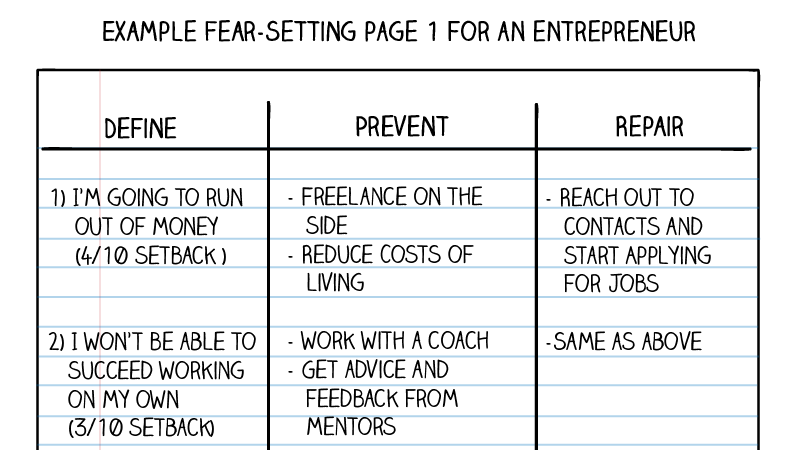
Image taken from mindfulambition.net

Practice #3: Be your own hype buddy in front of your bathroom mirror

I feel silly doing this.

Nonetheless, I make the effort of saying three things I’m grateful for when I stand in front of my bathroom mirror.

I do it at least twice a day — once in the morning, once in the evening — and it’s always after brushing my teeth.

The effects are surprising. Since leaning into gratitude, I’ve noticed a shift in my mindset and I feel more productive. The morning reset disrupts negative thoughts.

If you’re likely to forget the practice, try one of the following:

  1. Stick a post-it on your mirror
  2. Write a reminder on your mirror with a whiteboard pen

Over time, “stacking” it on brushing your teeth will also help reinforce the habit.

“Habit stacking increases the likelihood that you’ll stick with a habit by stacking your new behavior on top of an old one.

“This process can be repeated to chain habits together, each one acting as the cue for the next.” — James Clear

Practice #4: Send a request to your subconscious

Most nights, I spend 10 minutes journalling.

I write down whatever pops into my head. This helps clear the gunk in my brain.

I then spend 30–40 minutes reading in bed. Usually, it’s a fiction piece. Lately, though, I’ve dipped into autobiographies of people I admire.

The most recent belongs to British comedian, Jimmy Carr. After graduating from Cambridge, he left his job at Shell to become a stand-up comic. This happened in his mid-twenties — around the age I am now.

Books like this are a reminder of what’s possible.

The final thing I do is flick through a yellow scrapbook I’ve been putting together. It’s a colourful reminder of my favourite quotes, goals, and important people in my life.

My mind is ready for a peaceful night.

“Never go to sleep without a request to your subconscious.” — Thomas Edison

Practice #5: Block out the noise

The only news I consume is in The Economist.

I have no news on my phone, I don’t watch it on TV, and I can’t remember the last time I picked up a newspaper.

Some call it ignorance, others a lack of care. I call it bliss. If anything important pops up, I find out from my family.

News heightens our emotions. I want no part in this, particularly when it’s fear.

It’s the same with social. I don’t have any of the apps on my phone (apart from WhatsApp) and notifications are off. I also avoid looking at my phone until I’ve done an hour of writing.

I’m not perfect at this. However, on the days I take these steps, I’m less distracted. My mind engages in deep work.

“The modern life is shallow and distracted. The timeless life is deep and focused.” — Derek Sivers

Takeaways

Quitting the 9–5 is scary.

The human brain is thousands of years old, and it’s hardwired to detect fear. Just the faintest whiff is enough to trigger alarms.

There’s no point running. Let’s embrace it! After all, mindset is 80% of the game.

We may as well smile at our fears.

Here’s a summary of five practices that have helped me stay sane. They make help you too if you ditch the 9–5:

#1: Switch the focus to being the best — Bring value to others and the money will take care of itself.

#2: Try a weekly fear-setting practice — When you pin down your fears, it’s easier to call their bluff.

#3: Practice gratitude in front of your bathroom mirror — Stop negative thoughts before they derail your work.

#4: Send a request to your subconscious — Prime your mind for a peaceful night’s sleep.

#5: Block out the noise — You’ll be less distracted.

Want to leave your 9–5? Get my 6-month plan on how I did it by joining my newsletter :)

Fear
Entrepreneurship
Money
Productivity
Work
Recommended from ReadMedium