How to Skin Flood Like a Minimalist, From a Dermatologist
Move over skin fasting, skin flooding is here to stay

What if your epidermis could talk?
“Hi there, it’s epidermis speaking.”
“Hi hi that I’m dermis here, what’s up today?”
“I’m sick. Have you heard of skin fasting?”
“They are starving me….
Literally.”
“No worries, I’ll just let Tik Tok know.”
In 2020 beauty insiders began the debate about skin fasting — that it promises healthier, clearer skin. In dermatologist speak, skin fasting i.e. taking a break from skincare products possibly allows your skin to return to a natural state of balance. And this, theoretically can give your skin time to reset. The caveat is, that’s if you were applying stimulating or potentially irritating skincare actives in the first place. Like retinol/retinoids, AHAs and BHAs.
Frankly, ingredients that stimulate the skin are passé. A decade ago, when I first entered dermatology residency, dermatologists were obsessed with everything that “stimulates collagen production.” That also meant we expected a trade-off — stimulated skin was red, flaky and sometimes painful. The more you tolerate that, the better your skin gets. That’s not just patently false, it’s bordering on dangerous.
In Singapore, where I practice, I deal with primarily skin of color. What was considered a superficial chemical peel in caucasian skin was really not so superficial in asian skin types…who were prone to hyperpigmentation. Specifically, post-inflammatory hyperpigmentation which potentially could arise from the slightest redness or flaking that occured post-procedures. Ditto for topical skincare that contained retinols and acids.
Our tropical weather made for ultra-sensitive skin that would react because of sun exposure as well. That was the case I made for post-procedure care — a K-beauty inspired regimen of layering skincare. A milk cleanser, 3 serums, an emulsion and sheet masking every night. Plus facial mists throughout the day.
In 2023, Tik Tok called that skin flooding. I quite like the term I must say, it makes the skin barrier easy to understand. I’ll also like to explain it this way. Think of your skin barrier as a sandwich model — how effective your skincare will be depends on… well how you make the sandwich.
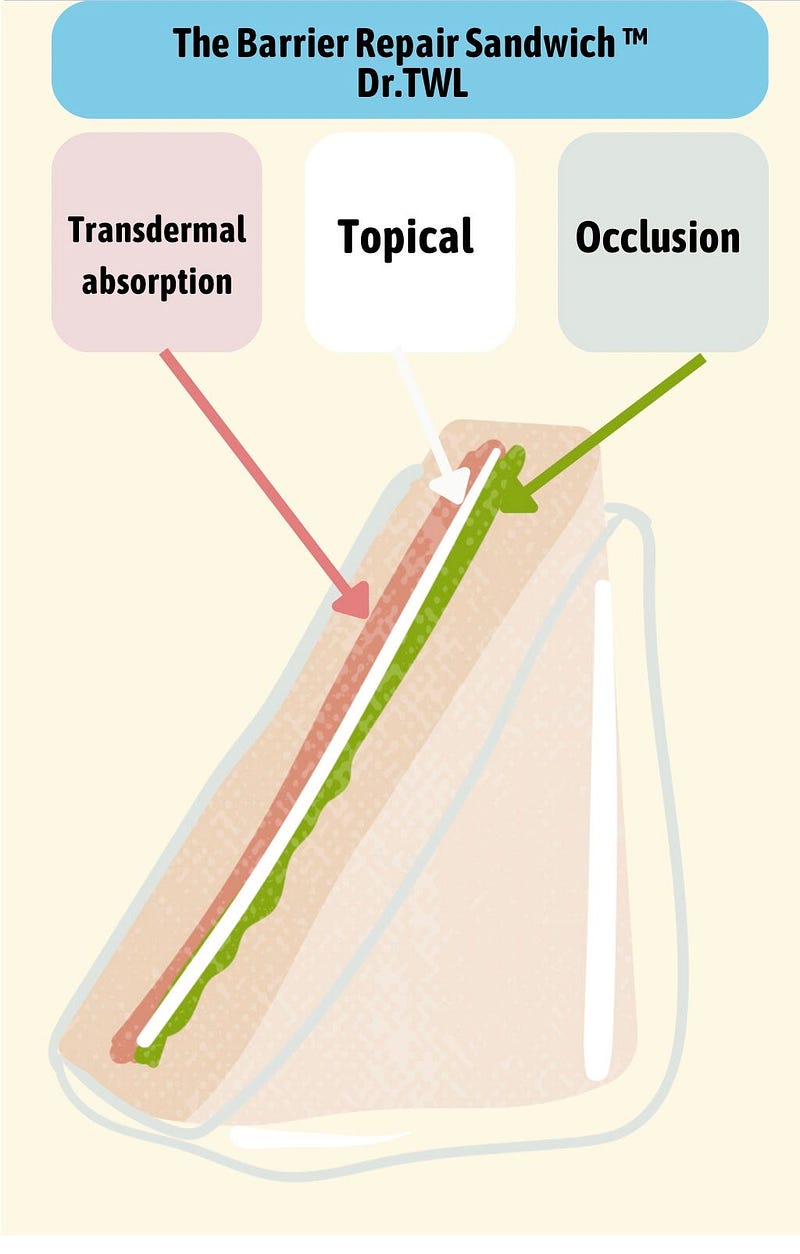
Layer (1) Occlusion: Think of how to prevent moisture from escaping
Layer (2) Filling! At the centre, the filling is your choice of topical
Layer (3) Skin barrier: How permeable it is
Skin flooding primarily targets layers (1) and (2), but there’s another aspect to be considered — how well skin can absorb what is applied. I.e. vacuum microdermabrasion, chemical exfoliation, massage are some techniques that increase uptake. The entire model showcases the concept of the skin micro-environment. The point being, that a healthy skin ecosystem can be created with the use of cosmeceutical skincare.
Minimalists, Here are 3 Steps to Skin Flood Like a Dermatologist
If you are into skin minimalism, you may find the layering routine quite excessive. The science behind that though, is that the concentration of actives matter. So one simply cannot obtain the same results by using a 10-in-1 product. The key though is by addressing the factors in the sandwich model described above:
1. Choice of skincare products to enhance occlusive, humectant and barrier repair effects
This means choosing ingredients in your moisturiser that are based on ceramides, hyaluronic acid, polyglutamic acid and traditional moisturisers like glycerin.
2. The technique of application matters
If you are just using 1 product, use a copious amount (palm-sized for your face, over night as a sleeping mask hack). Apply on damp skin, this increases dermal absorption. Wet a soft microfibre towel and leave it on your skin. Or use a mask material like polysaccharide which creates a mini-reservoir for skin. These methods increase permeability of the epidermis, allowing skincare to absorb readily.
3. Technology hacks
Once a week, use a pore vacuum with your facial mist/essence (AHA, BHA-free). Spritz it on and use the pressure from your vacuum to enhance absorption of skincare. In clinics, we use a professional hydrodermabrasion machine which infuses antioxidants with vacuum exfoliation simultaneously.
Why Skin Flooding is the Tik Tok trend that’s here to stay
The fact is, dermatologic therapeutics are rooted in the use of topicals. The skin is unique in that it allows absorption of actives via the epidermis — especially important for drug delivery. The basis of skin fasting is not scientific i.e. no studies have been performed and any discussion of that is based on the fact that synthetic cosmeceuticals can cause skin irritation. This is especially so for western pharmacology based products in the 2010s which favored retinols and acids.
With repeated use over a period of time, even those not overtly allergic tended to become sensitised. There were no accurate predictors as well, in my clinical experience. I myself successfully tolerated high doses of topical retinoids for over a decade, before I developed a sensitivity that manifested a bad bout of retinoid dermatitis (trust me, dermatologists know how to skin cycle, even back in 2016). The reason? These actives can cause damage to the skin barrier — that is what dermatologists term irritant contact dermatitis. Which by the way is not dissimilar to a chemical burn.
In 2023, the skin flooding concept inspired by K-beauty regimens instead rightly points us towards restoring the healthy skin microenvironment. It excludes the use of skincare actives that have the potential to cause skin irritation, namely retinoids and hydroquinone which are used in traditional dermatology practice.
Overexposure to multiple skincare actives can lead to sensitisation, which possibly leads to a complex skin condition known as cosmetic intolerance syndrome. Reducing product use can help eliminate triggers, usually in the case of western-formulated skincare regimens which contain retinols and acids. For this reason some may propose skin fasting. Except that this isn’t a problem with K-beauty regimens which focus more on synergistic botanicals.
That’s also about all the benefits I can think of when it comes to skin fasting — primarily because it goes against the grain of dermatologic therapeutics which focuses on application of topicals. So not applying anything at all, or thinking of ways to reduce your skincare regime; well to me is quite counterintuitive. I’d choose skin flooding over skin fasting anytime.
Dr. Teo Wan Lin is a board certified dermatologist with published original research on sensitive skin, acne and the skin microbiome in top journals such as the Journal of the American Academy of Dermatology and the International Journal of Dermatology. She is known for her holistic approach to dermatology, integrating functional skincare, with a focus on repairing the skin barrier, building skin resilience from the inside-out with plant-based actives from Asian ethnobotany. Dr. Teo can be found on Instagram and Tik Tok @drteowanlin.
Consider becoming a Medium member if you appreciate reading stories like this and want to support Medium writers. The membership costs $5 per month and gives you unlimited access to Medium content.


