
How to Save an Extra $4,187 in the Next 6 Months
Here are 12 ways to earn more and spend less.

When money is tight, we have to re-examine our lifestyle choices. Whether you’ve been laid off or financially impacted in another way by the pandemic, saving money is an even bigger priority than usual.
The “savings” formula is quite simple.
Income - expenses = net income (i.e. savings)
That means there are two ways to save more money:
- Earn more
- Spend less
If you commit free time to money-making activities and cut back on extraneous lifestyle expenses, you could significantly enhance your savings over the next six months.
How much?
Potentially up to $4,187 if you follow most of the below recommendations.
5 ways to earn more money
Let’s start with a few straightforward and accessible ways to earn more money.
Assuming you have a full-time job already, your free time is pretty limited. Time is finite. There are only so many hours in a day. Once you subtract working, eating, and sleeping. You’re not left with time for much else.
But, for the sake of finding time to earn more money, let’s assume you can commit 12 hours per month (i.e. three hours per week) to a side hustle. That should give us a pretty conservative estimate.
Sell old stuff
It’s easy to forget how much stuff we have. We accumulate and outgrow things over time.
I’ll give you a personal example.
I have three freaking slow cookers. Two were gifts. I love making crockpot meals, but I’ve made two simultaneous slow cooker dishes once. There’s no reason for me to have two slow cookers — let alone three.
Which makes them excellent candidates for selling.
But that’s just one example. Think about your closet. If you had to put a number on it, what percentage of your closet do you actually wear?
Sifting through your stuff could make you a sizable chunk of change. One woman made $2,800 in four months selling old stuff.
Online marketplaces (eBay, Craigslist, Facebook Marketplace, etc.) simplify this process.
I can attest to the ease of selling on Facebook marketplace. Fair warning though: 90% of the inquiries you receive — the “Is this still available?” messages — will go nowhere.
Try implementing a blend of scarcity and social proof persuasion tactics. If several people have reached out about a particular item, let these people know that other potential buyers are ahead of them.
Say something to the effect of, “Five people have messaged me about this, so I’ll let you know.” I sent this type of message to several prospective buyers.
They were the ones who ultimately bought my stuff.
Transcribe
It might not sound like the most thrilling job, but transcription can be a viable side gig. For instance, Rev.com is an established transcription services company that offers freelance opportunities to qualifying applicants. You decide when to work and how many assignments to take on.
And the rates aren’t bad.
Rev pays transcriptionists between $0.30 and $1.10 for every minute of audio/video. So, if you transcribe an hour-long video at $0.50 per minute, you’ll earn $30.
Rev also pays captioners between $0.54 and $1.10 for every minute of captioning. Captioning requires a little more creativity — like accurately depicting sounds.
If you transcribe three hours every week and earn $0.50 per minute, you’re looking at $360 per month. Over a six-month period, you could rack up $2,160.
Write
You don’t need to be a professional journalist or author to make money writing. You only need one of four things:
- Applicable knowledge about a subject
- Interesting stories or life lessons
- A unique perspective
- The ability to research
If the thought of writing tickles your fancy, Medium’s partner program is a free and easy outlet for beginners. You don’t have to worry about pitching or managing clients.
That said, there’s a tradeoff. Earning money isn’t guaranteed.
If you want to take writing a step further, you can subscribe to newsletters (like Write Jobs) or peruse job boards (like Freelance Writing). They’ll help you discover paid opportunities.
Walk dogs
Walking: a great way to get outside and exercise.
Walking man’s best friend: a great way to get outside, exercise, spend quality time with a dog, and earn money.
Dog walking rates vary. Your location is the biggest factor. Densely populated cities will have a much higher demand for this service compared to rural areas.
But, per Angie’s List, you could reasonably charge $20 to $30 for every 30-minute walk. If the owner has more than one dog, you can add an extra $5 to $10 to that rate.
Finding your own canine clientele can pay better. But, if you want a curated marketplace, you can also leverage sites like Wag to find local dog walking opportunities. According to Wag’s CEO, a dog walker makes about $17.50 per walk on average.
Review books
Did you know you can get paid to read? It’s not the most lucrative of these side gigs, but it’s a solid option if you’re an avid reader. Online Book Club pays people to read and review books.
Your first review is a trial run of sorts. Beyond receiving the book for free, you’re not paid for your first submission. After that, Online Book Club pays between $5 and $60 per review.
And you’re not required to love the book — they want honest reviews.
They also offer daily money prizes to randomly chosen members. So, if you like reading and need a few extra bucks, consider signing up to review books.
And they said you couldn’t mix business and pleasure…
7 ways to spend less money
If you don’t have the time or ability to earn more money, you can focus on spending less. It’s much easier to control your lifestyle expenses compared to your income.
Like we said. there are only 24 hours in a day — you can’t create more time to earn more money. But your personal expenses are another story. You have direct control over what you spend. For the most part, you choose where you live, what services you receive, and what products you buy.
Before you read this section, I need you to keep something in mind: cutting expenses doesn’t have to be permanent. Your lifestyle doesn’t need to change forever.
When we think about cutting expenses, we unconsciously assume everything is permanent.
This leads us to resist change. Don’t stress about permanence when you’re reviewing your lifestyle.
With that principle in mind, we’re ready to save money.
Next to each of the below expense categories, I’ve added either the price of certain services or the average amount of money the typical American spends on a particular category. Average prices are according to the Bureau of Labor Statistics’ (BLS) consumer expenditures survey.
Note that the survey aggregates expenses based on consumer units (i.e. households). I’ve converted the average household’s expenses into individual expenses by dividing by the average number of people in a consumer unit (2.5).
Double side note: it’s much easier to control your expenses if you know how much you’re spending. That’s where a budget comes into play. I used my budget to cut my monthly expenses by 32%.
TV (up to $115 per month)
Over the last few years, the number of TV service providers has grown. Even big tech companies like Hulu and YouTube created their own pay-TV offerings.
If you still have cable or satellite TV, you can save anywhere from $30 to $115 per month, depending on your provider. While 39.3 million Americans elected to “cut the cord” last year, there are still plenty of people that pay for such services.
If you can’t imagine living without TV (even temporarily), consider switching to a streaming platform like Netflix or Hulu. At $12–13 per month, they’re a fraction of the cost.
Beware of difficult customer service reps when you call to cancel your service. They’ll try every trick in the book to get you to stay — including offering lower prices or temporary promotions.
Clothing ($62 per month)
According to the BLS, the typical American spends about $62 per month on apparel and related services (tailors, dry cleaning, etc.).
I’m sure we can all agree — that number is subjective. Some people spend way more of their disposable income on clothing than others. That said, if you want to increase your savings during the recession, clothing fits under “wants” versus “needs” most of the time.
If clothes shopping is a financial drain, identify the channels you take to buy clothes. That usually means online shopping websites or marketplaces and brick-and-mortar stores. For instance, Amazon makes online shopping fast, accessible, and painless…which can come back to bite you if you find yourself aimlessly browsing the app.
You can use website blockers to prevent yourself from making unnecessary online purchases.
Dining Out ($58 per month)
Making your own food is a time commitment. No one’s saying it’s not. But it can also be much cheaper (and healthier) than dining out.
Based on the BLS survey, the average person spends $115 per month on food outside of the home. It’s unreasonable to expect anyone to prepare and cook every single meal. So, our $58 per month reduction assumes the average person cuts the “dining out” category of their budget in half.
And ordering delivery is the same thing as “dining out,” by the way.
The pandemic and ensuing social restrictions made ordering delivery an easy alternative. DoorDash and Uber Eats experienced spikes in food delivery.
Sure, it’s convenient — but it’s also pricy.
For example, DoorDash’s delivery fee ranges from $5 to $8 per order. That’s almost like getting one meal for the price of two, depending on the restaurant.
Streaming ($40 per month)
The average American has three streaming subscriptions. If you have monthly subscriptions to HBO ($14.99), Hulu ($11.99), and Netflix ($12.99), you’re spending $40 per month on video streaming. That might be lower than most cable services, but it still adds up.
Each of these platforms offers a wealth of content — more than you could ever possibly watch. If you want to cut costs without totally depriving yourself of movies and shows, consider dropping down to one.
Groceries ($25 per month)
Buying ingredients and cooking your own meals can save you a lot of money. But that doesn’t mean splurge in the grocery store.
In other words, when you’re grocery shopping for the week, don’t roll out of the meat section with five prime ribeyes.
First, I’m not a doctor, but that has to be terrible for your heart.
Second, you’re missing the point if you’re going to spend even more at the store.
According to the BLS, the average person spends a little under $150 per month on groceries. But it might make more sense to consider grocery shopping from a household perspective since people/families often share supplies. The average household spends $372 on groceries every month.
Since we’re operating under the assumption that you won’t rely on dining out as much, we don’t want to aggressively cut grocery expenses. Instead, it seems reasonable to aim for a $25 reduction on monthly groceries.
Aim for products that are on sale — especially higher price items like meat. Check out your local store’s website or app — they’ll likely have discounts or promotions.
Car Insurance ($19 per month)
“15 minutes can save you 15% or more on car insurance.”
You know the slogan. Geico engraved it into our brains.
The average monthly car insurance payment is $129. Well, if we assume the average person can save 15% on their car insurance just by switching, that could equate to $19 of savings per month.
Car insurance prices are very dependent on your location and driving history, but you’d be surprised how much you can save.
I was floored when I realized how much I was overpaying.
For a year or so, my insurance payments were an unnecessary drain. But I had no idea how much I could be saving. I spent $255 per month for Traveler’s car insurance.
In retrospect, it’s a ludicrous amount. But I didn’t know any better. I switched to State Farm a few years ago and saved $165 per month.
Alcohol ($19 per month)
I might lose some readers here, but I’m just pointing out facts. Based on the BLS survey, the typical person spends $19 per month on alcohol. That’s about a case of beer or a few cheap bottles of wine.
It might sound like a crazy idea during this unusual time, but abstaining from drinking can have health benefits too.
The big picture overview
Through a close-up lens, it’s hard to see the long-term benefits of cutting expenses. So, let’s take a step back.
What do these cost-cutting initiatives and income boosters look like when combined?
Let’s assume you add transcribing as a side hustle (earning $0.50 per minute) and work 12 hours each month. Let’s also assume you cut each of the above expenses.
If you commit to the cause for the next six months, you could save an extra $4,187 — or more depending on your current habits.
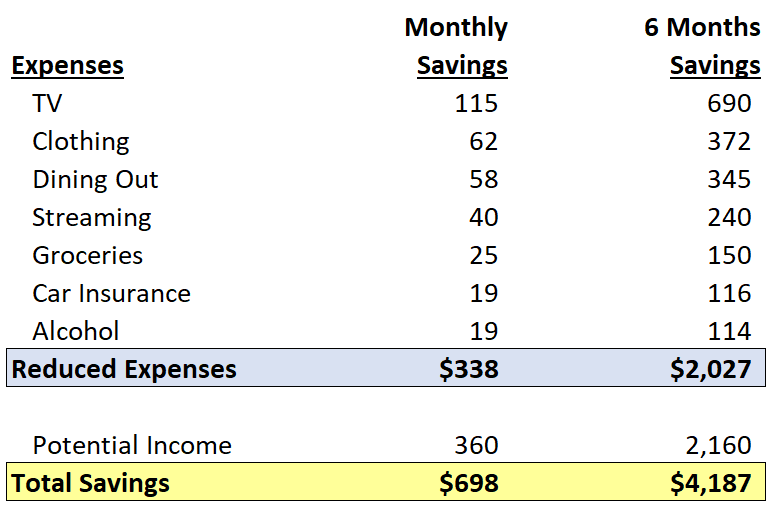
It goes without saying that everyone’s financial situation is different. Some people have less room to improve their savings than others. For instance, people who don’t have cable or streaming services can’t cut back on these activities any further — because they already don’t spend money on them.
At the end of the day, no one’s budget is perfect. Don’t beat yourself up if you don’t wind up saving $4,000+ over the next six months.
Any amount of savings is better than no savings at all.
Do you want to learn more about personal finance? But without the complicated jargon and dry explanations? Sign up here for Bits — our personal finance newsletter.