
How to Run a Little More Like Eliud Kipchoge and Become a Better Runner
A slow start may just be the key to a great finish.
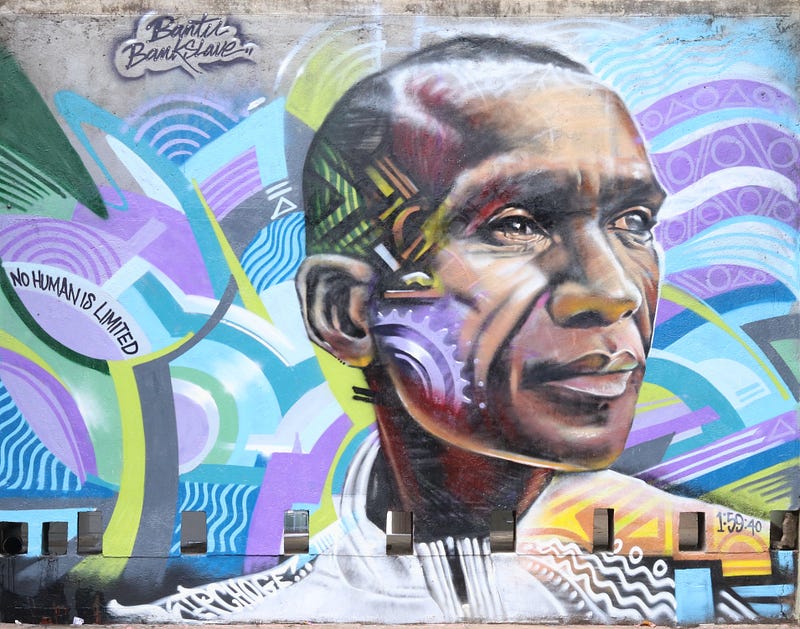
Eliud Kipchoge runs a marathon at a faster pace than most people can run a mile. He ran his world record of 2:01:39 at the Berlin Marathon, which is 4:38 per mile (2:54 per kilometer).
I’m not as fast as Eliud Kipchoge, but I’m a somewhat serious runner myself. I run marathons, and in the past year and a half, I have run a half marathon at 5:39 mile pace (74:37) and a marathon at 6:05 mile pace (2:39:55).
I am trying to get a lot better. I’m all for different things and different training methods working for different people. We are all very individualized people and individualized athletes, whether you’re trying to go from couch to 5k or trying to qualify for the Boston Marathon.
But I wish I took a page out of Eliud Kipchoge’s playbook sooner.
Eliud Kipchoge (and many of his Kenyan training partners) does one thing that might surprise you on his runs, that has really helped me and may really help you:
Start out really easy and slow.
I think there are a lot of misconceptions about how elite Kenyan marathoners train. People try to look to running tips from one of the best running countries in the nation to get better themselves.
One myth is that elite Kenyan runners do their easy runs very, very slow and very easy.
And there’s some truth to that — Kipchoge and his teammates start out a lot of their runs at 8–9 minute per mile pace, or 5–6 minutes per kilometer. This is almost twice as slow as his marathon pace, and for the likes of the fastest marathon runner in history, that’s almost a walk.
The misconception is that Kipchoge and many elite runners run 8 minute to 9 minute miles for the entire run. But for someone who runs 200 to 220 kilometers per week (124–136 miles), 80% of which is at an easy pace, this would mean he spends an absurd amount of time running.
Kipchoge does do 80% of his runs at a pace that’s very easy for him.
The fact is he and his group (the NN Running Team) might start their runs incredibly slow and at a near walking pace. But by the end of an easy run, Brittany Hambleton at Running Magazine notes the team is running under 6-minute mile pace, which for most of us, is very fast, but for Kipchoge and his team is jogging.
Kipchoge starts his run with a slow start, and sometimes a very slow start. But that slow start allows him to warm up into his actual easy pace or an even faster pace.
And we can all take a page out of Kipchoge’s running.
For me, I learned this lesson not by trying to run like Kipchoge, but almost by accident. The more I’m running and the more mileage I’ve racked up in my training cycle, I just feel really bad to start my runs.
Sometimes, I honestly feel like shit the first mile, two, or three. I feel like I don’t even want to run on a given day, and sometimes I feel so bad that I just go home and don’t run that day entirely.
I had a workout where a did 25 quarter miles (400 meters) around the track with 30 seconds rest the other day. I warmed up a mile, and after the first 400, I looked at my watch. I was running absurdly slow for my goal pace, and it felt incredibly hard.
I was sore, breathing hard, and still trying to do everything I could to keep it relaxed. I was dismayed that I was feeling so bad just to run slow. But I stayed with it, and after three or four reps where I similarly ran slow and felt bad, I started feeling better. I started feeling normal. By the last five reps, I was feeling like a rockstar and gliding to hit my goal splits while barely trying.
I felt significantly better and smoother by the end, running a lot faster, than I did at the beginning and running slow.
I’ve learned that for the vast majority of us, at the beginning of runs, we just feel awful because we’re not warmed up and our body really isn’t in exercise mode. It takes some time to warm up, and it’s different for every person. Sometimes, we’ll warm up during a race.
During the marathon, you rarely see people (except elites) doing a two to three-mile warm-up prior to a 26.2-mile race. To run my best marathon, I intentionally try to go a slower pace for the first half marathon than my overall goal pace so my body can be warmed up for the second half (where, for me, the race really starts).
But the worst thing you can do is force a fast pace when you’re not feeling good, especially at the beginning of the run.
Here are two runs where I started out much slower than I finished. The first is a more moderate-paced run, whereas the second is an easy run:
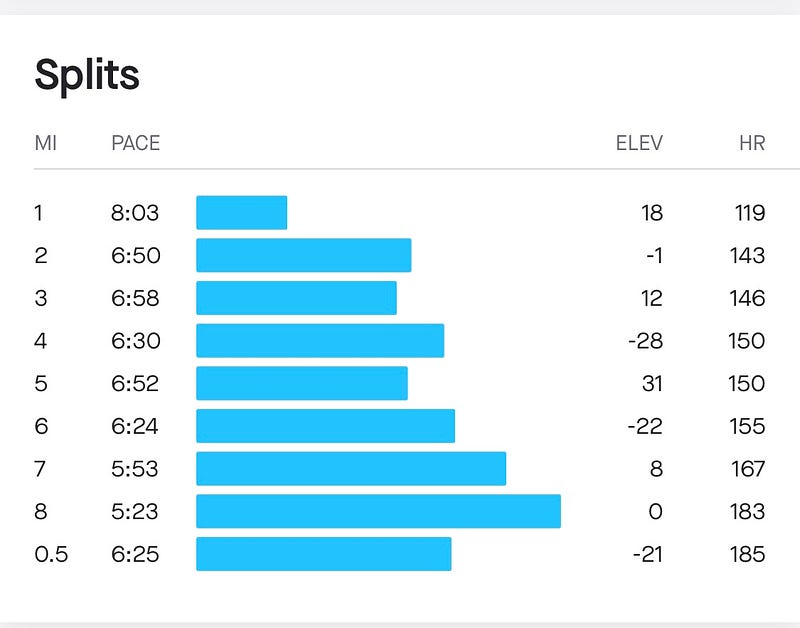
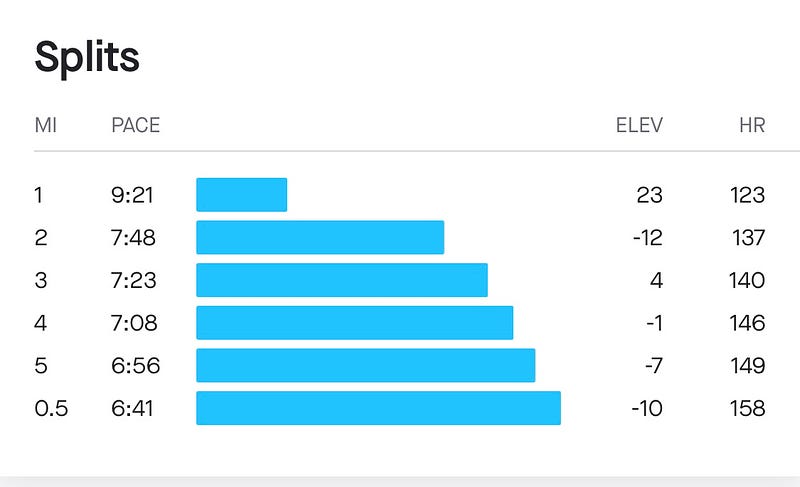
On both runs, the first and second miles felt by far the worst of any part of the run, and that’s because feeling really crappy at the beginning of the run is very common.
Taking it easy, not pushing it, and allowing yourself to run as slow as you need to the first one or two miles (or even more) is key.
There are days where you feel like crap to start and you feel only marginally better or not better at all later — it’s good to start out easy and slow so you respond to your body. Likewise, there are days when you feel like crap to start and then you feel on top of the world later, like the run where I ran my eighth mile in 5:23.
The key, at the end of the day, is to listen and respond to how you feel. And there are days when you might feel incredible to start the run, but it’s still wise to start out slower than you intend on finishing or slower than you intend on going in the middle of the run. I’ve had so many runs in the past where I started out too fast and felt crappy the rest of the run, or felt like I gave way too much effort for an easy run.
A slow start may just be the key to a great finish.