
How To Reverse Your Age With Your Mind
You can’t stop growing older but you can stop growing old
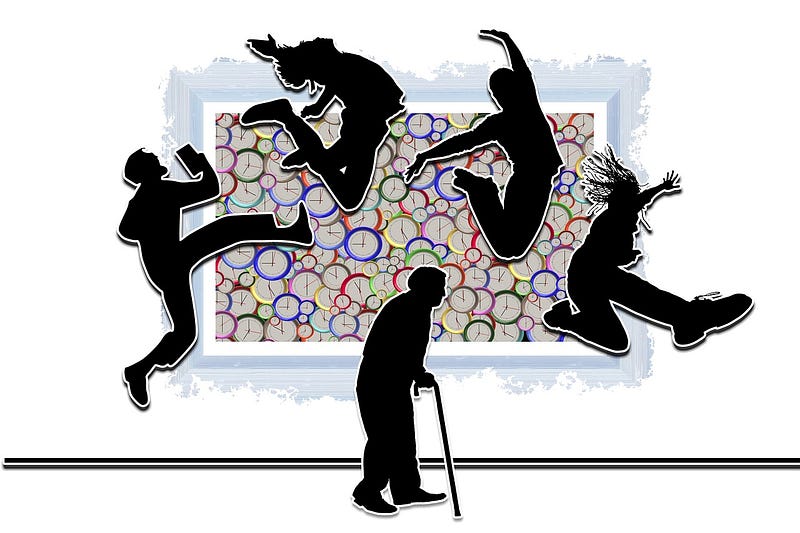
We have three ages — Chronology, Biology and Psychology.
We have no control over our Chronological age, so best to ignore it — except on birthdays.
The word “old” enters early into our vocabulary — How Old Are You? This follows us through the years.
A faithful dog which many of us feed with bowls of “I’m getting old. I’m so forgetful. I’m too old to change my ways.”
But Biology and Psychology are exciting timeless toys.
Here’s where the fun begins!
I’ve played games with them, more with Psychology, for over 20 years. To stay young at heart, I need to act and be young. And I know the importance of keeping my brain fit and active. Believe me, it works.
But I discovered more!
What Happened Last Summer?
Before we had a TV, we used to listen to Jukebox, a music program, on Radio 702 on Saturday nights. There’s not much else happening on a Saturday night in the semi-rural bush veld where we live. Golden Oldies from my generation — Pink Floyd, Procol Harum, Santana, The Beatles, Bob Dylan, Eric Clapton, Cream, Janis Joplin, sweet Soul sprinkled here and there — music from the 60's, 70's and early 80's.
And there I was, dancing barefoot in the lounge, oblivious to the groans from my back and hips.
I was lighter, ignited — I thought I was younger.
I fell asleep that night content and woke on Sunday morning refreshed and vibrant.
Two months later a question tapped me on the shoulder.
“Why is this happening?”
Ever curious, indomitable Detective de Braganza knew she had to search for answers. After all, she had clues to guide her. There had to be a connection between the music, my age when I first heard it and what memories it evoked.
How did these three ingredients combine to alter my physical and mental state? Where did this elixir of youth originate?
From my days of recovering from depression, and the book I’m writing, I knew the role the hippocampus plays in memory and the emotions attached to a specific event.
I knew you can rewire your brain to attach new memories to old events — I’d done that to my brain.
(I still keep a pair of trusty wire cutters handy. You never know when your neural network might go rogue.)
Armed with clues, the intrepid detective discovered mind-blowing facts that confirmed her suspicions.
“I grow younger on Saturday nights. Age is a state of mind!”
“Prove it,” a reader’s voice whispers in my ear.
I shall.
Let’s play a little game first.
Close your eyes. Now imagine sucking on a fresh slice of lemon.
What’s happening? Is your mouth puckering at the sour taste? Are you salivating?
Why? There IS no lemon!
But Brain remembers. Happy Hippocampus!
Exhibit 1 — The Counter-Clockwise Study
Ellen Langer, a Harvard Professor of Psychology, together with her students, conducted an experiment in 1979 to test the impact of our state of mind on aging.
She took a group of men aged 75 to a closed retreat which had been converted into the year 1959, taking them back 20 years. The décor, furniture, music, magazines, newsreels, clothing, conversations — an authentic time capsule where they spent a week.
Tests for biological age included hearing, vision, grip, finger length, muscle mass, bone density, physical strength, blood, hormones, flexibility, and balance were conducted beforehand and at the end of the experiment.
The results were astonishing — the whole group had reduced their biological age by at least 7 years.
(A control group at the same location were older after a week, despite being in a relaxed environment.)
Although this was not a pure scientific study, it edged me closer to an answer. They were younger in their minds and their bodies responded and became younger.
Exhibit 2 — Time Travel
Michael Mosley and the BBC posed the following questions in 2010, building on Ellen’s experiment of 21 years earlier.
If elderly people dress, live and talk as they did in their heyday, does this help them feel younger and fitter? Is slowing down with age all in the mind?
Michael tested his theory using 6 celebrities (trust the BBC) aged between 76 and 88. This time he was going back 35 years to 1975. The venue was the science lab at his country house.
Michael explains:
“They agreed to live in our time capsule house for a week, during which they dressed in 1970s clothes, slept in replicas of their very own 70s bedrooms, watched television from that era, and discussed 1975 in the present tense.”
The volunteers were expected to look after themselves. Research in nursing homes shows that giving residents control over their own lives and their own choices has a massive beneficial impact on health and happiness.
They had to carry their own bags up the stairs to their bedrooms.
“It was the first time they’d been forced into such physical activity in many years, and they were not happy.”
Step by step, day by day, they regained a level of vitality they had not experienced in years.
Physical and psychological tests were conducted before and after. Most showed improvement in memory, mood, flexibility and stamina. Their biological clock had reversed between 12 and 20 years.
Sylvia Sims, 88, one of the guinea pigs, had this to say,
“I forgot to be old. I slipped back to the world of 35 years ago and forgot my age.”
She had used two sticks to walk since her stroke and often relied on a wheelchair. On the fourth day she had taken 148 steps with the aid of only one stick. (She had imposed her own physical constraints.)
She now visits old people’s homes and teaches.
You can get older, you do not have to get old.
Exhibit 3 — May I have this dance?
Neuroscientists have revealed that dancing is the number one exercise to slow aging.
“A new study, published in the open-access journal Frontiers in Human Neuroscience, shows that older people who do regular physical exercise can reverse the signs of aging in the brain, and dancing is the most effective form of exercise.”
Closing Argument
(Drum roll)
Not only was I spending time on Saturday nights thinking I was 50 years younger but that belief gave me the energy to dance, revving up my brain with memories and neurons which made me shed half a century — a revolving expanding universe in my head.
Given the evidence submitted, I have proved beyond a reasonable doubt that our chronological age is irrelevant. We can reverse our biological age, not only with diet and physical exercise, but by keeping our brains fit. Fill them to the brim with beliefs, thoughts and language that keeps us young — our psychological age.
You are as young as you are — you are as old as you choose. (Memory loss has nothing to do with age — kids and teens are just as forgetful as anyone of any age.)
Our mind can play tricks on us. It’s time to return the favor and trick it back!
Use your Brain muscle every day by doing or learning something new so your neural network sparkles and thrives and adapts.
Our brain cells reproduce until the day we die, so let’s nurture them.
You don’t grow older until you stop growing — then you become old.
I rest my case.


