
How to resolve conflicts mentally.
5 ways to De-wrinkle any relationship
“An eye for an eye will only make the whole world blind.” ― Mahatma Gandhi
We have been truly believing in giving tit for tat to shut down the opponent forever. If someone shouts at us, we shout even harder. It is like adding more fire to extinguish the fire.
As a result, the situation goes from bad to worse and from worse to worst most of the time. If we are not able to retaliate in actions, we do it internally which is even more detrimental for our mental health.
But even after doing so, do we really attain contentment?
I am sure the answer is a straight forward NO.
Then why have we not found other ways to resolve conflicts?
So, first, let us understand the meaning of a conflict in order to pluck its stem out of our mind after any fallouts.
“A disagreement of thoughts, needs, values, or perceptions leading to a chaotic mind, and sometimes actions are called conflicts.”
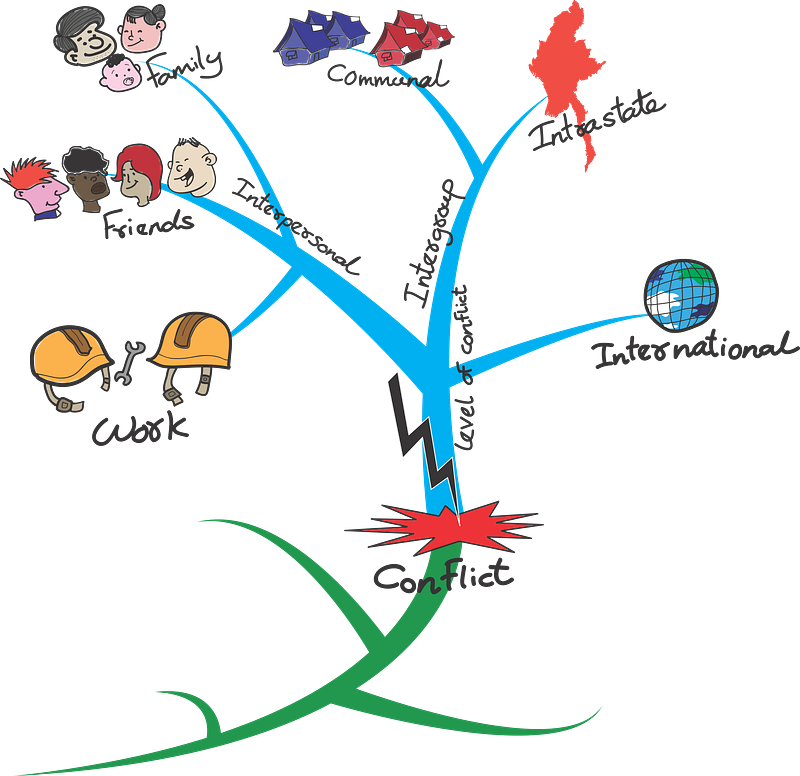
Having said that, there can be conflicts at work, public place, or at home. And the major reason for a relationship to fail is also a conflict.
For example, a boss fires an employee due to a conflict of opinions whereas the married couples get divorced due to a conflict of ideas and way of living. Many people succumb to depression and anxiety owing to unresolved conflicts. Hence conflicts prevent us from growing mentally and loving one another. Hence, we must learn this technique of “conflict resolution”.
Avoiding conflict is a temporary solution but resolving it mentally is a long-lasting remedy.
Moreover, we need to resolve a conflict, for the sake of our peace of mind and not to straighten things sometimes, perhaps. But, we fail very often in doing so and the rate of unrest and chaos in the world is the testament of that. In addition, we don’t live with people all the time but we do with oneself 24/7, round the clock. Hence the need of the hour is to learn to live a conflict-free life.
1. Do some Mental Exercises
The mental exercise of conflict resolution is to detect and classify the ways in which we approach conflict. The more we can understand ourselves, the more we will be able to understand others and resolve a dispute.
Our attitudes, feelings, and emotions trigger our actions; hence it is important to understand this intricate connection.
Firstly, our inner work is about being always ready, keen, and open to learning new behaviors and new tactics. It’s about inculcating new approaches towards situations or people, creating new perspectives, and a new vision for healthy sustainability.
In any conflict situation, it’s very easy to blame others and not take up our own end of the responsibility.
Secondarily, inner work is about taking that personal responsibility and taking charge of our life. Once we do this, we empower ourselves and become masters of the situation. We are no longer waiting for the opponent to change, or for them to fix the situation so that we can be cheerful.
Tertiary, doing inner work is about accepting the differences. Each person is unique, bringing something new to the table according to their own set of ideas, attitudes, beliefs, values, perceptions, feelings, experiences, memories, judgments, etc.
Differences are likely to occur, and we must accept them as a part of our everyday life.If we reject differences, we reject our life.
In addition, whenever a dispute arises, everyone tries to look from their own perspective and understanding. This does not mean that one person’s view is correct and the other is not: it simply means that there two different vantage points.
The knowledge of our deep-rooted sanskaras (personality traits) and understanding the different ways is also one of the fundamental steps in dealing with and resolving conflict.
Hence, the inner work is about having deep, concentrated meditation, the sort that burns our layers of perceptions, opening the tunnels to newer paths. When we return to a purer state of being, we will have fewer differences and fewer conflicts.
2. Going the Spiritual Way
With the changing and challenging times, we need to find new understandings and new approaches to managing our lives. We need to bolster our lives very firmly to survive. As a result, we must cultivate a different type of power — spiritual power.
But the question arises that what is spiritual power?
How do we cultivate our spiritual powers?
The answer is very simple than it seems.
Spirituality is an inner peace where nothing is chaotic, and no one can shake that dignity. It is a strong determination where one is stable and glued to one’s virtues. Spiritual powers strengthen the mental ability of a person which can never be broken, no matter what.
Moreover, when treating a dispute or a conflict, the power of modesty allows us to let go of negative emotions and move on, and the power of detachment allows us to stay unemotional and attentive.
Cultivating spiritual power in oneself is a very easy affair. We only need to create pure, peaceful, positive, and relevant thoughts irrespective of the circumstance. To achieve this feat, we must constantly keep on practicing. One minute devoted every hour in practicing these types of thoughts can do wonders for our mind.
Don’t we all love peace, happiness, purity, bliss, and truth? Have you not wondered why?
Well, the answer is simple!
The innate qualities of the soul are peace, power, knowledge, bliss, purity, love, and happiness. Consequently, we would be enriched with that feeling of completeness when we cultivate and use spiritual powers.
3. Increase your Self-Esteem by Valuing Yourself
Self-esteem is a strong belief in one’s worthiness and faith in one’s principles. In a way, it is a conversation with oneself. Raising self-esteem is not something to be achieved but it is the way of life. Because the day we stop talking to ourselves, we start degrading.
Having said that, the quality of the conversation matters the most. Understanding one’s worth and ability to cope up with situations help us in constructing ourselves externally. If we treat ourselves with respect, then the people around us do the same thing. That is the law of attraction.
“We only attract in our life what we feel we deserve hence self-worth gains momentum.”
If we do not value our resources like time and life, people also perceive the same. As a result, they start taking us for granted. Then, we tend to blame the people but it is we who must be blamed. If we take a stand for our values, our time, our lives then we demonstrate self-confidence.
Because of this portrayal, we create our image of being strong and resilient. If we fail to do so, we are creating a wrong image unknowingly. The more we become weak the more we start depending on others for their approval. As a result, we automatically lower our self-esteem.
Never ever mistake your self-esteem as EGO.
But, there is a fine line between self-esteem and ego. Self-esteem is the knowledge and awareness of our own intrinsic uniqueness and self-worth. Whereas ego is considering oneself to be superior to others. Self-esteem is not boasting or bragging; instead, it is an honest assessment of our successes and the internal strengths that bring us victory.
When we elevate ourselves internally by increasing our self-worth, we rise above all the conflicts and disputes.
4. Learn to calm down your Anger
When we are at the peak of our anger, we are at the trough of our ability to distinguish and to discriminate. In simple words, it makes us look stupid! This explains why much of the crime in our society is done in the heat of the moment.
There is a lot of information out there about anger management, but a more relevant question may be, how do we transform our anger?
We often tend to justify our anger by calling it instinct or flight response. But, none of them is true. Anger is a sign of weakness. Whenever we are not able to accept anything, we get angry.
The weakness of rejecting a change creates anger.
Anger is simply a habit that we have created over time where we repeat the same reaction to a certain situation. Habits are something that we do unconsciously. For example, in the morning, we brush, bath, and clean ourselves without thinking about it because it is a habit in the unconscious mind. In the same way, anger has rooted in the unconscious mind as a reaction to a particular type of behavior.
In order to become conscious and aware of our reactions, we must step in and use the power of choice.
Through responding rather than reacting we can begin to change our destructive thought patterns of anger.
Being assertive, not aggressive, is a much better strategy for success. But to be assertive, it takes self-respect, and the angry person is usually angry for the very reason that they have low self-esteem.
Moreover, practicing meditation helps the mind stay cool and focus clearly. In mediation, we deeply realize that peace is our personal property, which no one can steal.
5. Give up the Judgemental Attitude
If we approach any conflict with an attitude of judgment about others or ourselves, we will find it difficult to be collaborative.
Judgmental thinking implies that one person is right and the other is wrong and creates a concept of ‘you versus me’.
Whenever we become judgemental, we get blindsided by the other person’s perspective and declare a one-way partial decision. But decisions can’t and should not be made without acquiring full knowledge. As it is said, a half-truth is even more dangerous than a full lie.
Hence, with a judgemental attitude, we can never resolve conflict. To get a clear picture of the situation, we must distant from our point of view to understand others. And that is called the attitude of discovery.
An attitude of discovery allows us to listen to another’s point of view with openness and respect for differences. Neither of us is the problem; the dispute or unresolved issues become the problem. As a result, we become united in tackling the common enemy of misunderstandings.
Hence, I believe that once we resolve conflicts mentally, the external conflicts does no harm to us.
These are my ways of solving disputes and remain peaceful. What do you do to resolving any possible conflicts in relationships? Please, share it with me in the responses below.
Thanks for reading!